
Reviewed · ANGKOR WAT TEMPLE TOURS
4 Days | Angkor Wat & Preah Vihear Tours
Four days can vanish fast at Angkor. This is a temple-focused run that stacks Angkor Wat, Angkor Thom, and the calmer jungle ruins on one side, then swings over to the big-ticket remote feeling of Preah Vihear.
What I love most is the timing. You’ll start early (8:00am on Day 1, 4:30am for sunrise on Day 2, and 5:30am on Day 4), so the temples don’t just blur by under the midday crush. Hok, the English-speaking guide behind this service, also brings a flexible, human touch—he’s known for adjusting plans to match what you want and for pointing out solid photo spots.
One thing to think through: most temple admissions are not included (Angkor tickets, Preah Vihear ticket, Koh Ker ticket), so your real spend isn’t only the $444 price. Also, this schedule is dense, so you’ll want to be okay with long days and early wake-ups.
In This Review
- Key things to know before you go
- Entering the Angkor-to-Preah Vihear rhythm
- Day 1: Angkor Wat, Angkor Thom South Gate, Bayon, Ta Nei, Ta Prohm
- Day 2: 4:30am Angkor Wat sunrise, then Banteay Srei and the quieter circuits
- Day 3: Phnom Kulen’s sacred mountain and the “untouched” feeling of Beng Mealea
- Day 4: 5:30am for Preah Vihear and Koh Ker’s ancient capital setting
- Is $444 good value after tickets and meals?
- Who should book this 4-day Angkor Wat and Preah Vihear tour?
- FAQ
- Does the tour include hotel pickup?
- What time does the sunrise at Angkor Wat start?
- Are Angkor temple tickets included?
- Is the Preah Vihear temple ticket included?
- Is Koh Ker admission included?
- What’s included in the price besides the tour itself?
- Are meals included?
- Is this tour private?
- Is there a cancellation window for a full refund?
- Should you book it?
Key things to know before you go
- Early starts on three days mean better light and fewer crowds
- Hok’s flexibility and photo help make the sightseeing feel smoother
- Air-conditioned vehicle + water and towels keep you comfortable between stops
- A mix of famous temples and quieter ruins (like Ta Nei and Prasat Kravan)
- You’ll go beyond Angkor with Phnom Kulen, Beng Mealea, and Preah Vihear
- Admission tickets are on you for Angkor, Preah Vihear, and Koh Ker
Other ways to walk the great temple
- Angkor Wat Sunrise or Sunset Tour with Guide from Siem Reap★ 5.0 · 12,109 reviews
- Siem Reap: Angkor Wat: Small-Group Sunrise or Sunset Tour★ 5.0 · 9,444 reviews
- Siem Reap: Angkor Wat 2-Day Tour with Sunrise and Sunset★ 4.9 · 4,429 reviews
- Siem Reap: Full-Day Angkor Wat Guided Tour with Sunset★ 4.9 · 3,803 reviews
Entering the Angkor-to-Preah Vihear rhythm
This tour is built around movement. You’ll spend your days hopping between major Khmer sites, with breaks handled via the vehicle and scheduled return times. The payoff is simple: you don’t waste half your day “figuring it out” or waiting around.
The transport matters here. You get an air-conditioned vehicle, plus cool water and towels, and the day-to-day pacing stays realistic even when you’re up before sunrise. You’ll also get an English senior tour guide, which is a big deal in Cambodia where temple information can get lost fast if you’re stuck with partial translations.
The other part of the rhythm is the way the tour mixes “wow” stops with quieter ones. Day 1 includes the big hitters (Angkor Wat, Bayon, Ta Prohm), but it also filters in calmer temple moments (like Ta Nei, described as peaceful and surrounded by dense rainforest). Day 3 and Day 4 then shift gears into less-visited places where the ruins feel more “inside the landscape” than next to a souvenir shop.
Day 1: Angkor Wat, Angkor Thom South Gate, Bayon, Ta Nei, Ta Prohm
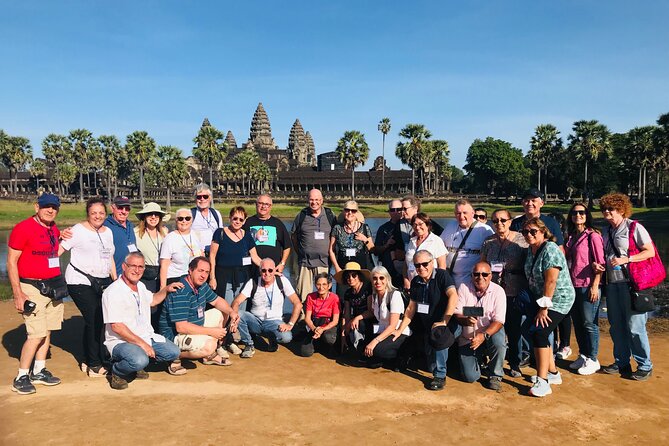
Day 1 starts at 8:00am with hotel pickup, then heads straight to Angkor Wat. You’re given a full block to explore, plus a chance to see nearby villages and the forest area around Angkor Wat. That local add-on is more than filler. It helps you remember the temple isn’t the only story in the region; it’s part of a living area people still move through every day.
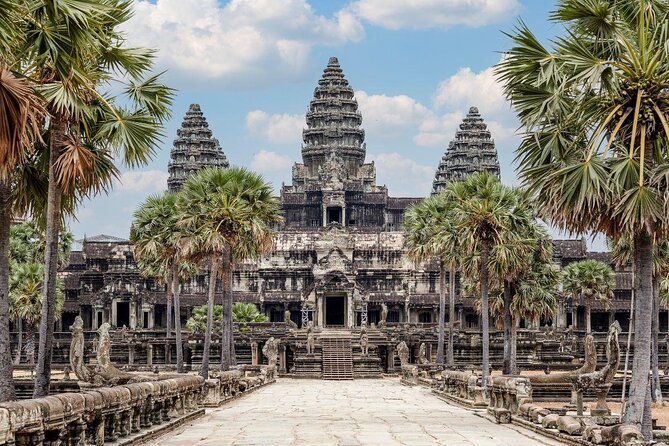
At Angkor Wat, the focus is on why it’s considered the largest religious monument in the world and one of the best preserved. You also get the architecture angle: it combines a temple-mountain layout with later galleried temple elements. If you like understanding why something looks the way it does, this kind of explanation helps you “read” the stone instead of just taking photos.
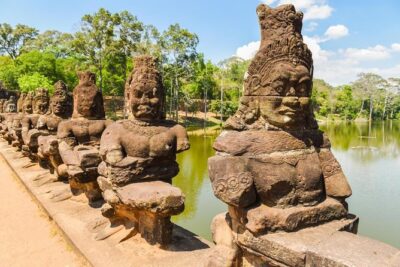
From there you move into Angkor Thom South Gate, the last capital of the Khmer Empire, established in the late 12th century by King Jayavarman VII. The gate leads you into the city ringed by a massive wall and moat, with five gates carved in detail. It’s a good transition from Angkor Wat’s iconic stillness into the broader urban layout of Khmer royal planning.
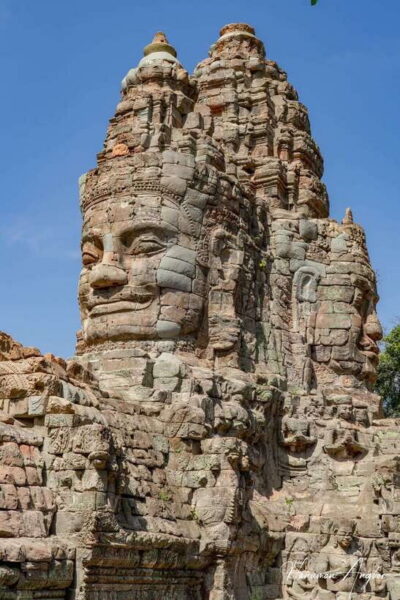
Next is Bayon Temple, the heart of Angkor Thom, famous for the stone face towers. You’ll hear the story of 49 towers and the four smiling faces aimed toward the main directions, with associations explained for Hindu and Buddhist meanings (Shiva, Brahma, Vishnu, Indra; plus Lokesvara/Jayavarman VII). This is one of those stops where a good guide changes everything. With the symbolism explained, the faces stop being just decoration.
After Bayon, you get a breather at Ta Nei, the jungle temple stop. This is described as peaceful, with original ruins and fewer visitors. The best use of this time is slow looking—watch how the vegetation sits around the stones and keep your eyes up for birds and animals. The tour specifically points out possibilities like gibbons, monkeys, and hornbills around the dense forest.
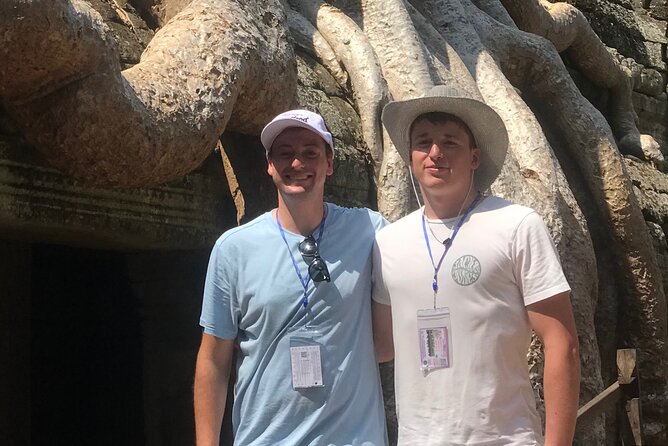
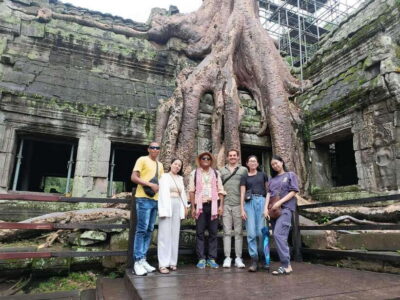
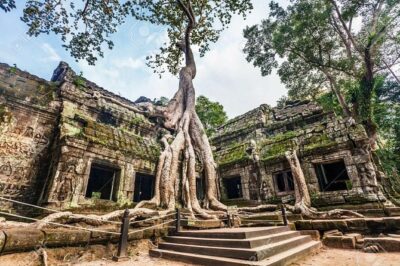
Then it’s on to Ta Prohm, the one everyone recognizes for the tree roots grabbing the temple. You’ll get the background: built by King Jayavarman VII in 1186, dedicated to his mother as Prachnabaramita (mercy and perfection of wisdom in Mahayana Buddhism). You’ll also hear the temple’s Khmer cultural naming explained and its older name as Rajavihara, meaning Royal Monastery.
Day 1 wraps with Prasat Kravan, a brick temple dedicated to Vishnu (built by Harshavarman I in 921). It’s not meant to be as time-consuming as the big temples, but it’s a satisfying end because it’s more about symmetry and carving detail. If you like the craft—lines, proportions, relief—this stop gives your brain something new after all the “face and roots” imagery.
Day 2: 4:30am Angkor Wat sunrise, then Banteay Srei and the quieter circuits
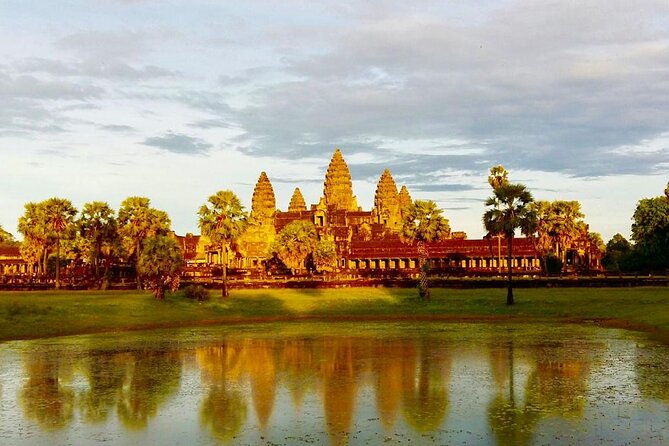
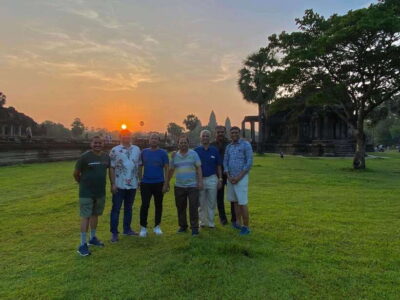
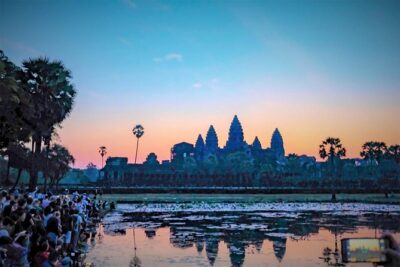
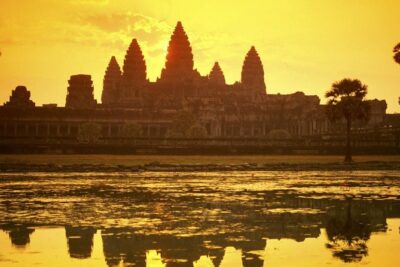
Day 2 starts at 4:30am. The plan is sunrise at Angkor Wat, then returning to your hotel for breakfast and refreshment. If sunrise is on your “must do” list, this timing is the whole point. The tour also flags the reflecting pool as the spot to aim for, and that’s exactly where the iconic mirrored scene comes from.
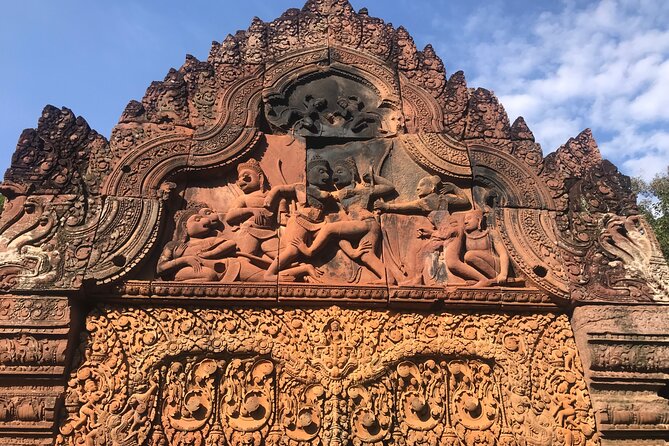
Once the sky show is done, you head north to Banteay Srei, the pink stone Lady Temple about 37km from Angkor Wat. What I like about this stop is the way it’s framed: small in scale but loaded with fine, intricate carving. You’ll hear why people connect it with the idea that women built it, plus the temple’s historical name Isvarapura and its dedication to Shiva.
Then you move through the Angkor main park circuit with less-famous but very rewarding temples. Preah Khan is next, built by Jayavarman VII in 1191 and dedicated to his father as Lokesvara in the central sanctuary. The tour notes it also served as a university of fine art and culture, which makes it easier to think of Preah Khan as more than a photo stop.
After that is Neak Pean, set in the middle of Jayatadak lake and designed around water-based spiritual medicine ideas. You’ll hear that the four pools relate to Water, Earth, Fire, and Wind, connected by stone conduits and associated animals (elephant, bull, horse, lion) by direction. Even if you’re not into ancient belief systems, this temple is fascinating because the layout is the message.
You’ll then visit Ta Som, another tree-rooted, Mahayana Buddhist temple. The tour calls out that the east gate is still grabbed by roots, so this is your “nature and stone” contrast after the sunrise symbolism of the morning.
Next is Banteay Samre, a Hindu temple in the Angkor Wat style. It’s described as well preserved, with a single ogival tower and large carvings. The tour also notes restoration by Maurice Glaize from 1936 to 1944, which is a helpful detail if you’re wondering why some parts look sharp while other Angkor areas look weathered and raw.
The day ends with Eastern Mebon, a temple mountain built in combined brick, laterite, and sandstone. You’ll get an orientation lesson—north-south and east-west axis planning—and a connection to other nearby monuments. This type of stop is great if you like the big-picture geometry behind Khmer design.
Day 3: Phnom Kulen’s sacred mountain and the “untouched” feeling of Beng Mealea
Day 3 takes you away from the main Angkor park energy. You start at Phnom Kulen National Park, also described as a sacred mountain and tied to the symbolic birthplace of the ancient Khmer Empire. The tour highlights the Devaraja Cult, the proclamation of Jayavarman II as the God King, and the mountain’s name changes across time.
What you’ll likely want to watch for here is variety. The tour lists holy waterfalls, a reclining Buddha, a sacred river with thousand lingas, Srash Damrei, and Bat Cave. This mix means Phnom Kulen isn’t one single “big thing.” It’s a day where you can bounce between different kinds of sacred points—water, stone, and myth tied to the same mountain.
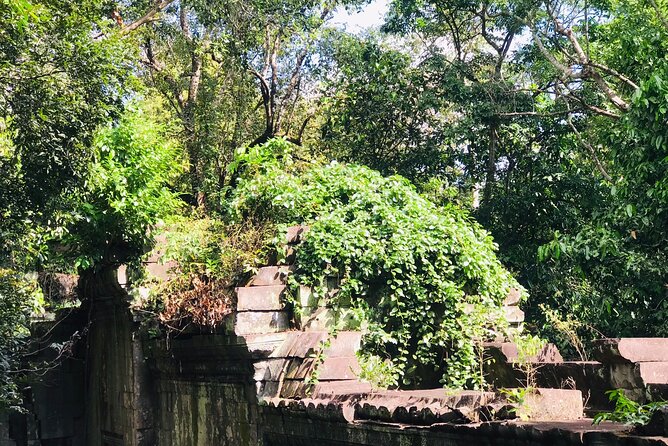
After Phnom Kulen, you head to Prasat Beng Mealea, positioned as a remote jungle temple around 66km from Siem Reap. This is where the tone changes again. The tour describes Beng Mealea as ruins still in harmony with nature and not heavily restored. It also notes the site opened to visitors after land mines were cleared (with that opening happening in the early 2000s).
The atmosphere here is the main draw: piled stones, dark galleries, and that “Indiana Jones” sarcophagus-looking urn comparison. Since the tour itself warns to use caution, this is not the stop for rushing or treating everything like a theme park. It’s better if you enjoy exploring carefully and letting the place keep some mystery.
Day 3 includes a short Siem Reap countryside stop as well. You’ll see a farmer and fisherman way of life explained in plain terms, plus the crops grown in Cambodia (rice, potatoes, cashews, bananas, durian, peppers, sugar palms, jackfruit, oranges, and vegetables). It’s a quick taste, but it anchors the whole trip in daily life rather than only royal monuments.
Up to the cliff-top sanctuary
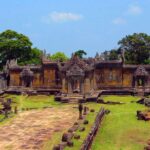
Day 4: 5:30am for Preah Vihear and Koh Ker’s ancient capital setting
Day 4 is early again: pickup at 5:30am, with the suggestion to ask your hotel for breakfast boxes. You stop in Anlong Veng, a small town tied to Khmer Rouge history, including details like it being the last stronghold of the Khmer Rouge Army before 1998 and that Pol Pot died in the area. There’s also a historical visit at Ta Mok’s House.
This part of the day can feel emotionally heavy compared with Angkor. If you prefer your tours to stay in pure “ancient wonder” mode, this is the day you’ll likely need a little time to reset and then keep going. The good news is that it provides context for why Preah Vihear is not only a temple—it’s part of a modern story too.
Then you drive to Preah Vihear Temple, located on top of the Dangrek mountain range near the Thailand border, with views where you can see the Thai army (as stated by the tour). The visit is timed at about 3 hours, which is enough time to take in the climb and then focus on the temple views without feeling ripped along.
After Preah Vihear, the tour continues to Koh Ker, described as the ancient capital of King Jayavarman IV, moved from Angkor around 921 A.D. The city name is given as Chhoarkoki or Lingapura, and the tour notes that many Hindu temples were built between 921 and 944. Koh Ker is here mainly as a “make time for it” stop—less familiar than Angkor, and that’s part of the appeal.
Finally you’re transferred back to Siem Reap to relax.
Is $444 good value after tickets and meals?
At $444 per person for about four days, the value depends on what you already plan to pay separately. The big item is that temple admissions are not included: Angkor tickets, Preah Vihear ticket, and the Koh Ker ticket. Meals are also not included, and tips for guide and driver aren’t included.
So what are you getting for the base price? You’re paying for the “make it work” parts: hotel pickup, air-conditioned transport, a senior English tour guide, plus cool water and towels and some local snacks and beers. That combination is what protects you from spending your days bargaining for transport or losing time on poorly organized timing.
For me, the best value angle is the early starts and the route logic. Sunrise at Angkor Wat (with the reflecting pool photo setup) plus the later remote sites means you’re buying time and access. You’re also buying an experienced guide. Hok’s flexible, kind approach and his knack for photos and explanations are the sort of extras that quietly matter on a trip this packed.
If you’re the type who wants to travel at a gentler pace, you might feel the intensity. If you like seeing a lot and keeping the days efficient, the price starts to look fair—especially because you’re not expected to coordinate tickets and routes day by day.
Who should book this 4-day Angkor Wat and Preah Vihear tour?
Book it if you want:
- Many Khmer temples in a short time, with sunrise and a strong early-morning plan
- A guide who can explain what you’re seeing and help with photo angles
- The mix of major sites (Angkor Wat, Bayon, Ta Prohm) plus less-crowded stops (Ta Nei, Beng Mealea, and the Preah Vihear area)
Skip it (or consider a slower alternative) if:
- You hate early starts or want plenty of downtime
- You’d rather handle temple tickets and planning yourself, since admissions are not included
FAQ
Does the tour include hotel pickup?
Yes. Pickup is offered from your hotel in Siem Reap, with early pickups on Day 2 and Day 4.
What time does the sunrise at Angkor Wat start?
The tour starts at 4:30am on Day 2 for sunrise at Angkor Wat.
Are Angkor temple tickets included?
No. Angkor tickets are not included, and they’ll need to be paid separately.
Is the Preah Vihear temple ticket included?
No. The Preah Vihear ticket is not included.
Is Koh Ker admission included?
No. The Koh Ker temple ticket is not included.
What’s included in the price besides the tour itself?
You get an air-conditioned vehicle, a senior English tour guide, cool water and towels, plus some local snacks and beers.
Are meals included?
No. Meals and personal expenses are not included. On Day 4, you’re asked to request breakfast boxes from your hotel.
Is this tour private?
It’s described as a private tour/activity, with only your group participating.
Is there a cancellation window for a full refund?
You can cancel up to 3 days in advance for a full refund, based on the experience’s local start time.
Should you book it?
I’d book this tour if you’re aiming to see Angkor Wat at sunrise, experience the signature temples of Angkor Thom and Ta Prohm, and still make time for Phnom Kulen, Beng Mealea, and Preah Vihear without doing the heavy planning. The early timing, guide support from Hok, and included comfort touches (air-con, water, towels) make it feel efficient. Just budget for temple tickets and plan for the early mornings, especially Day 4.
More Temple Circuits Around Siem Reap
- Angkor Wat Sunrise or Sunset Tour with Guide from Siem Reap
★ 5.0 · 12,109 reviews - Siem Reap: Angkor Wat: Small-Group Sunrise or Sunset Tour
★ 5.0 · 9,444 reviews - Siem Reap: Angkor Wat 2-Day Tour with Sunrise and Sunset
★ 4.9 · 4,429 reviews - Siem Reap: Full-Day Angkor Wat Guided Tour with Sunset
★ 4.9 · 3,803 reviews - Angkor Wat Sunrise tour with Small – Group and Guide tours
★ 5.0 · 3,655 reviews
Up to Preah Vihear
- Preah Vihear: Full-Day Preah Vihear and Koh Ker Temple Tour
★ 4.9 · 263 reviews - Full-Day Preah Vihear, Koh Ker and Beng Mealea Private Tour
★ 4.4 · 101 reviews - Preah Vihear temple – Koh Ker & Other temple with Small Group
★ 5.0 · 96 reviews - Private Preah Vihear and 2 Temples Guided Tour
★ 5.0 · 42 reviews - Preah Vihear, Koh Ker & Beng Mealea Tour
★ 5.0 · 18 reviews
Angkor Wat, a Few More Ways In
- Angkor Wat Sunrise or Sunset Tour with Guide from Siem Reap
★ 5.0 · 12,109 reviews - Siem Reap: Angkor Wat: Small-Group Sunrise or Sunset Tour
★ 5.0 · 9,444 reviews - Siem Reap: Angkor Wat 2-Day Tour with Sunrise and Sunset
★ 4.9 · 4,429 reviews - Siem Reap: Full-Day Angkor Wat Guided Tour with Sunset
★ 4.9 · 3,803 reviews - Angkor Wat Sunrise tour with Small – Group and Guide tours
★ 5.0 · 3,655 reviews
Just Added: Fresh Siem Reap Tour Reviews

Angkor Wat Temple Tours, compared.
 ★ 5.0Angkor Wat Sunrise or Sunset Tour with Guide from Siem ReapFrom $1812,109 reviews
 ★ 5.0Angkor Wat: Small-Group Sunrise or Sunset TourFrom $159,444 reviews
 ★ 4.9Angkor Wat 2-Day Tour with Sunrise and SunsetFrom $344,429 reviews
 ★ 4.9Full-Day Angkor Wat Guided Tour with SunsetFrom $153,803 reviews
 ★ 5.0Angkor Wat Sunrise tour with Small – Group and Guide toursFrom $143,655 reviews
 ★ 5.0Angkor Wat Highlights and Sunrise Guided Tour from Siem ReapFrom $233,213 reviews
 ★ 5.0Angkor Wat Sunset Small Group Tour with Lunch IncludedFrom $203,059 reviews
 ★ 5.0Full-Day Angkor Wat Sunrise Private Tour with Guide from Siem ReapFrom $602,920 reviews
Browse the lists this tour appears in