
Reviewed · ANGKOR WAT TEMPLE TOURS
Angkor Wat Sunrise & All Highlight Angkor Temple Private Day Tour
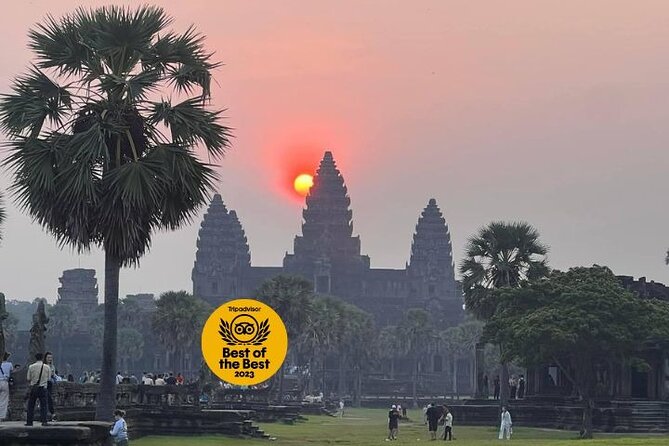
4:30 a.m. beats the heat and crowds. That early start is the heart of the Angkor Wat sunrise plan, and the day keeps moving in a smart order so you hit the big sights without feeling glued to the masses. I also love that it stays private for your group, with an English-speaking guide doing the explaining. My only real consideration is the wake-up call: it’s an ultra-early start, so you’ll want a solid sleep plan the night before.
You ride in a comfortable air-conditioned vehicle (or tuk-tuk depending on the option), and you get cold drinking water and cold towels along the way. In practice, that matters in Angkor, where the morning light can be gorgeous but the day can still build heat fast.
The route is built around the classics: Angkor Wat at sunrise, then Angkor Thom, Bayon, and the famous faces, and later Ta Prohm with its tree-wrapped stones. The tour is designed to finish around Pre Rup after a day of terraces, carvings, and temple details like the Terrace of the Elephants.
In This Review
- Key things to know before you go on this Angkor sunrise tour
- Why 4:30 a.m. works for Angkor Wat sunrise
- Hotel pickup and comfort: AC rides and small perks that matter
- Angkor Wat at sunrise: where to stand and what to watch for
- What the guide adds here
- Angkor Thom South Gate and Bayon: faces, geometry, and meaning
- How to make your time here feel less rushed
- Beyond the main faces: Baphuon, Phimeanakas, and the Royal Palace zone
- Terrace of the Elephants plus the Leper King: carving lovers, rejoice
- A tip for enjoying both terraces
- Ta Nei and Ta Prohm: from formal temple to the kingdom of trees
- What makes Ta Prohm worth it in a private format
- Banteay Kdei: a strong addition if you like Buddhist monastery vibes
- Price and value: what you’re paying for at $65.55
- Who this private tour fits best in real life
- Booking check: how to choose between this and your other Angkor options
- Should you book this Angkor Wat sunrise and all-highlight private day tour?
- FAQ
- What time does this Angkor Wat sunrise tour start?
- Is hotel pickup and drop-off included?
- Is the Angkor Pass entrance fee included?
- Is this tour private or shared with other groups?
- What about lunch—does the price include it?
- How long is the tour?
Key things to know before you go on this Angkor sunrise tour
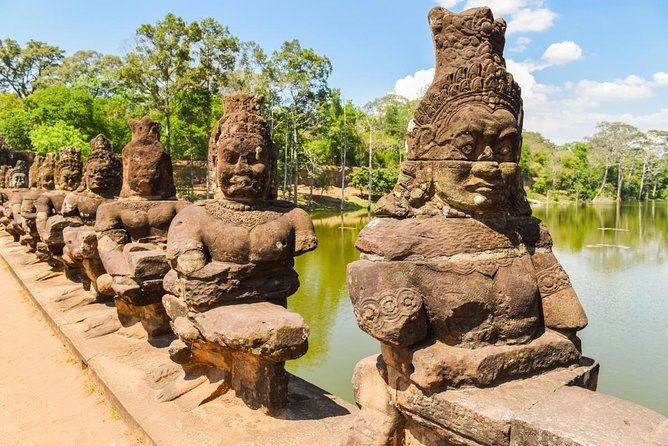
- Sunrise timing gives you the best shot at spots near the Angkor Wat reflection pools
- Private, just-your-group pacing makes it easier to stop for photos and questions
- English-speaking guides (I’ve seen names like Mr. Sara and Leap come up for strong communication)
- Air-con transfers plus cold towels help you stay comfortable before midday
- Route includes major hits like Bayon and Ta Prohm, plus quieter terraces like Ta Nei
- You still budget for the Angkor Pass and your lunch, since they’re not included
Other ways to walk the great temple
- Angkor Wat Sunrise or Sunset Tour with Guide from Siem Reap★ 5.0 · 12,109 reviews
- Siem Reap: Angkor Wat: Small-Group Sunrise or Sunset Tour★ 5.0 · 9,444 reviews
- Siem Reap: Angkor Wat 2-Day Tour with Sunrise and Sunset★ 4.9 · 4,429 reviews
- Siem Reap: Full-Day Angkor Wat Guided Tour with Sunset★ 4.9 · 3,803 reviews
Why 4:30 a.m. works for Angkor Wat sunrise
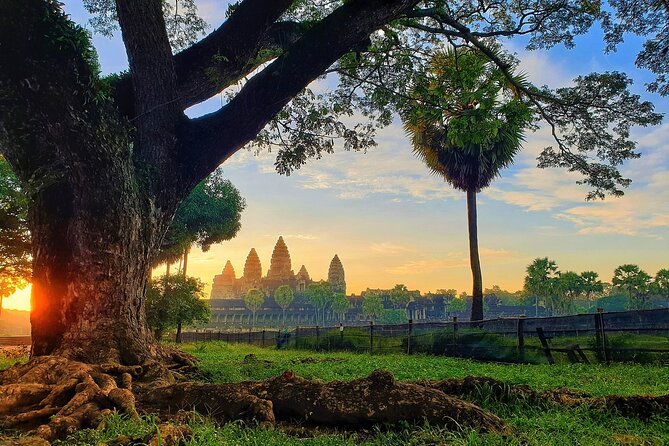
Angkor is one of those places where timing is not a detail, it’s the experience. This tour starts at 4:30 am, and that’s exactly what you need to get into Angkor Wat when the light is soft and the crowds are still forming.
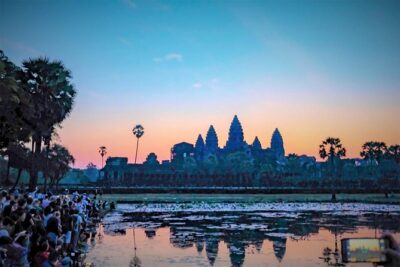
At sunrise, the two reflection pools in front of Angkor Wat are the big magnet. The practical challenge is simple: the closer you are at the start, the easier it is to settle for photos before the best viewpoints fill up.
The second advantage of going early is sweat. Even if the sunrise is cool, temperatures can rise quickly once the sun clears the ruins. Because this plan front-loads Angkor Wat first, you spend more of the day in the comfortable window rather than chasing shade later.
Hotel pickup and comfort: AC rides and small perks that matter
Pickup is from your hotel in Siem Reap city. You provide your hotel name and address when booking, and the guide and driver meet you at the lobby. That saves time and avoids the awkward question of how to get to the park before dawn.
You travel in a luxury air-conditioned vehicle or tuk-tuk in the price option you choose. Either way, the tour includes cold drinking water and cold towels. These aren’t just nice extras. They’re the difference between enjoying the long morning walk and feeling drained before you even reach the main temples.
One more comfort point: this is a private tour limited to your group. That means you’re not stuck waiting while a larger group sorts itself out. It’s also easier to adjust photo stops—especially if someone wants a second angle of a doorway carving or a face of Bayon.
Angkor Wat at sunrise: where to stand and what to watch for
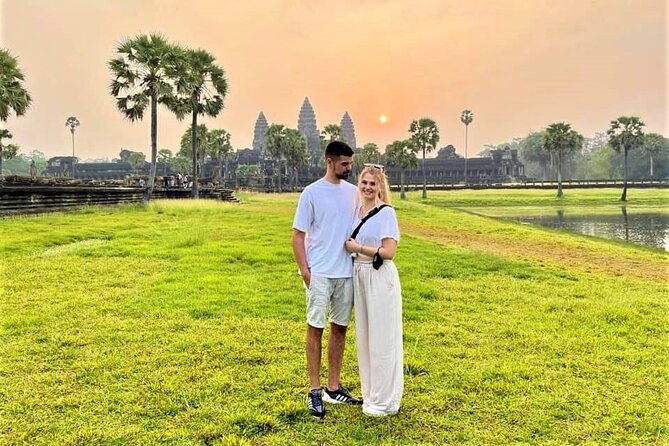
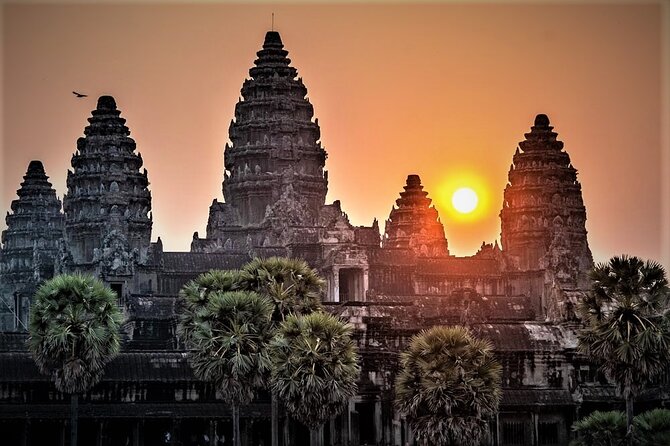
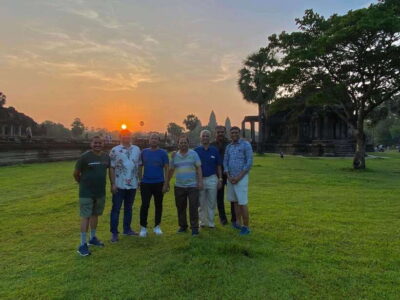
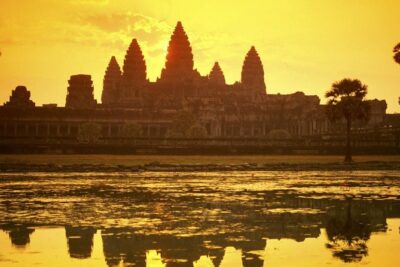
Angkor Wat is the headline. You start there and spend about two hours on site. The goal is straightforward: get to the temple at sunrise and position yourself as close as possible to the reflection pools for the best photos.
Here’s what I find helpful when you’re looking at sunrise temples in general: don’t rush to find the perfect spot so late that you miss the light changing. Instead, pick a viewpoint early, settle your camera, and let the sky do its work. As dawn brightens, reflections become clearer and the stone surfaces show more texture.
Also, keep an eye on movement patterns. Sunrise crowds tend to surge toward the most photographed angles first. Having a guide helps because they can steer you to the best flow of viewpoints without you feeling like you’re wandering in circles.
And if weather turns messy, the tour still has a plan. Cold towels and water are included, and a good guide can keep you moving so the day doesn’t stall.
What the guide adds here
This tour isn’t just walking. The included English-speaking licensed guide is focused on Cambodia’s history and on what you’re seeing in each temple. At Angkor Wat, that storytelling is the difference between looking at ruins and understanding what you’re actually looking at.
Chasing the light? More dawn and dusk runs

Angkor Thom South Gate and Bayon: faces, geometry, and meaning
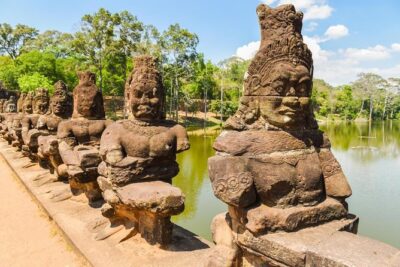
After Angkor Wat, you head into Angkor Thom, starting at the South Gate (about 30 minutes). This is a classic entry point because it’s restored and many of the heads are still in place. It sits on the main road into Angkor Thom from Angkor Wat, so it feels like you’re transitioning from one world into the next.
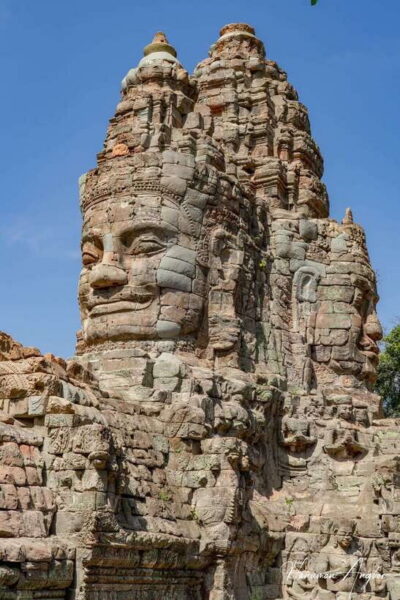
From there, you visit the Bayon Temple (about 1 hour). Bayon is later than Angkor Wat, built nearly a century later, and it’s famous for the many carved faces that watch from different directions. The big experience shift at Bayon is scale. You stop thinking of individual buildings and start seeing how the temple complex works like a mapped city-center.
Then you also spend time at Angkor Thom itself (about 30 minutes). This is where your guide’s commentary becomes especially valuable. Angkor Thom isn’t just a collection of stones—it’s tied to Buddhist cosmology and the idea of a royal city in stone-on-stone form.
How to make your time here feel less rushed
Because this is private, you don’t have to speed-run. I’d use the Bayon hour to do two things:
- Walk a loop at a steady pace once, just to take it in.
- Then slow down for the carvings and the faces once you see where the best viewing lines are.
If you’re into photos, this is where you can ask your guide to help you time the stops. The best photos often come when people shift around you, not when you’re trying to fight for the front row.
Beyond the main faces: Baphuon, Phimeanakas, and the Royal Palace zone
Once you’re in the Angkor Thom area, the tour continues with a set of temples that feel different from Bayon.
Baphuon (about 1 hour) is notable for its layered sandstone base—five levels—rather than the more common smaller-tapering style you might expect. If Angkor Wat feels like elegance and Bayon feels like intensity, Baphuon adds a “how did they build this?” feeling.
Next is Phimeanakas (about 25 minutes), near the center of the walls of the Royal Palace. It’s described as having originally had a golden pinnacle, and your guide can connect that visual to what the place meant in the royal layout.
A practical note: these stops can be shorter than Angkor Wat or Ta Prohm, so it helps to show up with curiosity. If you pay attention to the base design, the gateways, and the placement inside the palace area, you’ll feel like you got something real out of each one—rather than just checking boxes.
Terrace of the Elephants plus the Leper King: carving lovers, rejoice
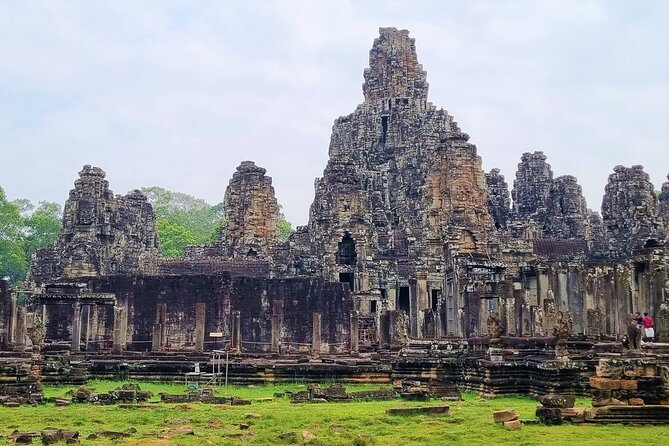
Some Angkor sights are dramatic at first glance. Others reward you if you slow down. Two of the best examples here are the Terrace of the Elephants and the Terrace of the Leper King.
The Terrace of the Elephants (about 30 minutes) has a quiet power. The elephants are paired with steps and procession-like rhythm, and the carvings are famous for showing servants and princes positioned as if the scene is happening in a controlled parade.
Then comes the Terrace of the Leper King (about 30 minutes). This terrace carries the grandeur of Jayavarman VII’s reign and is faced with dramatic bas-reliefs. If you like temple art, you’ll probably end up spending longer than you think here—because your eyes keep finding new details.
A tip for enjoying both terraces
Don’t treat them as separate photo stops. Treat them like one art experience: look at how the figures repeat, how the bas-reliefs are arranged, and how the terrace design directs your gaze. With a guide explaining the context, those carvings turn from decoration into a story.
Ta Nei and Ta Prohm: from formal temple to the kingdom of trees
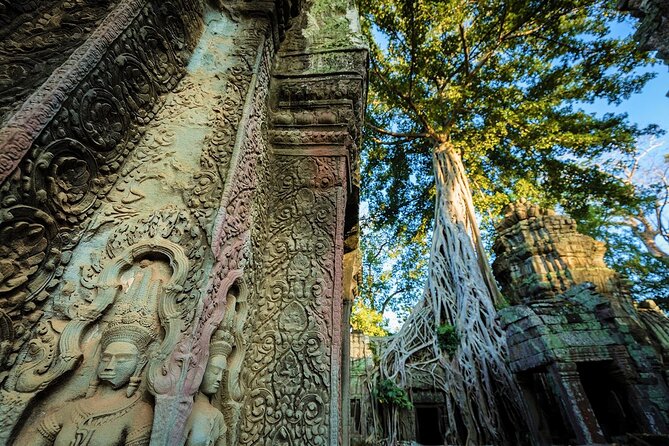
After the terraces and nearby temple stops, the tour includes Ta Nei (about 30 minutes) near the northwest corner of the East Baray reservoir area. It’s dedicated to the Buddha, and even though the time here is shorter, it helps balance the big-name temples with something a bit calmer.
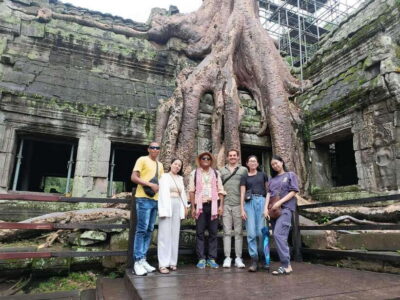
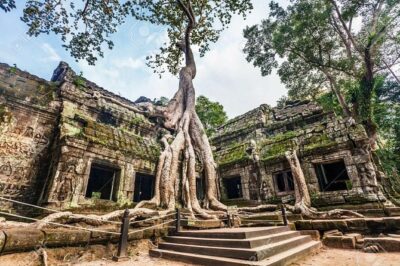
Then the schedule reaches Ta Prohm (about 1 hour). Ta Prohm is the one people recognize instantly because it’s strongly linked to trees taking over stone. The key idea with Ta Prohm is preservation style: archaeologists left it largely untouched, aside from clearing paths for visitors and strengthening structures to prevent further damage.
That combination—ruins plus living roots—creates a different feel from the more formal temple geometry. At Ta Prohm, you’re not just looking at buildings. You’re watching nature and architecture share the same frame.
What makes Ta Prohm worth it in a private format
Ta Prohm is busy. In a crowded group situation, you often end up rushing to keep up. In this private tour format, you can slow down for the parts you care about: the framing of roots around doorways, the angles of collapsing stone, and the way the paths cut through the ruins.
If you want photos, you can also ask your guide for help timing stops. I’ve seen praise for guides who are patient with photos and still keep the day moving.
Banteay Kdei: a strong addition if you like Buddhist monastery vibes
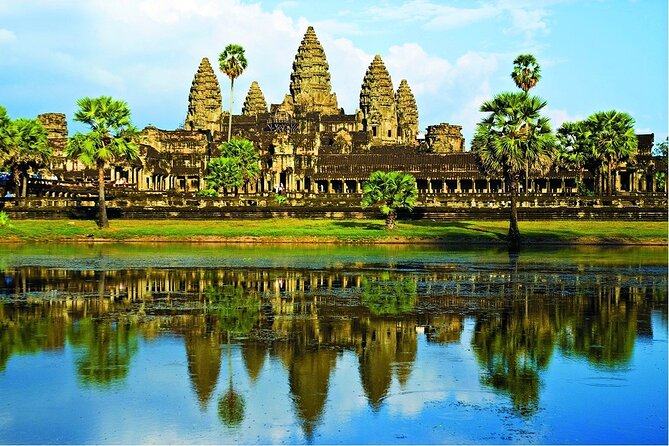
The last set includes Banteay Kdei (about 1 hour). It’s known for the 2001 discovery of a cache of broken statues and Buddhist artifacts. The temple itself is built at ground level and is tied to the idea of a Buddhist monastery.
This is a good “breather” temple between the intensity of Ta Prohm and the wrap-up of the day. It won’t feel as instantly famous as Bayon or Angkor Wat, but if you enjoy understanding how Buddhist temples functioned as spaces for practice, it adds depth.
And because your route keeps moving in a deliberate order, you avoid the feeling of spending the last hour tired and staring at the wrong thing.
Price and value: what you’re paying for at $65.55
The price shown is $65.55 per person, and the value comes from how much is handled for you.
Included highlights:
- Professional English-speaking licensed guide
- Hotel pickup and drop-off in Siem Reap city
- Private transfers by luxury air-con vehicle or tuk-tuk (based on your option)
- Cold drinking water and cold towels
- Services charge and current government VAT tax
- A mobile ticket option
- Group discount availability
Not included:
- Tips for guide and driver
- Entrance fee via the Angkor Pass (your guide assists you buying it at the entrance)
- Lunch (available for $3–$10 per dish at local restaurants, vegetarian and non-vegetarian options)
So what’s the real math? You’re paying for a guided, comfortable, time-efficient plan from before sunrise until the late morning/early afternoon stretch. If you were doing this on your own, you’d still need a guide at least for context and you’d still need transport. The Angkor Pass cost and lunch are separate, but at least the big coordination work is handled.
If your priority is a smooth, explanation-heavy day with smart pacing, this looks like a reasonable value. If your priority is absolute lowest cost and you don’t care about interpretation, you could compare against cheaper independent options.
Who this private tour fits best in real life
This tour is a great fit if you:
- Want the sunrise advantage without thinking through timing and logistics
- Like history and context more than just sightseeing snapshots
- Prefer a private group pace where you can take photos and ask questions without pressure
It may not be ideal if:
- Ultra-early mornings are a hard sell for you
- You’d rather spend the day at your own rhythm with no set order
One practical sweet spot: families and mixed-age groups often do well when the guide handles the flow. The route is structured, and the included water/towels help during the long early hours.
Booking check: how to choose between this and your other Angkor options
Before you lock it in, confirm what you care about most:
- Do you want sunrise photos near the reflection pools? If yes, this timing supports that goal.
- Do you want an English guide with a history focus? This is built around commentary.
- Are you okay paying for the Angkor Pass separately and buying lunch on site? If yes, you’re set.
Also, if you’ve seen names like Mr. Sara or Leap associated with the guiding style you want, that’s a good sign. Drivers named Ay and Ree also came up with helpful support like cold towels and staying on schedule—exactly the kind of small service that keeps a long day from feeling chaotic.
Should you book this Angkor Wat sunrise and all-highlight private day tour?
I’d book it if you’re the kind of traveler who wants Angkor Wat at sunrise, then a full day that ties the temples together with clear English commentary. You’ll get comfortable transport, thoughtful pacing, and major sights like Bayon and Ta Prohm without the stress of building a route yourself.
Hold off if you hate early mornings or you’re trying to minimize every extra cost. The Angkor Pass and lunch are not included, so budget accordingly.
If you can handle waking up early, this is a solid way to see the big icons and the detailed carvings—without feeling like you’re stuck in a long, crowded shuffle.
FAQ
What time does this Angkor Wat sunrise tour start?
The start time is 4:30 am. Pickup is from your Siem Reap hotel before you begin the sunrise visit.
Is hotel pickup and drop-off included?
Yes. Pickup and drop-off are included, and you’ll need to provide your hotel name and hotel address at booking.
Is the Angkor Pass entrance fee included?
No. Entrance fees are not included, and the Angkor Pass is required for the temples on the itinerary. Your guide assists you with purchasing it at the entrance of Angkor Park.
Is this tour private or shared with other groups?
It’s a private tour restricted to your group only.
What about lunch—does the price include it?
Lunch is not included. Meals are available at local restaurants with vegetarian and non-vegetarian options, and you pay on your own (menu prices range from $3 to $10 per dish).
How long is the tour?
The tour duration is approximately 8 to 9 hours.
More Temple Circuits Around Siem Reap
- Angkor Wat Sunrise or Sunset Tour with Guide from Siem Reap
★ 5.0 · 12,109 reviews - Siem Reap: Angkor Wat: Small-Group Sunrise or Sunset Tour
★ 5.0 · 9,444 reviews - Siem Reap: Angkor Wat 2-Day Tour with Sunrise and Sunset
★ 4.9 · 4,429 reviews - Siem Reap: Full-Day Angkor Wat Guided Tour with Sunset
★ 4.9 · 3,803 reviews - Angkor Wat Sunrise tour with Small – Group and Guide tours
★ 5.0 · 3,655 reviews
Dawn and Dusk Over Angkor
- Angkor Wat Sunrise or Sunset Tour with Guide from Siem Reap
★ 5.0 · 12,109 reviews - Siem Reap: Angkor Wat: Small-Group Sunrise or Sunset Tour
★ 5.0 · 9,444 reviews - Sunset tour of Kampong Phluk stilts home village on the Tonle Sap
★ 5.0 · 4,865 reviews - Siem Reap: Angkor Wat 2-Day Tour with Sunrise and Sunset
★ 4.9 · 4,429 reviews - Siem Reap: Full-Day Angkor Wat Guided Tour with Sunset
★ 4.9 · 3,803 reviews
Angkor Wat, a Few More Ways In
- Angkor Wat Sunrise or Sunset Tour with Guide from Siem Reap
★ 5.0 · 12,109 reviews - Siem Reap: Angkor Wat: Small-Group Sunrise or Sunset Tour
★ 5.0 · 9,444 reviews - Siem Reap: Angkor Wat 2-Day Tour with Sunrise and Sunset
★ 4.9 · 4,429 reviews - Siem Reap: Full-Day Angkor Wat Guided Tour with Sunset
★ 4.9 · 3,803 reviews - Angkor Wat Sunrise tour with Small – Group and Guide tours
★ 5.0 · 3,655 reviews
Just Added: Fresh Siem Reap Tour Reviews

Angkor Wat Temple Tours, compared.
 ★ 5.0Angkor Wat Sunrise or Sunset Tour with Guide from Siem ReapFrom $1812,109 reviews
 ★ 5.0Angkor Wat: Small-Group Sunrise or Sunset TourFrom $159,444 reviews
 ★ 4.9Angkor Wat 2-Day Tour with Sunrise and SunsetFrom $344,429 reviews
 ★ 4.9Full-Day Angkor Wat Guided Tour with SunsetFrom $153,803 reviews
 ★ 5.0Angkor Wat Sunrise tour with Small – Group and Guide toursFrom $143,655 reviews
 ★ 5.0Angkor Wat Highlights and Sunrise Guided Tour from Siem ReapFrom $233,213 reviews
 ★ 5.0Angkor Wat Sunset Small Group Tour with Lunch IncludedFrom $203,059 reviews
 ★ 5.0Full-Day Angkor Wat Sunrise Private Tour with Guide from Siem ReapFrom $602,920 reviews