
Reviewed · ANGKOR WAT TEMPLE TOURS
Angkor Wat Sunrise, Banteay Srei, Bayon & Ta Prohm Temple
Siem Reap hits hardest before the day starts. This 8-hour Angkor tour is interesting because it times the visit for the best light at Angkor Wat Sunrise and then follows with the ultra-detailed Banteay Srei carvings on pink stone; the trade-off is you’ll be on your feet in strong heat and early morning brightness, so plan for pace and comfort.
I like that the day moves like a smooth circuit: pickup from Krong Siem Reap, air-conditioned travel between sites, and thoughtful extras like cold towels, water, and fresh coconut juice. You also get a real mix of Angkor moods, from quiet sunrise silhouettes to jungle-choked stones at Ta Prohm and the crowd-friendly, face-filled geometry of Bayon.
In This Review
- Key highlights to look for
- Sunrise at Angkor Wat: the light, the scale, the calm
- Banteay Srei’s pink stone carvings: small temple, big detail
- Pre Rup area and the six-tower viewpoint mood
- Ta Prohm: when the jungle takes over
- Bayon’s smiling faces: 54 towers, 200 watchers
- Price and value: what you’re paying for (and what you aren’t)
- Comfort, heat, and what to pack for this kind of day
- Guides, explanations, and how much English you should expect
- Should you book this Angkor Wat sunrise, Banteay Srei, Ta Prohm and Bayon day tour?
- FAQ
- What’s the total duration of the tour?
- How much does this tour cost?
- What’s included in the price?
- What isn’t included?
- Do I get pickup from my hotel?
- Where does pickup happen?
- What temples are included in the tour?
- How long do I spend at each main site?
- What should I bring and wear?
- Is it suitable for pregnant women?
Key highlights to look for
- Angkor Wat Sunrise on your schedule: arrive before the day’s busiest surge.
- Banteay Srei’s pink sandstone/lime-carved walls: some of the most intricate work in the Angkor region.
- Ta Prohm with jungle takeover: massive fig and silk-cotton trees growing through towers and corridors.
- Bayon’s 54 towers and 200 smiling faces: a temple that feels like it’s watching you back.
- Pre Rup area for the mountain temple vibe: six large towers in a classic Angkor silhouette.
- Cooling breaks that actually help: cool towels and chilled water after time in the sun.
Other ways to walk the great temple
- Angkor Wat Sunrise or Sunset Tour with Guide from Siem Reap★ 5.0 · 12,109 reviews
- Siem Reap: Angkor Wat: Small-Group Sunrise or Sunset Tour★ 5.0 · 9,444 reviews
- Siem Reap: Angkor Wat 2-Day Tour with Sunrise and Sunset★ 4.9 · 4,429 reviews
- Siem Reap: Full-Day Angkor Wat Guided Tour with Sunset★ 4.9 · 3,803 reviews
Sunrise at Angkor Wat: the light, the scale, the calm
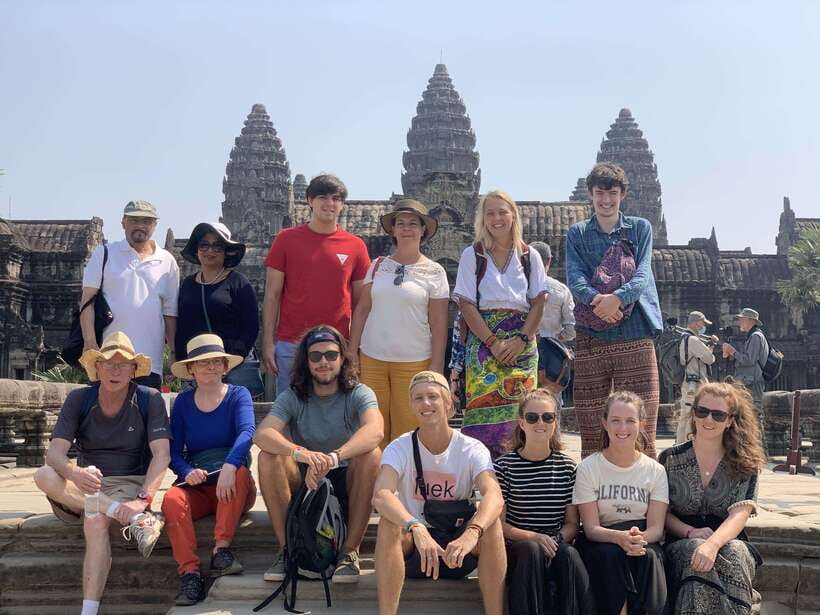
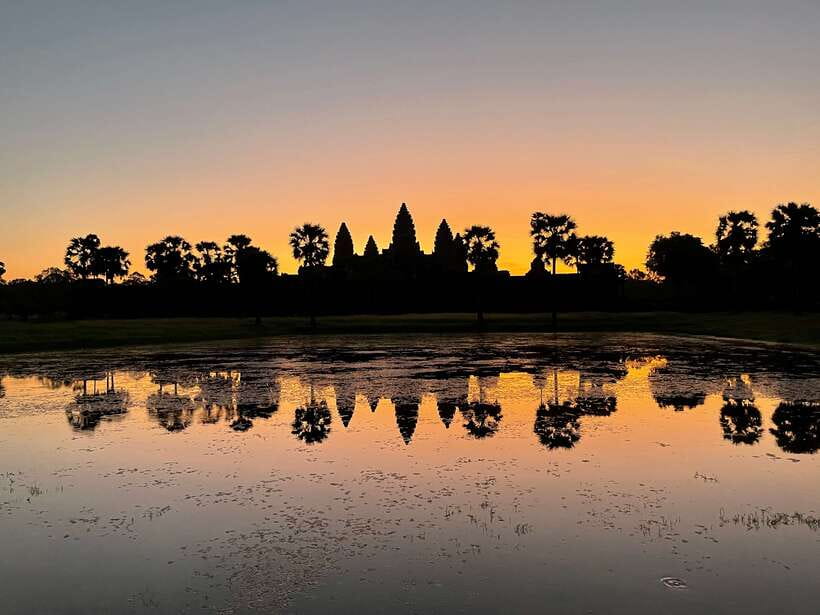
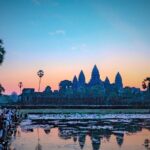
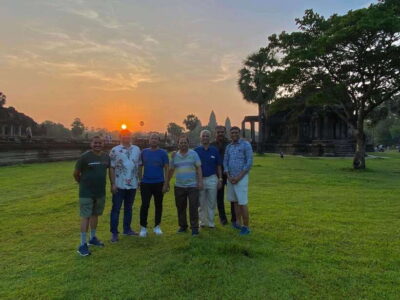
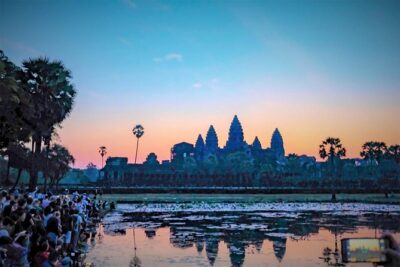
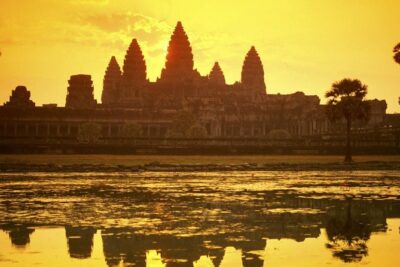
Angkor Wat is on a different scale. It’s the world’s largest religious monument, and seeing it at sunrise changes how it feels. In the early hours, the stone looks less like a monument you’ve read about and more like a scene you step into—clean lines, long reflections, and that first soft color spreading across the towers.
The big value here is timing. This tour is set up so you’re at Angkor Wat before the day’s crowds arrive in full force. That means you’ll spend your 2 hours at the site with fewer bottlenecks and better chances to enjoy the atmosphere rather than just fight your way through it.
Practical tip: sunrise can be deceptively cold for a little while, then quickly turns hot. Bring comfortable clothes you can work with—no need to dress for fashion. And wear shoes you can trust on uneven stone.
If your guide is someone like Sinan or Makara (names you might hear on this kind of circuit), expect clear explanations that connect what you’re seeing to why it matters—so the sunrise isn’t just pretty, it’s meaningful.
Banteay Srei’s pink stone carvings: small temple, big detail
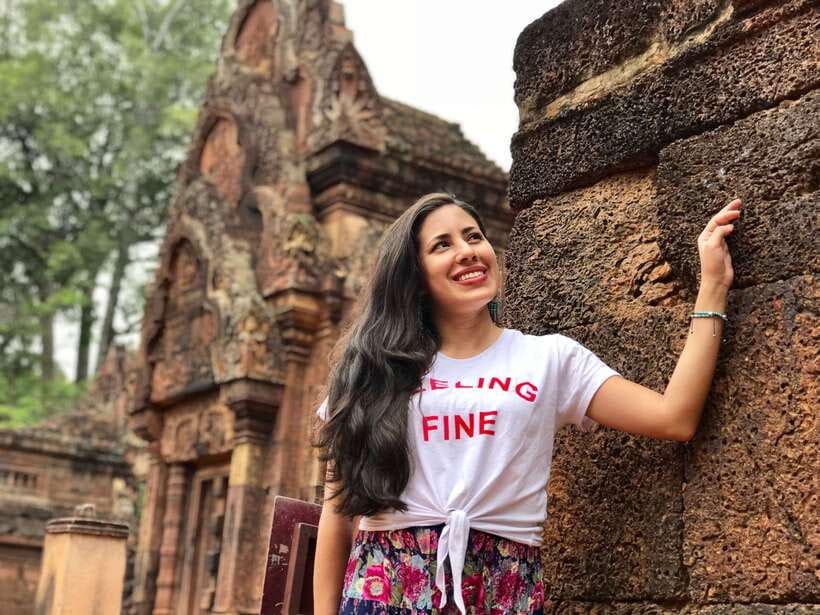
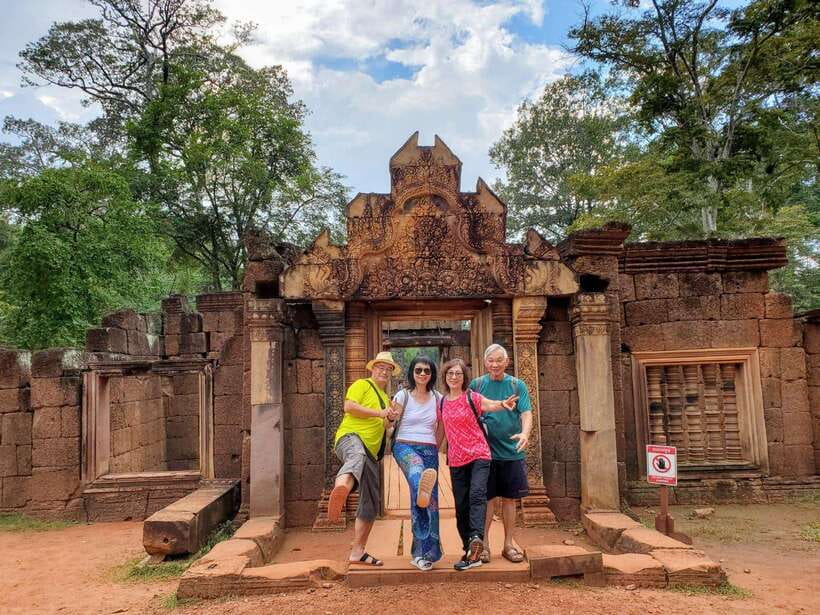
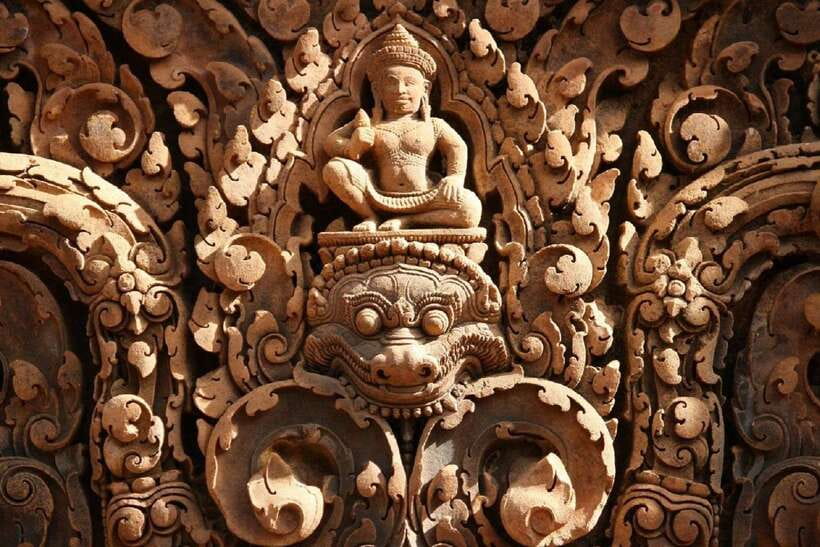
After the early grand moment, the day shifts to a temple that rewards close looking: Banteay Srei. This is the kind of stop where you slow down without realizing it. Built in the 10th century by King Rajendravarman V, Banteay Srei is known for its richly carved surfaces—so deep and intricate that the details almost feel layered.
What I love about this portion is the contrast. Angkor Wat is monumental and formal. Banteay Srei is more intimate and decorative. The carvings on the pink sandstone (often described as pink limestone as well) have a sharpness that’s hard to appreciate when you’re rushing.
You also get around an hour here with time for a short break, walking through the temple area, and a chance to browse or shop nearby. That balance is useful. With Angkor sites, your legs get tired fast, and having a little flexibility helps you enjoy the carvings instead of just surviving them.
A nice extra on the way: you’ll pass through areas where you can see real life of local people. It’s a gentle reminder that Angkor isn’t a museum island—it sits in a living landscape.
One consideration: you’ll likely be exposed to sun for stretches, so plan to drink water, use shade when you can, and keep an eye on your energy level.
Pre Rup area and the six-tower viewpoint mood
The tour’s highlights also include a stop around the Pre Rup temple area, with the mountain-temple look and its 6 large towers. This is one of those Angkor experiences that feels like a “frame” for the day—an in-between moment that helps you see how temples were designed to create a sense of height, ascent, and ritual movement.
Even if you’re not planning a long stay here, it’s a valuable visual marker. The towers and the setting help you understand how the Angkor complex works as an architectural system rather than isolated monuments. It also gives your eyes a breather before Ta Prohm ramps up the drama.
Think of it as a palate cleanser: not as busy as the biggest headline temples, still iconic, and good for photos when the light isn’t too harsh.
Ta Prohm: when the jungle takes over
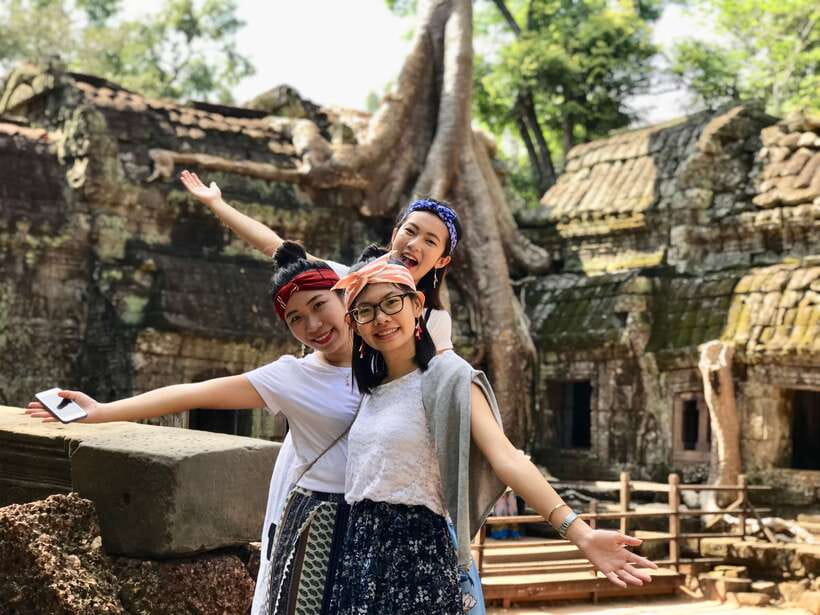
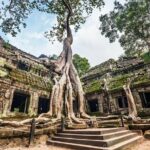
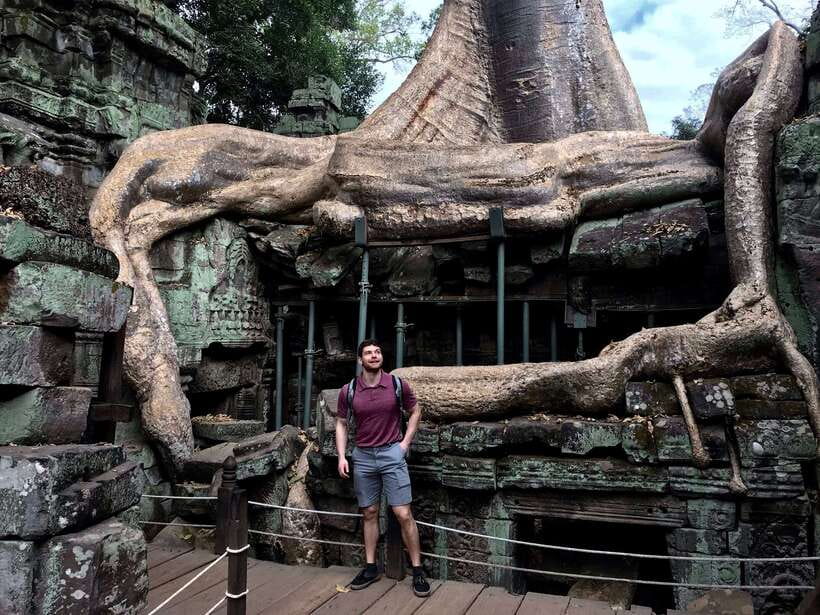
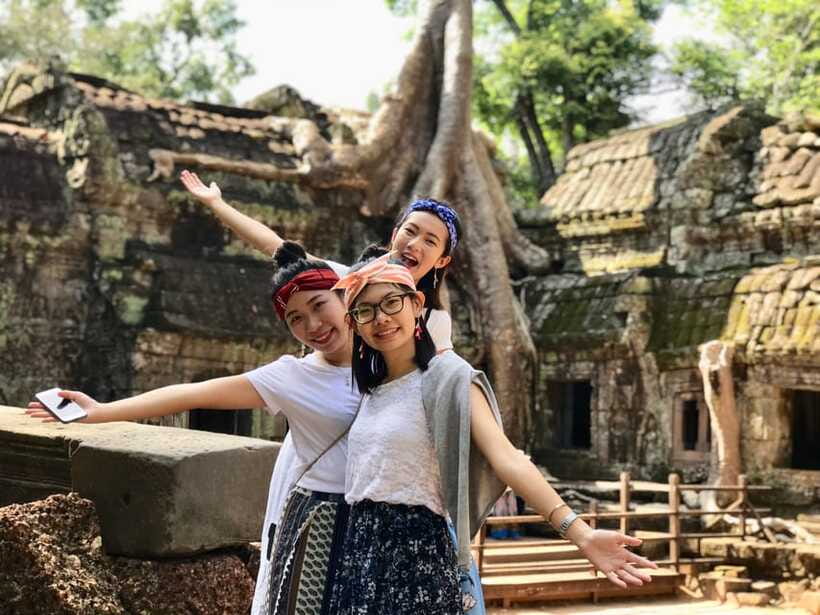
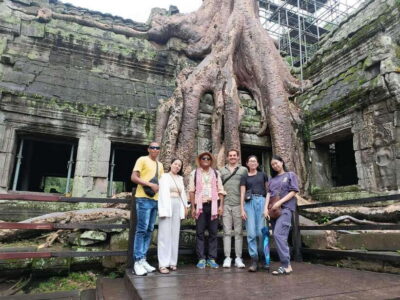
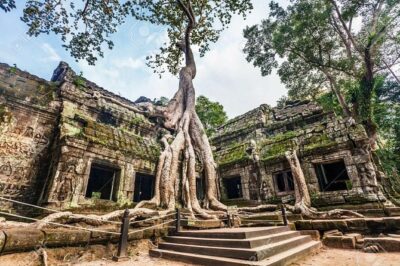
Then comes Ta Prohm, and it’s one of the most memorable stops for a simple reason: nature looks like it moved in and refused to leave. This is the monastic complex where you can see the jungle encroaching on the ruins—exactly how the stones have been swallowed by vines, roots, and thick tree growth.
What makes it special are the massive fig and silk-cotton trees growing from inside the towers and corridors. It doesn’t feel like an overgrown ruin from a distance. Up close, it’s stranger and more powerful. You notice how the architecture still holds shape while the forest wraps it.
You’ll spend about an hour here with time to walk and look around. That’s enough to understand the layout and to find those “how is this even standing?” moments without exhausting yourself completely. It’s also the part of the day where your sense of scale changes again: you stop thinking in straight lines and start noticing how roots and cracks guide your attention.
Practical tip: Ta Prohm can be slippery and uneven. Don’t wear anything you wouldn’t trust on damp stone. Comfortable shoes matter more here than at any other stop.
If you’re worried about heat, this is where the tour’s cooling rhythm helps. On hot days, guides and drivers on this route tend to keep water moving and use cool towels to reset you after time in the sun. One traveler specifically noted how much refreshed they felt from cooled towels after getting back into the car—exactly what you’ll want when your body starts to lag.
Chasing the light? More dawn and dusk runs
Bayon’s smiling faces: 54 towers, 200 watchers
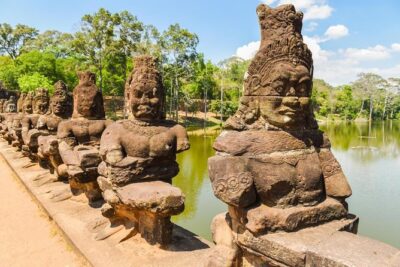
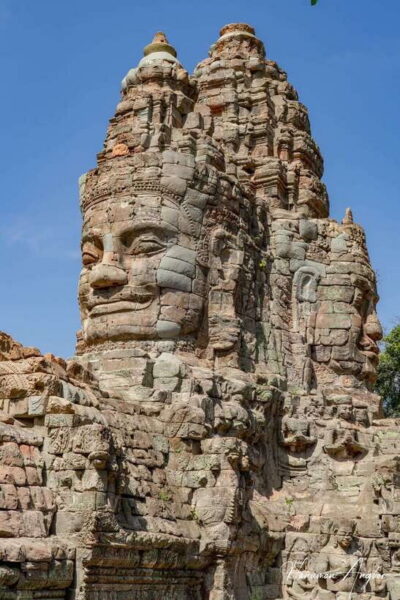
By the time you reach Bayon, the day feels like it’s turning into the “crowd-pleaser” zone, but in a good way. Bayon is defined by its many towers, famous for 54 towers decorated with about 200 smiling Buddha faces. The effect is immediate: you look up, you notice repetition, and you realize the faces are part of the temple’s storytelling strategy.
This stop is about 1 hour, with some free time inside. That’s important. Bayon can be visually intense. Having a little unstructured time lets you pause when you want, not just when the schedule forces you.
A helpful mental trick: don’t try to capture everything. Pick two or three towers, walk a slow arc, and let your eyes adjust. The faces vary slightly by angle and lighting, so your experience changes the way a set of photos never fully will.
Also, Bayon is a great place to appreciate how Angkor uses symmetry and controlled chaos. Even when people gather around the most popular views, the temple’s structure still leads you around in a way that feels natural.
Price and value: what you’re paying for (and what you aren’t)
This tour costs $80 per person and runs about 8 hours. For that price, you’re getting a lot of the hard parts handled: air-conditioned transportation between sites, an English-speaking guide, and small comfort boosts that make a difference in Siem Reap’s heat—fresh coconut juice, drinking water, and cool towels.
The other key value point is the sunrise. Sunrise tours are often priced higher for a reason: you’re paying for early timing and getting you into the right mindset before the crush of the day. In a day that covers multiple major temples, that early start is what keeps the experience from feeling rushed.
What’s not included: meals and drinks, and the Angkor pass (1-day listed at $37 per person). So a realistic “all-in” budget for your day is closer to around $117 per person if you eat one meal on the circuit and use the 1-day pass. You can reduce the hit by keeping snacks light, but your best move is to plan meals as part of your temple strategy—short breaks, quick refuel, back out into the heat.
If you’re trying to get the biggest hit of Angkor in a single packed day, this price tends to make sense because it combines a major sunrise site plus Banteay Srei, Ta Prohm, and Bayon without making you coordinate everything yourself.
Comfort, heat, and what to pack for this kind of day
This route isn’t an indoor museum crawl. You’re walking temples, climbing stairs in places, and spending time outdoors. Heat is the real opponent.
Bring:
- Comfortable shoes (you’ll want grip on stone)
- Comfortable clothes you can move in
Note: sportswear is listed as not allowed, so go for normal travel clothes that cover up without looking like gym gear.
The tour helps with heat control in practical ways:
- Drinking water is included.
- Fresh coconut juice shows up during the day.
- Cool towels are used to refresh you during the tour.
That last point matters more than it sounds. When you’re sweating and your shirt feels soaked, your pace drops. A cool towel after a car transfer can get you back into sightseeing mode faster.
Also, note the tour isn’t suitable for pregnant women. If you’re in that situation, you’ll want to look for a more accessible, slower-paced alternative.
Guides, explanations, and how much English you should expect
You’ll have a fully vaccinated English-speaking tour guide. That’s a good baseline.
In real life, the guide experience can vary. One traveler noted that their guide explained highlights clearly and helped a lot with understanding what they were seeing. Another mentioned English wasn’t optimal, though the guide was still polite and very flexible—so the person who needed more clarity had more questions than usual.
My advice: if you want history explained in detail, come with a few questions ready. Ask why the temple layout is designed the way it is, or what the faces at Bayon represent. Good guides respond to that. And if your guide is less strong in English, staying curious and patient usually keeps the day enjoyable.
Should you book this Angkor Wat sunrise, Banteay Srei, Ta Prohm and Bayon day tour?
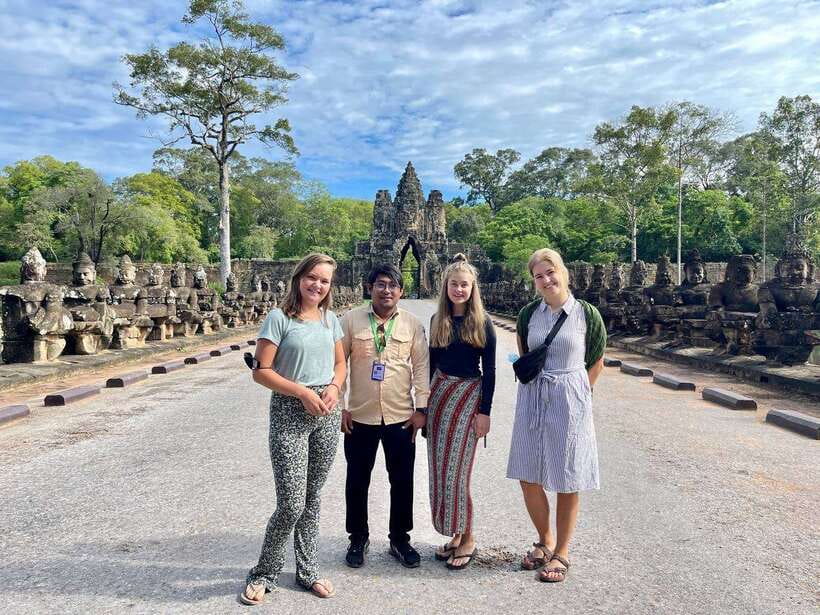
Book it if you want a high-impact Angkor day that hits the biggest visual themes: sunrise at Angkor Wat, the pinpoint carving detail of Banteay Srei, the jungle drama of Ta Prohm, and the famous faces of Bayon—without spending time figuring out logistics.
Skip it (or look for a different format) if you want a relaxed pace, minimal walking, or you’re sensitive to heat and early mornings. Also, if you’re not comfortable with uneven stone surfaces, the temple circuit can be tiring.
If you’re balancing budget and time and you want to see a lot of Angkor in one go, this is a solid value play—especially because the day is built around getting your best moments (like sunrise) before the crowds arrive.
FAQ
What’s the total duration of the tour?
The tour lasts about 8 hours.
How much does this tour cost?
It’s $80 per person.
What’s included in the price?
Included are transportation by air-conditioned car/minivan, an English-speaking tour guide, fresh coconut juice, drinking water, and cool towels.
What isn’t included?
Meals and drinks are not included. You also need an Angkor pass (1-day pass is listed as $37 per person per day).
Do I get pickup from my hotel?
Yes. Pickup is included. You’ll need to provide your hotel name, and you should wait in the lobby about 5 minutes before the start.
Where does pickup happen?
Pickup is available from Krong Siem Reap in Siem Reap Province.
What temples are included in the tour?
You’ll visit Angkor Wat (for sunrise), Banteay Srei, Ta Prohm, and Bayon, with the tour highlights also mentioning the Pre Rup temple area.
How long do I spend at each main site?
Time on-site is listed as: Angkor Wat sunrise (about 2 hours), Banteay Srei (about 1 hour), Ta Prohm (about 1 hour), and Bayon (about 1 hour).
What should I bring and wear?
Bring comfortable shoes and comfortable clothes. Sportswear is not allowed.
Is it suitable for pregnant women?
No. It’s listed as not suitable for pregnant women.
Through Angkor Thom to Bayon
- Siem Reap Tour: Angkor Wat Sunrise, Bayon, Ta Prohm, Banteay Srei
★ 5.0 · 931 reviews - Angkor Wat Private Driver Tours to Angkor Wat Sunrise, Angkor Thom & Ta Prohm
★ 5.0 · 98 reviews - Angkor Wat Sunrise and Angkor Thom Sunset Tour
★ 5.0 · 89 reviews - Angkor Wat, Angkor Thom Ancient Capital, Ta Promh Temple
★ 5.0 · 85 reviews - Private Temples Guided Tour (Angkor Wat, Ta Prom & Angkor Thom)
★ 5.0 · 75 reviews
Dawn and Dusk Over Angkor
- Angkor Wat Sunrise or Sunset Tour with Guide from Siem Reap
★ 5.0 · 12,109 reviews - Siem Reap: Angkor Wat: Small-Group Sunrise or Sunset Tour
★ 5.0 · 9,444 reviews - Sunset tour of Kampong Phluk stilts home village on the Tonle Sap
★ 5.0 · 4,865 reviews - Siem Reap: Angkor Wat 2-Day Tour with Sunrise and Sunset
★ 4.9 · 4,429 reviews - Siem Reap: Full-Day Angkor Wat Guided Tour with Sunset
★ 4.9 · 3,803 reviews
Angkor Wat, a Few More Ways In
- Angkor Wat Sunrise or Sunset Tour with Guide from Siem Reap
★ 5.0 · 12,109 reviews - Siem Reap: Angkor Wat: Small-Group Sunrise or Sunset Tour
★ 5.0 · 9,444 reviews - Siem Reap: Angkor Wat 2-Day Tour with Sunrise and Sunset
★ 4.9 · 4,429 reviews - Siem Reap: Full-Day Angkor Wat Guided Tour with Sunset
★ 4.9 · 3,803 reviews - Angkor Wat Sunrise tour with Small – Group and Guide tours
★ 5.0 · 3,655 reviews
Just Added: Fresh Siem Reap Tour Reviews

Angkor Wat Temple Tours, compared.
 ★ 5.0Angkor Wat Sunrise or Sunset Tour with Guide from Siem ReapFrom $1812,109 reviews
 ★ 5.0Angkor Wat: Small-Group Sunrise or Sunset TourFrom $159,444 reviews
 ★ 4.9Angkor Wat 2-Day Tour with Sunrise and SunsetFrom $344,429 reviews
 ★ 4.9Full-Day Angkor Wat Guided Tour with SunsetFrom $153,803 reviews
 ★ 5.0Angkor Wat Sunrise tour with Small – Group and Guide toursFrom $143,655 reviews
 ★ 5.0Angkor Wat Highlights and Sunrise Guided Tour from Siem ReapFrom $233,213 reviews
 ★ 5.0Angkor Wat Sunset Small Group Tour with Lunch IncludedFrom $203,059 reviews
 ★ 5.0Full-Day Angkor Wat Sunrise Private Tour with Guide from Siem ReapFrom $602,920 reviews
Browse the lists this tour appears in