
Reviewed · ANGKOR WAT TEMPLE TOURS
Angkor Wat Temples & Tonle Sap Lake Private Day Tour
Angkor Wat plus real lake life is a rare combo. I like how this tour connects Angkor’s temple stories to what people are still doing around Tonlé Sap today. Two things I particularly liked: the clear, history-focused explanations from guide Mr Phai Phearom, and the comfort of air-conditioned transfers plus cold bottled water on the way.
One main catch: the price advertised for the tour does not include the Angkor Pass you must buy (listed as $37 per person), and lunch is also on your own.
In This Review
- Key highlights to know before you go
- The real value: temples morning, living lake afternoon
- Morning pickup and the Angkor Pass you must plan for
- Angkor Wat: the star temple, explained without the hard sell
- Angkor Thom South Gate: demons, gods, and the naga myth
- Bayon Temple: the maze feeling in a shorter time slot
- Lunch break on your own: plan for heat and easy timing
- The boat to Tonlé Sap and Kompong Phluk: real life on stilts
- Comfort and small-group logistics that make a hot day manageable
- What you wear (and why it’s not optional at temples)
- How the guide experience shapes the whole day
- Price and value: what the $79 really turns into
- Who this day tour suits best
- Should you book this private-style Angkor + Tonlé Sap tour?
- FAQ
- Is pickup included, and when does the day start?
- Do I need to buy an Angkor Pass for this tour?
- What parts of Angkor does the tour cover?
- How long is the boat ride on Tonlé Sap?
- Is lunch included?
- What’s included for comfort during the day?
- What should I wear for temple visits?
- Can I cancel for a full refund?
Key highlights to know before you go
- Air-conditioned hotel pickup and a focused 7-hour plan that fits a short Siem Reap stay
- Mr Phai Phearom–style guiding: strong on history and practical help in hot weather
- Angkor Pass required at the Angkor Wat Ticket Office, so budget for it upfront
- Kompong Phluk by boat: floating community life on stilts, plus floodplain forests in season
- Balanced temple stops: Angkor Wat, Angkor Thom South Gate, and Bayon without rushing wildly
- Small group size (max 10) that’s easier to manage than huge buses
Other ways to walk the great temple
- Angkor Wat Sunrise or Sunset Tour with Guide from Siem Reap★ 5.0 · 12,109 reviews
- Siem Reap: Angkor Wat: Small-Group Sunrise or Sunset Tour★ 5.0 · 9,444 reviews
- Siem Reap: Angkor Wat 2-Day Tour with Sunrise and Sunset★ 4.9 · 4,429 reviews
- Siem Reap: Full-Day Angkor Wat Guided Tour with Sunset★ 4.9 · 3,803 reviews
The real value: temples morning, living lake afternoon
Angkor can feel like a museum you walk through. What I liked about this day tour is that it doesn’t stop at carved stone. You spend the morning inside the Angkor Archaeological Park, then you shift gears to a place where the water is the main character—Tonlé Sap Lake and the floating area near Kompong Phluk.
For me, the value is in the pacing. You get enough time for the big names—Angkor Wat, then the South Gate of Angkor Thom, then Bayon—and still have a full boat segment after lunch. That matters in Siem Reap, because arranging separate transport and splitting into multiple tours can eat up time fast.
The guide also changes the feel of the day. The better guides here do more than point at carvings. They explain why those carvings mattered to people in the 12th century and how the religious story shifted over time. If you want context you can actually use while you’re standing there, this is the right style of tour.
Morning pickup and the Angkor Pass you must plan for
Your day starts with pickup from your Siem Reap hotel, typically between 7:30 and 8:30am, in an air-conditioned vehicle. This early start is practical. Angkor temples and open courtyards can get brutally hot, and you’ll feel it more if you start later.
Before any temple time, you go to the Angkor Wat Ticket Office. That’s where you pay and get the Angkor Pass, described as required and listed as $37 per person. Two practical notes here:
- Bring cash or make sure you’re ready to pay at the ticket office, since entrance fees are not included in the base tour price.
- Keep your pass handy. You’ll need it on the temple side of the day.
The tour also mentions a mobile ticket, which can reduce fumbling once you’re inside the system. Still, having a backup plan—like a screenshot or physical note—can help if your phone acts up in the heat.
Angkor Wat: the star temple, explained without the hard sell
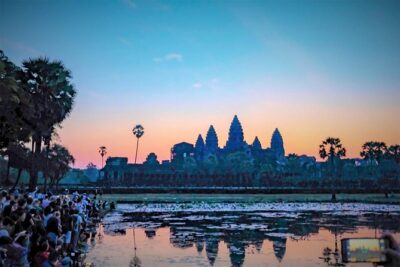
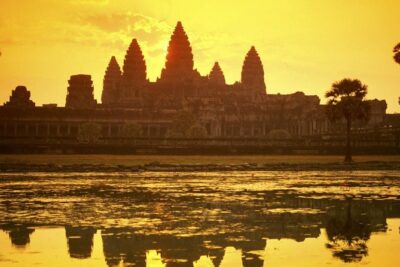
You’ll spend about 2 hours at Angkor Wat, and this is the part most people come for. Angkor Wat is the best-preserved temple at the site and the one that has stayed a significant religious center since it was founded—first Hindu, dedicated to Vishnu, and later Buddhist. It’s also described as the world’s largest religious building and a huge centerpiece of Khmer architecture.
What’s worth knowing before you go in:
- The design is intentional. Angkor Wat represents Mount Meru from Hindu mythology, with walls and galleries laid out in a sacred sequence.
- You’re not just looking at one building—you’re walking through a planned world: moat, outer walls, and raised galleries leading toward the center.
A strong guide helps you see the temple like a story, not just a photo backdrop. In the reviews tied to this tour, the guide is praised for being highly trained and able to explain Cambodia and Angkor in detail. That matters because the carvings can be overwhelming if you’re left on your own to figure out what you’re looking at.
The consideration: Angkor Wat is crowded and exposed in parts, and the tour gives you a limited window. If you want long, slow wandering or you’re chasing specific sunrise angles, you may find 2 hours feels tight. For most people, though, it’s a solid amount of time when paired with the rest of the day.
Angkor Thom South Gate: demons, gods, and the naga myth
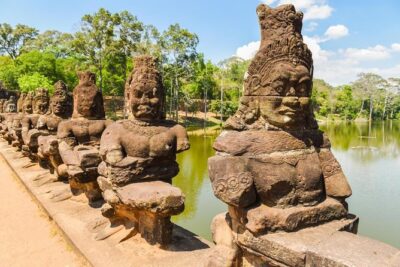
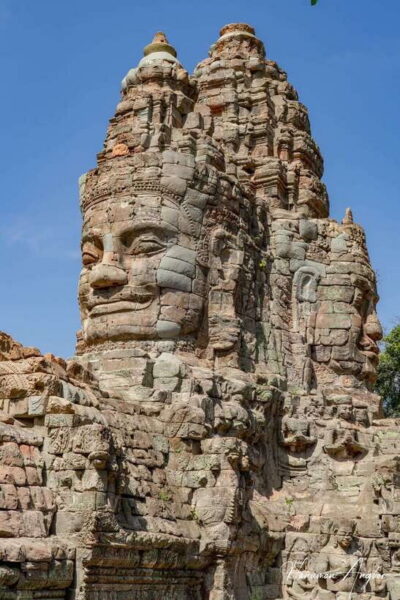
Next you head to Angkor Thom, the fortified city. You enter through the South Gate, crossing a causeway lined with statues of demons and gods. Each side is described as carrying a giant naga, a snake deity.
That entrance matters because it sets the theme for what you’re about to see. You’re not walking into a random ruin—you’re entering a city shaped by religious symbolism.
You’ll have about 30 minutes at this stop. That’s enough to:
- get oriented,
- walk the causeway for the main photo views,
- and listen while your guide points out the details in the carvings and statue groupings.
Practical tip: wear shoes you can grip. The causeway and temple steps can be uneven, and after you’ve been in sun for a while, every slip feels like a bigger deal.
More temple circuits, set side by side

Bayon Temple: the maze feeling in a shorter time slot
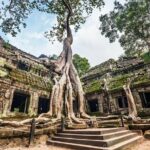
Then comes Bayon Temple, at the center of Angkor Thom’s capital. Bayon is described as richly decorated and built for the Mahayana Buddhist king Jayavarman VII in the late 12th or early 13th century. One detail I appreciate from the description: Bayon doesn’t have an enclosing wall like some other sites. It’s protected by the wall surrounding Angkor Thom instead.
Bayon’s layout is also presented in levels. The basics are:
- three levels of galleries,
- square galleries with bas-reliefs on level 1 and 2,
- and a central sanctuary on level 3.
The key word for your expectations is complexity. Even though the plan can sound simple, the arrangement includes a maze-like feel. With only about 45 minutes, you won’t have time to study every relief like a scholar. You will, however, get the main structure and the sense of how dense the site is.
What I’d do in your shoes: prioritize the big vantage points and let your guide direct you to the key reliefs. Then you can still enjoy the rest without spending the entire time guessing what’s important.
Lunch break on your own: plan for heat and easy timing
After the Bayon stop, you’ll drive toward the countryside. The tour then builds in a lunch break where you handle food on your own account.
Because this is the mid-day shift—after temple time—you’ll want to think about two things:
- Find something shaded and quick enough that you’re ready for the boat segment after lunch.
- Bring drinking water if you tend to run thirsty. You’re getting cold bottled water on the bus, but lunch is not included.
If you’re traveling with anyone who gets tired in heat, this is the moment to slow down. A good lunch break can make the afternoon more enjoyable.
The boat to Tonlé Sap and Kompong Phluk: real life on stilts
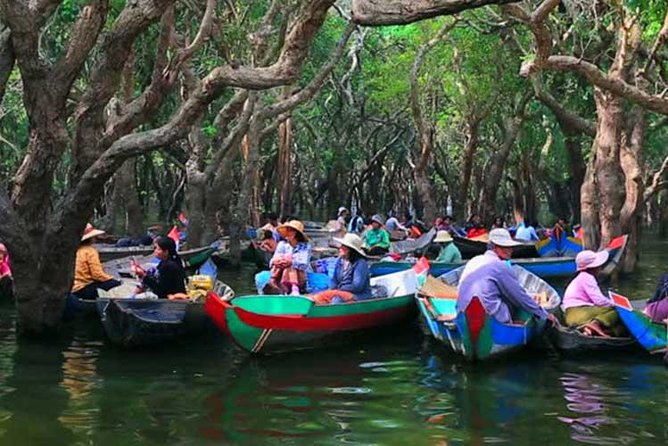
After lunch, you’ll drive about 45 minutes to the quay. From there, you board a local boat for about 1.5 hours. Along the way, the tour passes Kompong Phluk, described as a floating village and village on stilts—its name is explained as meaning harbor of the tusks.
This is where the tour earns its keep. Angkor is stone and myth; Tonlé Sap is living water geography. In the descriptions, you’ll observe daily life in a remote and extraordinary environment—colorful houses, schools, temples, churches, and local government offices. The point isn’t just to see buildings. It’s to understand how communities adapt when water levels define the year.
One more seasonal detail is included: you may see the surrounding flooded forest—described as green in the rainy season. That gives you a clear image of how the landscape changes, not just the village.
Then the ride continues past the village until you reach the wider area you’ll explore during the overall lake segment. The tour description puts this lake portion at about 3 hours total, which includes travel time and boat time.
A practical consideration: the tour does not include a canoe ride in the Mangrove forest (listed as only in rainy season). If you’re specifically hoping for that extra nature element, you may want to ask ahead of time whether it’s offered as an add-on during your dates.
Comfort and small-group logistics that make a hot day manageable
Even with temples and a boat, the day is built around comfort where it counts:
- Air-conditioned transfers between stops
- Cold bottled water on the bus
- A small maximum group size of 10 travelers
That matters more than it sounds. Angkor days involve walking, waiting, and sun. When the vehicle is cool and the water is handled, you can focus on the sites instead of survival.
Also, the tour is marketed as private-style with pickup and drop-off, but it still includes shared elements: a shared air-conditioned bus/mini van and a shared boat trip. So the experience may feel less like a one-on-one chauffeur and more like a compact group with professional guidance.
The tour also notes moderate physical fitness is recommended. That’s fair. You’ll be walking temple areas and moving between sites, plus you’ll spend time out in the open. You don’t need athlete legs, but you should be comfortable with uneven stone and some standing.
What you wear (and why it’s not optional at temples)
Temple rules are part of the day’s reality. The tour specifies that only trousers or knee-length skirt/dress are permitted. That’s not a style suggestion—it’s a constraint that can affect what you can buy last minute.
So pack with this in mind:
- wear breathable, modest clothing,
- plan for heat,
- and bring something that covers properly for both Angkor Wat and Angkor Thom areas.
If you’re used to touring in tank tops and shorts, you’ll need a quick gear shift for Cambodia temple visits.
How the guide experience shapes the whole day
From the reviews attached to this tour, the standout praise is about the guide. People explicitly thank Mr Phai Phearom for being professional, very well trained, and willing to help—one review notes he handled a traveler’s needs carefully during the tour.
That type of guiding shows up in two ways:
- History that sticks. The tour is built for explanation, and the better guides answer the question you keep having in your head: why does this matter?
- Practical care in heat. Water, timing, and pacing aren’t just logistics. They change how enjoyable the day feels.
If you do care about understanding what you’re seeing—not just collecting stamps—this tour is a strong fit. And because the group stays small, you’re less likely to get lost in the shuffle.
Price and value: what the $79 really turns into
The price shown is $79 per person, and the tour includes:
- an experienced English-speaking guide
- hotel pickup and drop-off
- shared air-conditioned bus/mini van
- the shared boat trip on Tonlé Sap
- cold bottled water
That’s a lot bundled together for one day, especially the transport and the boat component. In Siem Reap, you usually end up paying for these pieces separately if you DIY.
But to judge value, you have to add the required entrance fee. The Angkor Pass is listed as $37 per person and is not included. Lunch is also not included.
So your real budgeting looks like:
- base tour price
- plus Angkor Pass
- plus your lunch (and any optional extras like the rainy-season mangrove canoe ride)
For short-stay visitors, the value is that you don’t have to coordinate multiple transport arrangements. For longer stays, you may compare this to slower temple days, but for a one-day combo, it’s pretty efficient.
Who this day tour suits best
This tour is a good match if:
- you want both Angkor’s major temples and a lake-world experience in one day,
- you like explanations that make the carvings and architecture feel meaningful,
- you’re traveling with limited time in Siem Reap,
- and you appreciate practical comfort—air-con and water on a hot day.
It may feel less ideal if:
- you want lots of time for slow, deep temple wandering at Angkor Wat,
- you’re chasing optional nature activities like a rainy-season canoe ride (because that part isn’t included),
- or you dislike having entrance fees added on arrival.
Should you book this private-style Angkor + Tonlé Sap tour?
I’d book it if you want a full, well-rounded day: Angkor Wat and Bayon in the morning, then a genuine look at lake life at Tonlé Sap and Kompong Phluk after lunch. The combination is the point, and the included guide plus transport make it easier than cobbling together pieces on your own.
I’d think twice if you’re extremely budget-focused and don’t want to add the Angkor Pass fee, or if you want more time inside Angkor’s temples than the tour’s time blocks allow.
If you want a day that balances myth, stone, and everyday life—with a guide who can explain it and keep the day comfortable—this one is a solid choice.
FAQ
Is pickup included, and when does the day start?
Yes. Pickup is offered from your Siem Reap hotel in an air-conditioned vehicle, and the pickup window is listed as 7:30–8:30am.
Do I need to buy an Angkor Pass for this tour?
Yes. You’ll go to the Angkor Wat Ticket Office to pay for and receive your required Angkor Pass (listed as $37 per person). Entrance fees are not included.
What parts of Angkor does the tour cover?
You’ll visit Angkor Wat, Angkor Thom South Gate, and Bayon Temple.
How long is the boat ride on Tonlé Sap?
The boat trip is described as about 1.5 hours, with the overall Tonlé Sap lake time totaling about 3 hours.
Is lunch included?
No. Lunch break is on your own account.
What’s included for comfort during the day?
The tour includes cold bottled water on the bus and air-conditioned transfers.
What should I wear for temple visits?
You should wear trousers or a knee-length skirt/dress. This is required, not just recommended.
Can I cancel for a full refund?
Yes. Free cancellation is available if you cancel up to 24 hours in advance of the experience start time for a full refund.
Out on Tonle Sap
- From Siem Reap: Kampong Phluk Floating Village Tour by Boat
★ 4.9 · 6,979 reviews - Sunset tour of Kampong Phluk stilts home village on the Tonle Sap
★ 5.0 · 4,865 reviews - Kompong Phluk Floating Village Half-Day Tour ( Morning / Sunset )
★ 5.0 · 1,494 reviews - Siem Reap: Kulen Mountain, Beng Mealea and Tonle Sap Tour
★ 5.0 · 1,483 reviews - Tonle Sap Lake & Kampong Phluk Village Half-Day Tour
★ 5.0 · 1,045 reviews
More Temple Circuits Around Siem Reap
- Angkor Wat Sunrise or Sunset Tour with Guide from Siem Reap
★ 5.0 · 12,109 reviews - Siem Reap: Angkor Wat: Small-Group Sunrise or Sunset Tour
★ 5.0 · 9,444 reviews - Siem Reap: Angkor Wat 2-Day Tour with Sunrise and Sunset
★ 4.9 · 4,429 reviews - Siem Reap: Full-Day Angkor Wat Guided Tour with Sunset
★ 4.9 · 3,803 reviews - Angkor Wat Sunrise tour with Small – Group and Guide tours
★ 5.0 · 3,655 reviews
Angkor Wat, a Few More Ways In
- Angkor Wat Sunrise or Sunset Tour with Guide from Siem Reap
★ 5.0 · 12,109 reviews - Siem Reap: Angkor Wat: Small-Group Sunrise or Sunset Tour
★ 5.0 · 9,444 reviews - Siem Reap: Angkor Wat 2-Day Tour with Sunrise and Sunset
★ 4.9 · 4,429 reviews - Siem Reap: Full-Day Angkor Wat Guided Tour with Sunset
★ 4.9 · 3,803 reviews - Angkor Wat Sunrise tour with Small – Group and Guide tours
★ 5.0 · 3,655 reviews
Just Added: Fresh Siem Reap Tour Reviews

Angkor Wat Temple Tours, compared.
 ★ 5.0Angkor Wat Sunrise or Sunset Tour with Guide from Siem ReapFrom $1812,109 reviews
 ★ 5.0Angkor Wat: Small-Group Sunrise or Sunset TourFrom $159,444 reviews
 ★ 4.9Angkor Wat 2-Day Tour with Sunrise and SunsetFrom $344,429 reviews
 ★ 4.9Full-Day Angkor Wat Guided Tour with SunsetFrom $153,803 reviews
 ★ 5.0Angkor Wat Sunrise tour with Small – Group and Guide toursFrom $143,655 reviews
 ★ 5.0Angkor Wat Highlights and Sunrise Guided Tour from Siem ReapFrom $233,213 reviews
 ★ 5.0Angkor Wat Sunset Small Group Tour with Lunch IncludedFrom $203,059 reviews
 ★ 5.0Full-Day Angkor Wat Sunrise Private Tour with Guide from Siem ReapFrom $602,920 reviews
Browse the lists this tour appears in