
Stilts, stone, and sun in one day. This private 9-hour tour pairs Angkor Wat with Tonlé Sap Lake, then adds a boat ride around Kompong Phluk.
I love the straightforward flow: you get picked up, you visit the big sights with a driver guide, and you’re back in time to sleep well. You’ll also like the air-conditioned vehicle and the small touches like cool towels during the day.
One key consideration: temple entry works on a pay-first basis for the Angkor Pass, and the Kompong Phluk floating-village angle can feel more seasonal than the name suggests.
In This Review
- Key things I’d zero in on
- What You’re Really Getting: Angkor Wat meets Tonlé Sap life
- Price and the pass-and-tax reality check
- Morning start in Siem Reap: pickup timing and the Angkor Pass stop
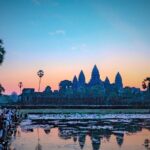
- Angkor Wat: the 2-hour plan that actually helps
- Angkor Thom South Gate and Bayon: when the details do the work
- Lunch on your own: how to handle the timing without stress
- Kompong Phluk on Tonlé Sap: the boat ride and the water-level question
- What to bring and how to pace yourself
- Who this tour suits best
- Should you book this Angkor Wat & Tonlé Sap private tour?
- FAQ
- FAQ
- How long is the Angkor Wat and Tonlé Sap private day tour?
- Does the tour include hotel pickup and drop-off?
- Do I need to buy an Angkor Pass for Angkor Wat?
- What is included with the boat portion at Tonlé Sap?
- Where do you visit on Tonlé Sap?
- Is lunch included?
- What extra costs should I expect besides the $40 price?
Key things I’d zero in on
- Hotel pickup and drop-off in a private, air-conditioned vehicle so you’re not juggling tuk-tuks
- Angkor Wat Ticket Office + Angkor Pass handled as part of the morning plan
- Real time at Angkor Wat, Bayon, and the South Gate, not just a drive-by photo stop
- A 1.5-hour local boat ride at Kompong Phluk after a short countryside drive
- Cool towels and an English-speaking driver guide to keep things smooth in the heat
- Private format means your group sets the pace
Other ways to walk the great temple
- Angkor Wat Sunrise or Sunset Tour with Guide from Siem Reap★ 5.0 · 12,109 reviews
- Siem Reap: Angkor Wat: Small-Group Sunrise or Sunset Tour★ 5.0 · 9,444 reviews
- Siem Reap: Angkor Wat 2-Day Tour with Sunrise and Sunset★ 4.9 · 4,429 reviews
- Siem Reap: Full-Day Angkor Wat Guided Tour with Sunset★ 4.9 · 3,803 reviews
What You’re Really Getting: Angkor Wat meets Tonlé Sap life
This is a day that mixes two very different kinds of Cambodia. You start with Angkor Archaeological Park, where stone temples tell older stories through carvings and layout. Then you shift to Tonlé Sap, where the lake and its floodplains shape everyday life.
What makes the combo feel smart is the contrast. Angkor Wat and the surrounding temples are about kings, religion, and power. Tonlé Sap is about survival, fishing, and adapting when water levels change. If you want more than temples on repeat, this is a good way to add context to what you’re seeing.
You’re also guided through the sights in a way that’s easy to follow. You’ll move from Angkor Wat to Angkor Thom’s South Gate and Bayon, then head out to Kompong Phluk for the boat portion. No rushing between random viewpoints. No guesswork about where you’re supposed to be next.
Price and the pass-and-tax reality check
The tour price is listed at $40 per person, private with hotel pickup and a guided day that includes the boat portion. That’s the headline number, but you should plan for extras so you don’t get surprised.
Here’s what you’ll need to budget for beyond the base price:
- Angkor Pass / temple admissions: your morning includes a stop at the Angkor Wat Ticket Office where you pay and get your pass, and temple admission is marked as not included.
- Government tax and community development: $20 per person (not included).
- Tips: tips are appreciated, but not included.
- Travel insurance is not included.
So, in practical terms, you’re closer to $60 per person plus meals and tips once you add the government fee and temple costs. Still, that can be good value if you care about a private day with an organized schedule, AC transport, and a guided boat ride rather than cobbling together tickets, a driver, and a separate boat booking yourself.
If you’re traveling as a group, keep an eye out for any group discount offered at booking. The format is private, so it’s not always “group sightseeing,” but pricing may still vary depending on how many seats you take.
Also worth knowing: cancellation is listed as free up to 24 hours for a full refund. That gives you room to book with confidence if your Angkor schedule is still flexible.
Morning start in Siem Reap: pickup timing and the Angkor Pass stop
Your day begins early. You should be ready for pickup around 7:30–8:30am in Siem Reap, using an air-conditioned vehicle from your hotel. That pickup window matters because Angkor is most comfortable before the heat and crowd energy ramp up.
Next, you head to the Angkor Wat Ticket Office. The key point is that you’ll pay and receive your Angkor Pass as part of the process. This is good for you because the morning can get chaotic when people try to handle tickets on the fly.
Then you start temple time with your guide and driver guide. The tour structure is simple: you get your pass, then you go temple by temple. You don’t spend your day trying to decode signage, confirm opening rules, or figure out where to line up.
Angkor Wat: the 2-hour plan that actually helps
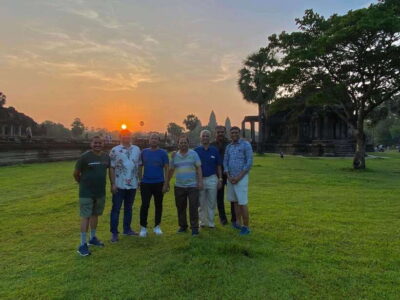
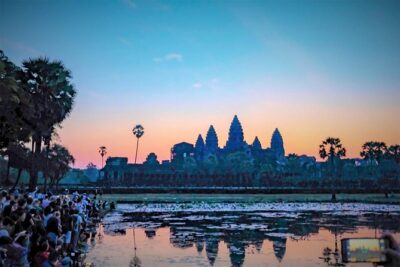
Angkor Wat gets the full attention it deserves here. You’ll have about 2 hours at the temple, and the admission ticket isn’t included (so that’s tied to your Angkor Pass).
Even if you’ve seen photos, being inside the complex changes things fast. You notice alignment, symmetry, and how the paths guide your eyes. And you start understanding why Angkor Wat is treated as the best-preserved and most iconic site in the Angkor zone.
The practical advantage of the 2-hour block is pacing. With that time, you can do more than snap the main angles and leave. You can also pause when you see carvings that match scenes described in the stories carved into the stone. Your guide’s job here is to point out what’s worth slowing down for, so you don’t feel like you’re just walking around a postcard.
One drawback to keep in mind: temple entry is not included in the tour price, so your morning budget gets heavier at the Ticket Office. But the trade-off is that you arrive with a pass and a plan already set.
More temple circuits, set side by side



Angkor Thom South Gate and Bayon: when the details do the work
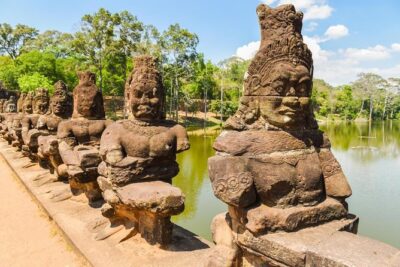
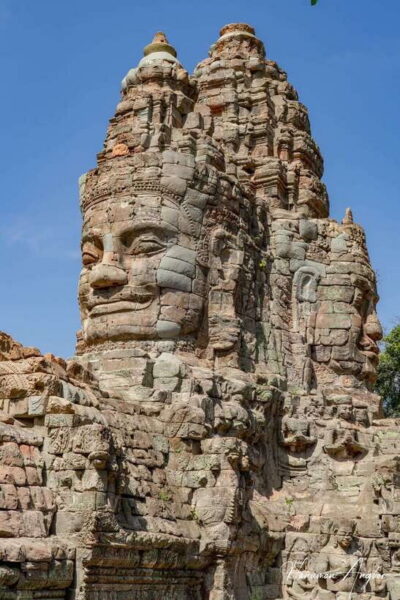
After Angkor Wat, the tour shifts to Angkor Thom, which is the bigger fortified city area. You enter through the South Gate and then continue to Bayon Temple.
South Gate is a shorter stop, around 20 minutes. That’s enough for the main experience—seeing the scale of the entrance and getting those classic views framed as you walk in and out. It’s not the kind of stop where you’ll want to wander for an hour, so the timing fits the location.
Then comes Bayon, where you’ll have about 1 hour. Bayon is known for its dense decoration and the way it centers the temple experience around the face-heavy, Khmer-inspired style associated with Jayavarman VII’s era. The value of a guided hour is that Bayon can feel visually busy. A guide can help you notice themes instead of only counting statues.
If you like your sightseeing with a balance of big and small, this temple pairing is a nice middle ground. South Gate gives you dramatic context. Bayon gives you texture.
Lunch on your own: how to handle the timing without stress
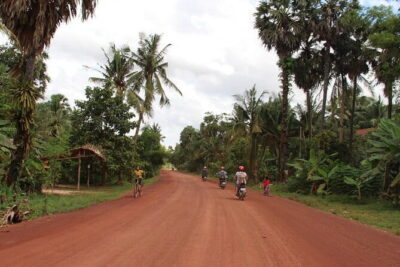
Lunch is not included. You get a lunch break on your own account, and after that you drive roughly 45 minutes toward the countryside to reach the quay for the boat ride.
This is one of those places where you can win or lose the day depending on your choices. You don’t want to waste time hunting for a meal far from where you’re supposed to be next. The best move is to eat something simple and quick, then keep your eyes on your return time.
If you have picky eating needs, you’ll be happier if you pick a place that’s easy to get back to. Your tour schedule depends on leaving on time so you can board the boat and use the full time window at Tonlé Sap.
Kompong Phluk on Tonlé Sap: the boat ride and the water-level question
After lunch and the countryside drive, you arrive at the quay and board a local boat for a 1.5-hour ride on Tonlé Sap. This portion is one of the reasons the tour feels different from a pure temple day.
You’ll explore floating villages and flooded forests as part of the private boat tour, guided by your driver. That guided aspect matters here because you’re moving through an active living lake environment. A guide helps you read what you’re seeing instead of just enjoying scenery.
Now for the honest part: Kompong Phluk is often sold as a floating village experience, but what you see can vary. One of the clearest pieces of feedback from past guests is that the marketing can set expectations for a continuous floating village, when the reality may be more mixed—more stilt homes and scattered floating structures, depending on conditions.
So here’s how to think about it so you don’t feel disappointed:
- Treat the experience as lake life in transition rather than a single, uninterrupted floating town.
- Expect that the most dramatic visual moments may come from areas built on stilts and the way the water frames homes and pathways.
- Go in curious. If you like observing how people adapt to water levels, you’ll likely enjoy it even if it’s not exactly what you pictured from the phrase floating village.
On the upside, the same feedback that flags the floating expectations also praises the stilt village visuals and the overall interest of the temple portion of the day. In other words, the boat scene can still be worth your time—it’s just not always the movie version of floating.
What to bring and how to pace yourself
This is a long 9-hour day, and you’ll be outside for parts of it. The tour includes an air-conditioned vehicle, but temple time and the boat ride still mean sun exposure.
Bring the basics:
- A hat and sunscreen (you’ll appreciate it by late morning)
- Water for between stops (your day is long, and you’ll be moving)
- Light layers for early morning comfort if you’re sensitive to AC
Also, plan your photo strategy. Angkor Wat and Bayon can be crowded at peak moments, and you’ll want to move with your guide rather than trying to leapfrog everyone for perfect shots. On the boat portion, focus on calm observation as much as photos. The best views often come when you slow down and let the boat follow the route.
Finally, keep your energy for the shift between temples and lake time. Temples are all about walking and standing. The lake portion is about patience and watching water patterns. If you treat both as separate activities, the day feels less exhausting.
Who this tour suits best
This tour fits you if:
- You want a private day with hotel pickup and drop-off, so logistics don’t eat your vacation time.
- You care about seeing how life continues around Tonlé Sap, not only visiting monuments.
- You’d rather have an organized guide covering Angkor Wat, Angkor Thom South Gate, and Bayon within a single schedule.
It might be less ideal if:
- You’re expecting a pure, continuous floating village scene with lots of houses truly on the water the whole time. Kompong Phluk can be more mixed than the label suggests.
- You hate paying extra at the start. Temple costs and the listed $20 government tax add up, so you’ll want to feel comfortable with the total.
Should you book this Angkor Wat & Tonlé Sap private tour?
If you want temples plus lake life in one organized day, I think this is a solid booking. The biggest strengths are the practical setup—pickup in AC, an English-speaking driver guide, and a guided 1.5-hour boat ride—and the way Bayon and Angkor Thom add variety beyond Angkor Wat alone. Add cool towels and the schedule, and it’s easier than trying to stitch everything together.
My main reason to pause is expectation management. Kompong Phluk is billed as floating village, but the “floating” part may be less dramatic than you imagine. If you’re going to see it as lake life shaped by water levels, you’ll likely be happy. If you’re going strictly for a postcard version of a fully floating town, you might feel shortchanged.
If you do book, I’d go in with a simple plan: enjoy Angkor Wat and Bayon as your anchor, treat the boat ride as a living environment experience, and keep lunch easy so you don’t rush the transition to Tonlé Sap.
FAQ
FAQ
How long is the Angkor Wat and Tonlé Sap private day tour?
It’s about 9 hours.
Does the tour include hotel pickup and drop-off?
Yes. You get private transfer pickup from your hotel in town and drop-off returning you to your hotel.
Do I need to buy an Angkor Pass for Angkor Wat?
Yes. You’ll stop at the Angkor Wat Ticket Office to pay and get your Angkor Pass, and Angkor temple admissions are marked as not included.
What is included with the boat portion at Tonlé Sap?
The tour includes a private boat tour with an expert English-speaking driver guide, plus cool towels during the touring. The boat ride itself is about 1.5 hours.
Where do you visit on Tonlé Sap?
You visit Kompong Phluk, including the boat ride around the flooded areas and local floating/stilt village life.
Is lunch included?
No. Lunch is on your own account during the break before you head to Kompong Phluk.
What extra costs should I expect besides the $40 price?
Temple admissions depend on your Angkor Pass, and there is also a $20 per person government tax and community development listed as not included. Tips are also appreciated but not included.
Out on Tonle Sap
- From Siem Reap: Kampong Phluk Floating Village Tour by Boat
★ 4.9 · 6,979 reviews - Sunset tour of Kampong Phluk stilts home village on the Tonle Sap
★ 5.0 · 4,865 reviews - Kompong Phluk Floating Village Half-Day Tour ( Morning / Sunset )
★ 5.0 · 1,494 reviews - Siem Reap: Kulen Mountain, Beng Mealea and Tonle Sap Tour
★ 5.0 · 1,483 reviews - Tonle Sap Lake & Kampong Phluk Village Half-Day Tour
★ 5.0 · 1,045 reviews
More Temple Circuits Around Siem Reap
- Angkor Wat Sunrise or Sunset Tour with Guide from Siem Reap
★ 5.0 · 12,109 reviews - Siem Reap: Angkor Wat: Small-Group Sunrise or Sunset Tour
★ 5.0 · 9,444 reviews - Siem Reap: Angkor Wat 2-Day Tour with Sunrise and Sunset
★ 4.9 · 4,429 reviews - Siem Reap: Full-Day Angkor Wat Guided Tour with Sunset
★ 4.9 · 3,803 reviews - Angkor Wat Sunrise tour with Small – Group and Guide tours
★ 5.0 · 3,655 reviews
Angkor Wat, a Few More Ways In
- Angkor Wat Sunrise or Sunset Tour with Guide from Siem Reap
★ 5.0 · 12,109 reviews - Siem Reap: Angkor Wat: Small-Group Sunrise or Sunset Tour
★ 5.0 · 9,444 reviews - Siem Reap: Angkor Wat 2-Day Tour with Sunrise and Sunset
★ 4.9 · 4,429 reviews - Siem Reap: Full-Day Angkor Wat Guided Tour with Sunset
★ 4.9 · 3,803 reviews - Angkor Wat Sunrise tour with Small – Group and Guide tours
★ 5.0 · 3,655 reviews
Just Added: Fresh Siem Reap Tour Reviews

Angkor Wat Temple Tours, compared.
 ★ 5.0Angkor Wat Sunrise or Sunset Tour with Guide from Siem ReapFrom $1812,109 reviews
 ★ 5.0Angkor Wat: Small-Group Sunrise or Sunset TourFrom $159,444 reviews
 ★ 4.9Angkor Wat 2-Day Tour with Sunrise and SunsetFrom $344,429 reviews
 ★ 4.9Full-Day Angkor Wat Guided Tour with SunsetFrom $153,803 reviews
 ★ 5.0Angkor Wat Sunrise tour with Small – Group and Guide toursFrom $143,655 reviews
 ★ 5.0Angkor Wat Highlights and Sunrise Guided Tour from Siem ReapFrom $233,213 reviews
 ★ 5.0Angkor Wat Sunset Small Group Tour with Lunch IncludedFrom $203,059 reviews
 ★ 5.0Full-Day Angkor Wat Sunrise Private Tour with Guide from Siem ReapFrom $602,920 reviews
Browse the lists this tour appears in