
Reviewed · ANGKOR TEMPLE TOURS
Exclusive Angkor temples and Small group temples tours
Angkor is easier to enjoy when you’re not stuck in a big crowd. This small-group van day keeps things moving at a human pace, with an English-speaking guide who helps you understand what you’re seeing instead of just pointing at stones.
I also like how the timing is built around key temple moments—especially the switch from the busy Angkor complex to a calmer Phnom Bakheng sunset vibe back near Siem Reap. You finish with an easy transfer back to your hotel, so the day doesn’t dissolve into chaos.
One heads-up: the tour price is low, but temple entry is extra ($37 per person) and meals aren’t included. You’ll be outside for hours, so plan for heat and bring sunscreen.
In This Review
- Key highlights you’ll actually feel
- Small-group Angkor: how it changes the day
- Pickup, timing, and why 6 to 10 hours matters
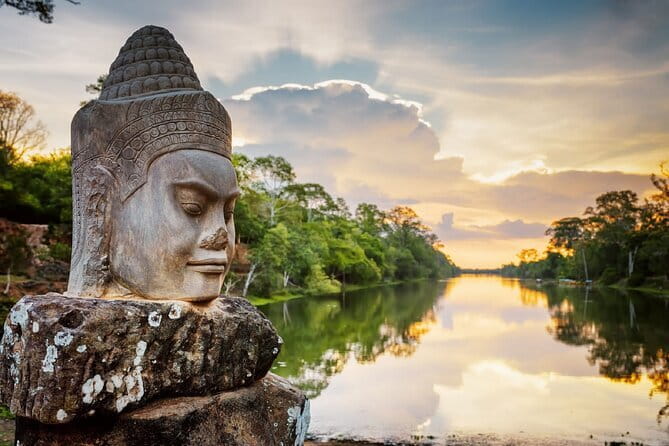
- Angkor Thom South Gate: the capital’s first impression
- Bayon Temple: reading those faces without guessing
- Terrace of the Elephants and the Leper King: symbolism you can spot
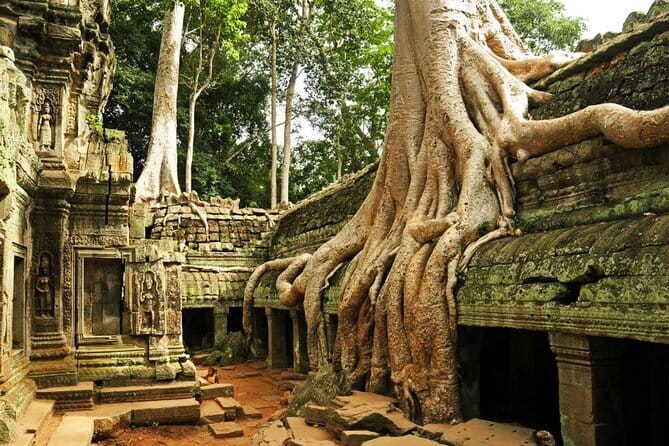
- Ta Prohm: when the jungle becomes part of the temple
- Angkor Wat: scale, patience, and the long look
- Phnom Bakheng sunset: a mountain temple after the crowds
- Price and value: why $19 can still mean real costs
- Who this tour suits best (and who might want something else)
- Should you book this small-group Angkor tour?
- FAQ
- How long is the tour?
- What temples are visited?
- Is pickup from my hotel included?
- Is the temple entrance fee included?
- Are meals included?
- Does the tour include a guide?
- Do I get mineral water during the tour?
- How big is the group?
- Is there a mobile ticket?
- What’s the cancellation policy?
Key highlights you’ll actually feel
- Small-group transport (max 25): You avoid the big-bus squeeze and get more flexible stops.
- Local guide focus: You learn what the Khmer rulers were trying to do with each site, not just facts.
- Angkor Thom + Bayon faces: The iconic “Great City” layout becomes way clearer once you get the story.
- Ta Prohm’s tree takeover: You see why this monastery feels both sacred and surreal.
- Phnom Bakheng sunset: Hindu and Buddhist mountain-temple atmosphere at day’s end.
- Hotel pickup and drop-off: It’s built for convenience, not logistics puzzles.
More temple circuits, set side by side
- Angkor Wat Sunrise or Sunset Tour with Guide from Siem Reap★ 5.0 · 12,109 reviews
- Siem Reap: Angkor Wat: Small-Group Sunrise or Sunset Tour★ 5.0 · 9,444 reviews
- Siem Reap: Angkor Wat 2-Day Tour with Sunrise and Sunset★ 4.9 · 4,429 reviews
- Siem Reap: Full-Day Angkor Wat Guided Tour with Sunset★ 4.9 · 3,803 reviews
Small-group Angkor: how it changes the day
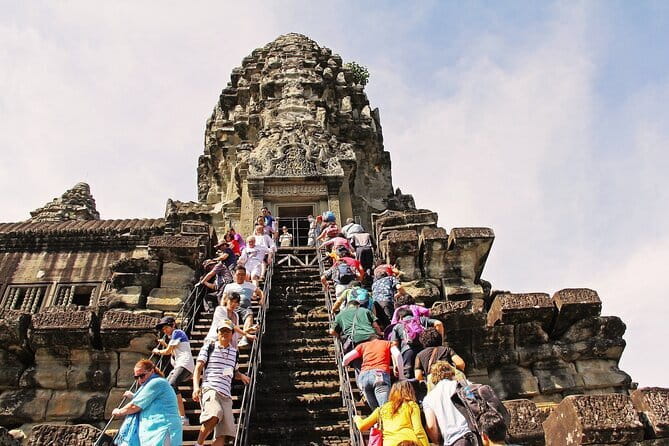
Angkor can feel like a theme park if you rush it or get herded in a line. On this tour, the group stays small enough that your time doesn’t disappear between photos and traffic jams. You’re in an air-conditioned van or bus, so you get real breaks from the heat while you travel between temple zones.
The guide’s value is practical. You don’t just hear dates and names—you get context for the Khmer empire and what each temple was meant to signal. That changes the way you look. Instead of standing in front of a wall of carvings like, okay… nice wall, you start noticing why certain areas were designed for specific rituals, rulers, or beliefs.
And yes, you’ll still take plenty of photos. The team makes it easier by pointing out good viewing spots, which matters at Angkor where the “right” angle can be the difference between a messy shot and a clean one.
Pickup, timing, and why 6 to 10 hours matters
This is a full-day format, about 6 to 10 hours, starting with pickup from your hotel and ending with a direct drop-off back to your hotel. That structure is a big deal in Siem Reap because it controls two things that wreck temple visits: lost time and wasted energy.
You’ll move through multiple major sites in one day: Angkor Thom, Bayon, Ta Prohm, and Angkor Wat, plus the sunset stop at Phnom Bakheng. That means you should treat the day like a marathon, not a stroll. Bring water (you get mineral water during the tour), wear light clothing, and assume you’ll be standing in direct sun at at least a few stops.
Because it’s a small group capped at 25 people, you can often get through busy areas with less waiting. Still, Angkor’s crowds are real. Your best strategy is to arrive open-minded, do your first viewing calmly, and save your “serious photo time” for the moments your guide gives you space and better angles.
Angkor Thom South Gate: the capital’s first impression
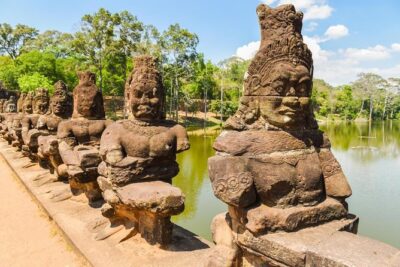
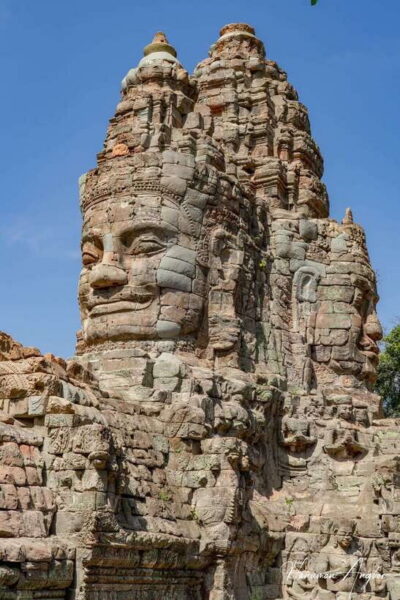
The day begins at the South Gate of Angkor Thom, the entrance to the ancient “great city” that served as the Khmer capital. Even before you reach the main temple structures, this gate sets the tone. You’re not just walking into an archaeological site—you’re stepping into the planned geography of a royal center.
This area matters because it’s a reminder that Angkor isn’t random. The temples weren’t built as one-off monuments. They were part of a bigger worldview: power, religion, and city design all tied together. The gate gives you that first “okay, I get what kind of place this is” feeling.
Expect a short stop, about 30 minutes, focused on getting you oriented. It’s a good pace starter—enough time to see the scale and then move on without letting the heat steal your energy.
Bayon Temple: reading those faces without guessing
Next comes Bayon Temple, one of the most famous and richly decorated Khmer temples at Angkor. This is the stop where you’ll see the iconic stone faces for real, not just in photos. The temple dates to the late 12th or early 13th century (a time when Khmer builders were going all-in on symbolic, expressive design).
What I like about Bayon is how it rewards attention. Even when you’re walking through in a hurry, you start noticing patterns: how decoration guides your path, where open spaces give you different perspectives, and how the temple’s composition pulls your eye.
Your guide’s job here is to help you avoid the common trap of treating the faces like a pop-culture feature. With the right background on the Khmer empire and the temple’s significance, you understand why Bayon feels so intense. It’s not just pretty stonework—it’s designed to communicate authority and spiritual meaning.
You’ll have about 1 hour here, which is enough for a first pass plus time to linger near viewpoints.

Terrace of the Elephants and the Leper King: symbolism you can spot
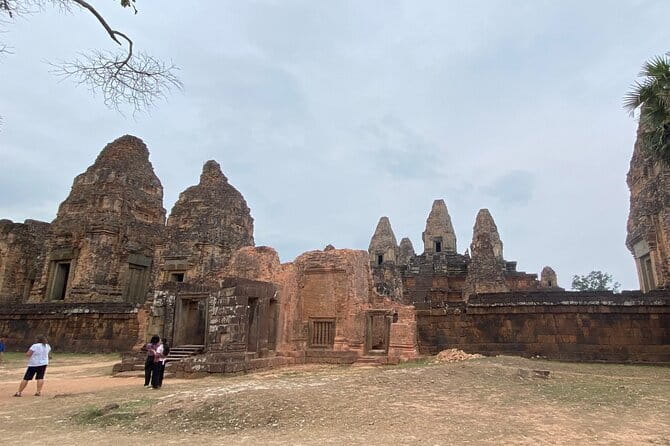
Then you hit the Terrace of the Elephants and Terrace of the Leper King. These stops are shorter—around 30 minutes each—but they can be some of the most memorable moments because they’re so characterful.
The Terrace of the Elephants is famous for a reason: the carvings and the “processional” layout tell you this was meant for movement and ceremony. You’ll get the sense that the stonework was built to accompany important events, not just to look impressive at rest.
The Terrace of the Leper King is another story. The statue is called the Leper King because discoloration and moss made it resemble a person with leprosy. The carvings became a kind of visual nickname over time, and your guide can help you read it in a Khmer context rather than as a spooky Halloween legend.
One extra detail you might hear while learning in this area: references to other Angkor temples that are harder to reach, like Beng Mealea, described as mysterious and about 68 km northeast of Siem Reap. Even if you don’t go there, the comparison helps you feel how different temples can be—some polished and iconic, some more swallowed by nature.
Ta Prohm: when the jungle becomes part of the temple
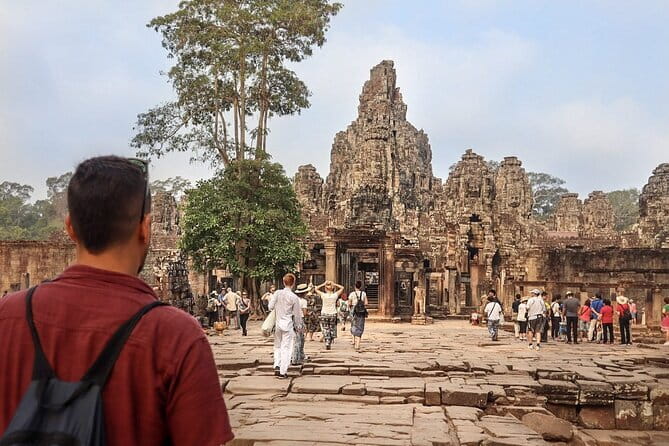
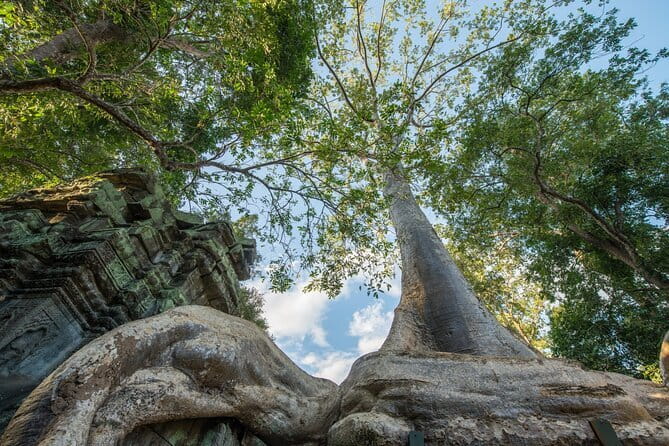
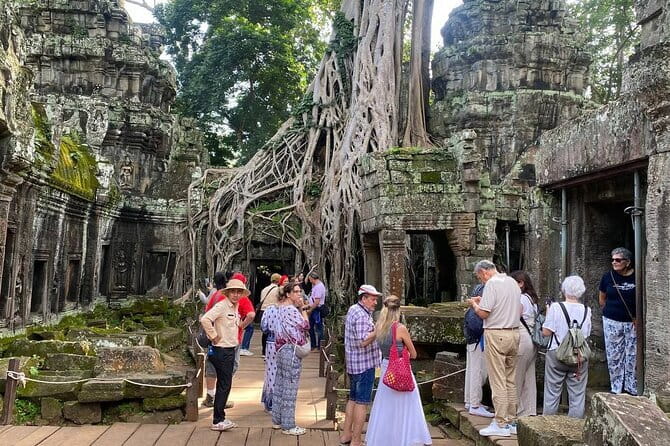
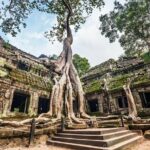
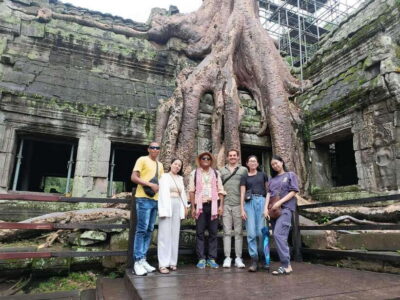
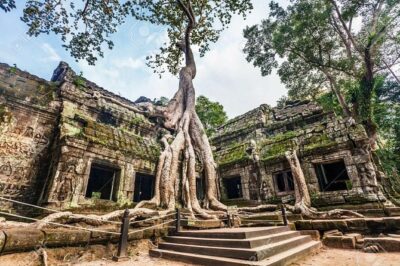
Ta Prohm Temple is a favorite for many people for one simple reason: it looks like it’s in dialogue with the forest. The temple was founded by King Jayavarman VII as a Mahayana Buddhist monastery and university. Unlike most Angkorian sites, Ta Prohm’s relationship with roots and branches turns the ruins into something that feels alive.
In practical terms, Ta Prohm is where you’ll feel the emotional shift of the day. Earlier temples can feel like grand architecture you’re studying. Ta Prohm feels more like theatre—columns framed by trees, sky chopped into rectangles, and the constant sense that nature isn’t just nearby. It’s inside the story.
You’ll spend about 1 hour here. Don’t try to sprint. Instead, take it in layers:
- First, get the big scene.
- Then, move to smaller details in the carvings and doorways.
- Finally, pause where the tree framing lines up with the most famous views.
That’s also where the guide’s photo-spot help really pays off. A slightly different angle can turn a cluttered shot into a composition that looks intentional.
Angkor Wat: scale, patience, and the long look
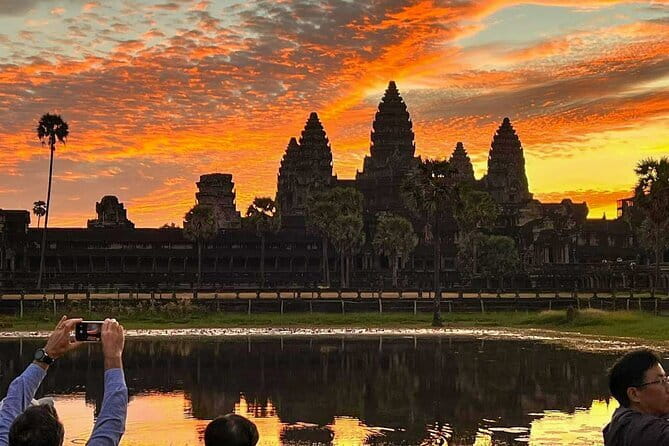
Then comes the grand finish (though it’s not really the end of the day)—Angkor Wat. It’s described as the largest religious monument in the world, on a site measuring 162.6 hectares. When you stand near the walls and realize the scale, you understand why people plan their whole day around it.
You’ll have about 3 hours at Angkor Wat, which is a solid window. Use it wisely. The first portion should be for orientation: where you are, how the temple’s layout pulls you forward, and what views open up as you move.
The second portion is for focus. Pick 2 or 3 areas you want to revisit. Angkor rewards repetition because light changes and your brain starts mapping the geometry. The carvings and symbolism feel less overwhelming when you’re not trying to capture everything at once.
If you’re the type who wants a “main viewpoint” moment, this is your stop. But even if you don’t chase the most famous angles, the sheer size keeps you from feeling like you’re rushing a checklist.
Phnom Bakheng sunset: a mountain temple after the crowds
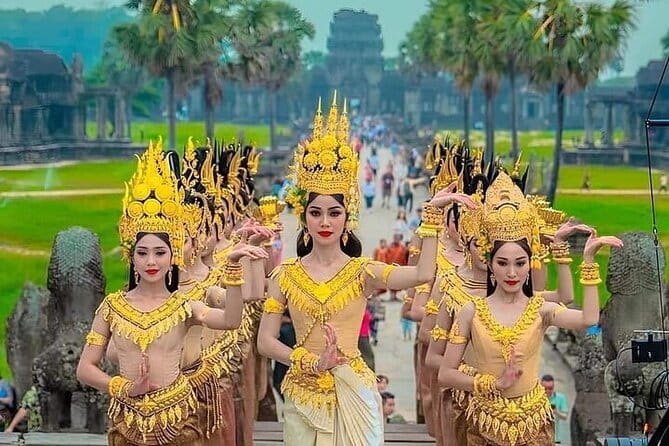
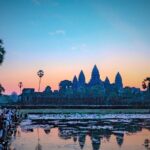
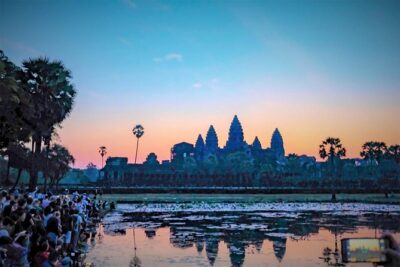
After temple time, the tour shifts to Phnom Bakheng for sunset. This is where the day gets emotional in a different way. Phnom Bakheng is described as a Hindu and Buddhist mountain temple, and that mix is part of what makes it feel layered.
Sunset at a temple changes the whole mood. Shadows stretch across the ruins, and the atmosphere becomes softer than midday. It’s also a natural way to break the day: you’ve spent hours in big stone complexes, and now you’re looking upward and outward from a viewpoint designed for ritual and gathering.
One practical tip: sunset plans always involve timing. Wear comfortable shoes, keep water handy, and treat the last stretch of the day like a calm finish rather than a sprint.
Once the sun drops, you’ll ride back to Siem Reap and get transferred directly to your hotel, which makes the day feel complete instead of cut off.
Price and value: why $19 can still mean real costs
Let’s talk money clearly, because this tour’s pricing is a little “trap for your brain” if you don’t separate base price from extras.
The tour price listed is $19, and that includes:
- an English-speaking guide
- an air-conditioned vehicle (van or bus)
- mineral water during the tour
- hotel pickup and drop-off
But temple entry is not included. The temples entrance fee is $37 per person, and meals aren’t included either. So your day’s real cost is closer to “$19 plus entry fees,” and then whatever you choose for lunch or dinner.
Is it still good value? For many people, yes—because you’re covering major sites in one day with transport and a guide, instead of renting a vehicle and figuring out everything yourself. Also, the small-group cap (up to 25) often makes the experience feel less chaotic than mass tours.
Where this price may not feel as good is if you already know you’ll want to pay for extra food, snacks, or if you’re the type who prefers a slower pace with fewer stops. In that case, you might feel like you’re spending time moving rather than lingering.
Who this tour suits best (and who might want something else)
This works well for you if:
- you want the classic Angkor lineup (Angkor Thom, Bayon, Ta Prohm, Angkor Wat) in one day
- you like learning context, not just wandering
- you prefer air-conditioned transport and less crowding
- you want pickup and drop-off so Siem Reap logistics don’t steal your energy
It may not be ideal if:
- you’re trying to keep every expense ultra-low (because entry fees add up and meals aren’t included)
- you don’t handle long outdoor days well
- you want totally unhurried temple time at each site (some stops are shorter by design)
The best match is a “see the big things, understand the meaning, then rest” style of traveler.
Should you book this small-group Angkor tour?
If you want a structured, guide-led day that hits the major Angkor highlights without making you wrestle with transportation, I think this is a strong choice. The biggest win for me is the combination of small-group pacing and the guide’s help with meaning—plus the practical convenience of pickup and drop-off.
Before you book, budget for temple entry ($37 per person) and plan for meals. Also, take the day seriously as a time-and-heat commitment. If you prepare for that, you’ll end with a classic Angkor sweep and a Phnom Bakheng sunset that feels like a real finish, not a frantic scramble.
FAQ
How long is the tour?
The tour runs about 6 to 10 hours.
What temples are visited?
You’ll visit Angkor Thom South Gate, Angkor Thom, Bayon, Ta Prohm, and Angkor Wat, and you’ll also go to Phnom Bakheng for sunset.
Is pickup from my hotel included?
Yes. The tour includes pickup and drop-off from your hotel.
Is the temple entrance fee included?
No. Temple entrance fees are not included and are listed at $37 per person.
Are meals included?
No. Meals (lunch/dinner) aren’t included.
Does the tour include a guide?
Yes. The tour includes an English-speaking guide.
Do I get mineral water during the tour?
Yes. Mineral water is included during the tour.
How big is the group?
The tour has a maximum of 25 travelers.
Is there a mobile ticket?
Yes. The tour includes a mobile ticket.
What’s the cancellation policy?
There is free cancellation. You can cancel up to 24 hours in advance for a full refund. If you cancel less than 24 hours before the start time, the amount paid isn’t refunded.
More Siem Reap Tours to Compare
- Angkor Wat Sunrise or Sunset Tour with Guide from Siem Reap
★ 5.0 · 12,109 reviews - Siem Reap: Angkor Wat: Small-Group Sunrise or Sunset Tour
★ 5.0 · 9,444 reviews - From Siem Reap: Kampong Phluk Floating Village Tour by Boat
★ 4.9 · 6,979 reviews - Sunset tour of Kampong Phluk stilts home village on the Tonle Sap
★ 5.0 · 4,865 reviews - Siem Reap: Angkor Wat 2-Day Tour with Sunrise and Sunset
★ 4.9 · 4,429 reviews
More Tour Reviews in Siem Reap
- Angkor Wat Sunrise or Sunset Tour with Guide from Siem Reap
★ 5.0 · 12,109 reviews - Siem Reap: Angkor Wat: Small-Group Sunrise or Sunset Tour
★ 5.0 · 9,444 reviews - From Siem Reap: Kampong Phluk Floating Village Tour by Boat
★ 4.9 · 6,979 reviews - Sunset tour of Kampong Phluk stilts home village on the Tonle Sap
★ 5.0 · 4,865 reviews - Siem Reap: Angkor Wat 2-Day Tour with Sunrise and Sunset
★ 4.9 · 4,429 reviews
More Temple Circuits Around Siem Reap
- Angkor Wat Sunrise or Sunset Tour with Guide from Siem Reap
★ 5.0 · 12,109 reviews - Siem Reap: Angkor Wat: Small-Group Sunrise or Sunset Tour
★ 5.0 · 9,444 reviews - Siem Reap: Angkor Wat 2-Day Tour with Sunrise and Sunset
★ 4.9 · 4,429 reviews - Siem Reap: Full-Day Angkor Wat Guided Tour with Sunset
★ 4.9 · 3,803 reviews - Angkor Wat Sunrise tour with Small – Group and Guide tours
★ 5.0 · 3,655 reviews
Just Added: Fresh Siem Reap Tour Reviews

Angkor Temple Tours, compared.
 ★ 5.0Angkor Wat Sunrise or Sunset Tour with Guide from Siem ReapFrom $1812,109 reviews
 ★ 5.0Angkor Wat: Small-Group Sunrise or Sunset TourFrom $159,444 reviews
 ★ 4.9Angkor Wat 2-Day Tour with Sunrise and SunsetFrom $344,429 reviews
 ★ 4.9Full-Day Angkor Wat Guided Tour with SunsetFrom $153,803 reviews
 ★ 5.0Angkor Wat Sunrise tour with Small – Group and Guide toursFrom $143,655 reviews
 ★ 5.0Angkor Wat Highlights and Sunrise Guided Tour from Siem ReapFrom $233,213 reviews
 ★ 5.0Angkor Wat Sunset Small Group Tour with Lunch IncludedFrom $203,059 reviews
 ★ 5.0Full-Day Angkor Wat Sunrise Private Tour with Guide from Siem ReapFrom $602,920 reviews