
Reviewed · ANGKOR TEMPLE TOURS
Two Days Angkor Complex, Beng Mealea plus Kampong Phluk Village
Angkor looks better when you slow down. This two-day route gives you the big-name temples and the quieter ones, with hotel pickup and a guide who helps you see what’s going on instead of just ticking off stops. You also get to add Beng Mealea and Kompong Phluk, so the trip feels more like a full Angkor region experience and less like a single-temple photo mission.
I especially love the two-day pace, because it takes the edge off the crowds you normally feel at the most famous sites. I also love how the guide experience can sharpen the visit—people in feedback mention guides like Thom San and Sokkun for clear English and for keeping your focus on Khmer meaning, not just architecture.
One drawback to plan for: temple entrance fees and the boat fee at Kampong Phluk are not included, and you’ll likely want to budget a bit extra for tipping your guide and driver.
In This Review
- Key highlights worth your attention
- Why this 2-day Angkor plan feels easier on your feet
- Price and logistics: what you’re paying for (and what you’ll still pay)
- Day 1 at Angkor: Angkor Wat, South Gate, Bayon, and Ta Prohm
- Angkor Wat: the big starting point
- Angkor Thom South Gate: five gates, one dramatic entrance
- Bayon Temple: faces that make the place feel personal
- Ta Prohm: jungle temple energy
- Day 2: Banteay Srei, Beng Mealea, and Kompong Phluk
- Banteay Srei: the pink sandstone carving stop
- Beng Mealea: the remote ruins that feel untamed
- Kompong Phluk: village life on stilts over Tonle Sap
- The guide makes the temples click: Thom San and Sokkun as examples
- What you need to know before you go: tickets, clothes, and comfort
- Who this tour suits best
- Social impact: how your tour helps locally
- Should you book this 2-day Angkor Complex, Beng Mealea, and Kompong Phluk tour?
- FAQ
- FAQ
- Are temple entrance fees included in this tour price?
- Is the boat fee included for Kampong Phluk?
- What’s included in the tour?
- What additional costs should I expect?
- Do I need to dress a certain way for temples?
- Does the tour involve hotel pickup and drop-off?
- How long is the tour?
- Is this tour private?
- What’s the cancellation window?
Key highlights worth your attention
- A relaxed 2-day Angkor rhythm that covers both large-circuit and smaller-circuit temples without cramming
- A guide who steers your attention toward Khmer history and spiritual symbolism, not just where to stand
- More off-the-beaten-path temple time, including Beng Mealea with its overgrown, remote vibe
- Kompong Phluk on Tonle Sap Lake, a real village life stop on stilts above the water
- Practical comfort built in, like air-conditioning, cold towels, and water during travel
- Local community support, since some tour profits go toward helping the area
Deeper into the jungle temple
- Siem Reap: Kulen Mountain, Beng Mealea and Tonle Sap Tour★ 5.0 · 1,483 reviews
- Kulen Mountain with Beng Mealea and Tonle Sap Small Group Tour★ 5.0 · 780 reviews
- Koh Ker Temple Group & Beng Mealea Full-Day Join-in Tour★ 5.0 · 710 reviews
- From Siem Reap: Koh Ker and Beng Mealea Temples Tour★ 4.9 · 293 reviews
Why this 2-day Angkor plan feels easier on your feet
Angkor can be intense. Even if you love temples, it’s hard to stay focused when you’re sprinting between sites, fighting heat, and standing in long lines. This tour’s main advantage is that you spread the experience across two days, which naturally makes the days feel calmer and more readable.
On your first day, you still hit the headline temples like Angkor Wat and Bayon. But because you’re not trying to do everything in one exhausting push, you get more time to look closely at carvings, statues, and the layout of each complex. On your second day, you shift toward temples that tend to feel less packed and more like discovery.
That “slow enough to notice” approach is exactly what makes this format work for first-timers. It helps you connect the dots: which places were built for Hindu worship, which were later used in Buddhist contexts, and how rulers shaped the temples to reflect their power and beliefs.
If you want a trip that doesn’t drain you, this pacing is a smart match.
Price and logistics: what you’re paying for (and what you’ll still pay)
At $153.79 per person for about two days, the value is mostly in what’s organized for you. You get an English-speaking guide, an air-conditioned vehicle, drinking water and cold towels, plus hotel pickup and drop-off. For many people, that’s the difference between a smooth day and a stressful one—Angkor is big, and travel time adds up fast.
Temple access is separate. Temple entrance fees are available at the temple and are not included, so you should expect to pay for entry on site. You’ll also want to budget for the boat fee during the Kampong Phluk portion, since that part is not included.
Tipping is also not included. It’s recommended for the guide and driver, which is common in Cambodia and usually makes sense if you want great care during long temple days.
So is it “cheap”? Not really. But if you compare it to the cost of piecing together a guide, transport, and comfort for two days, this pricing starts to look reasonable—and you’re buying time with a guide who can explain what you’re seeing.
Day 1 at Angkor: Angkor Wat, South Gate, Bayon, and Ta Prohm
Day 1 is your classic Angkor orientation day. It’s the kind of route that helps your brain map the whole area: starting with a big landmark, then moving into Angkor Thom, then ending with the famous jungle temple feel of Ta Prohm.
Angkor Wat: the big starting point
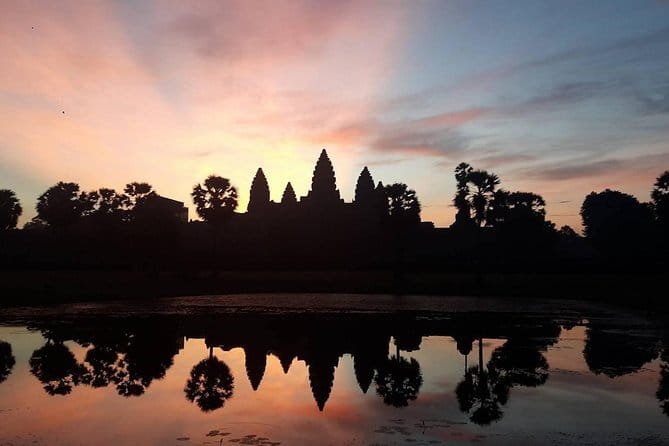
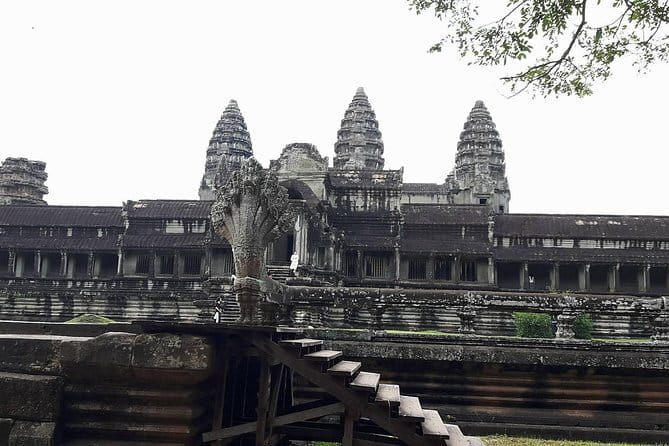
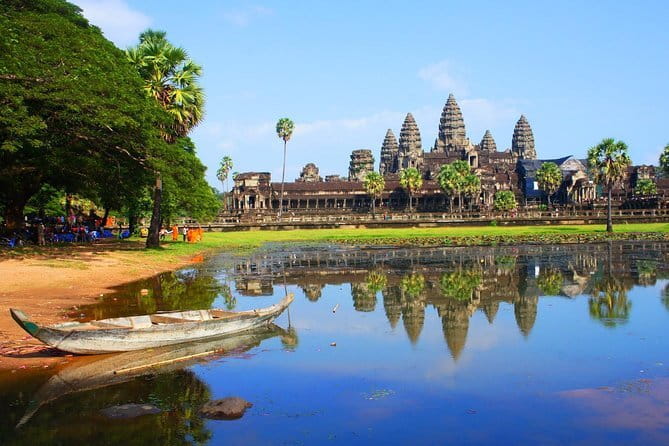
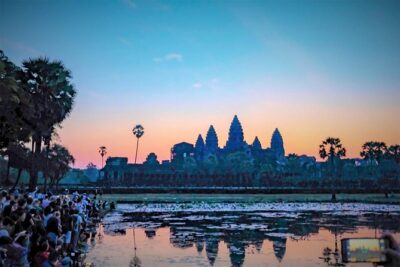
Angkor Wat is the first stop you’ll likely photograph, but it’s also the first place where your guide can make you look differently. This temple complex has five towers reaching about 65 meters, and it was built in the early 12th century by King Suryavarman II. The original name given to it was Parama Visnuloka, tied to Vishnu.
One practical tip: Angkor Wat tends to be the site people rush through. With a two-day pace, you have a better chance of taking your time. Keep an eye out for how the design frames the space and how the towers signal rank and sacred order.
More temple circuits, set side by side
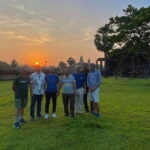
Angkor Thom South Gate: five gates, one dramatic entrance
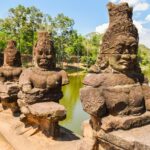
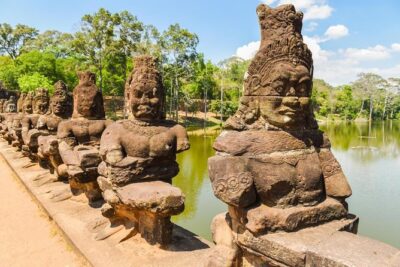
After Angkor Wat, you enter Angkor Thom through the South Gate. This gate is also called Tonle Oum, and it’s one of five gates used to access the city: south gate, ghost gate, victory gate, dei chhnang gate, and north gate (sometimes referenced as the northern gate area). Angkor Thom is described as about 3 kilometers per side, so it helps to think of these gates as entry points into a large urban temple zone.
Bayon Temple: faces that make the place feel personal
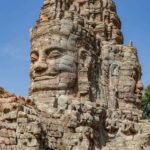
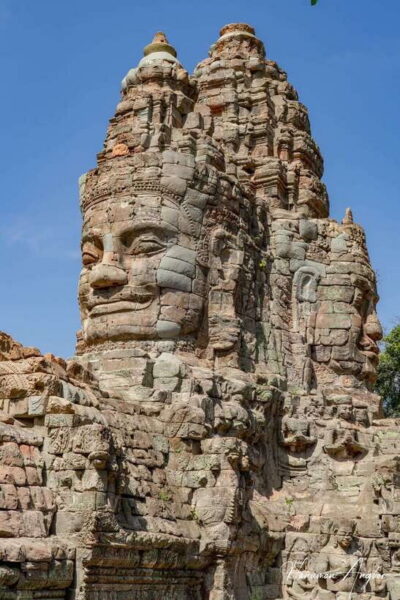
Bayon is a Buddhist temple built in the late 12th century under King Jayavarman VII. The famous feature is the large number of stone faces—described as 212 faces across 53 towers. Even if you’ve seen pictures, I’d still plan to slow down here. The faces aren’t just decoration; they shape how you walk through the space and how you read the temple’s mood.
If you’re tired from the morning, this is where your guide’s storytelling matters most, because Bayon can feel confusing without context.
Ta Prohm: jungle temple energy
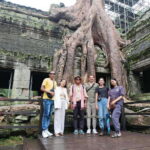
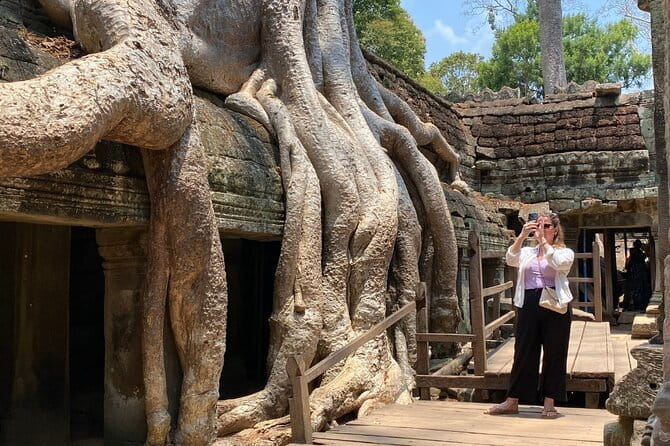
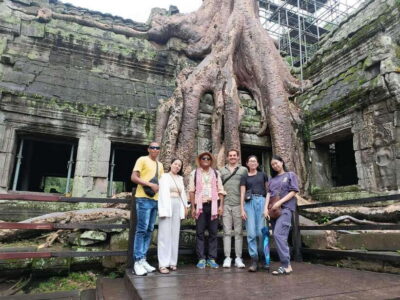
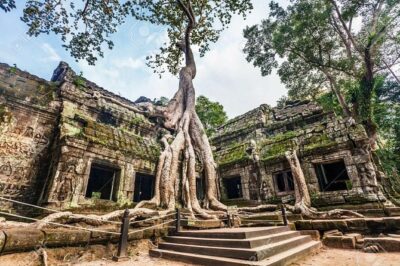
Ta Prohm is the jungle temple most people connect with the movie era, often called the Tomb Raider temple. It also has a deeper function in the story of Angkor: the temple is described as a place tied to an art-learning role, including teaching Apsara dance.
What I like about Ta Prohm is the contrast. It’s less orderly than the most carefully restored places, and that makes it feel more alive. Expect roots and overgrowth in the frame, plus lots of photo angles—but don’t let the crowds steal your attention from the carvings and gate details.
Day 2: Banteay Srei, Beng Mealea, and Kompong Phluk
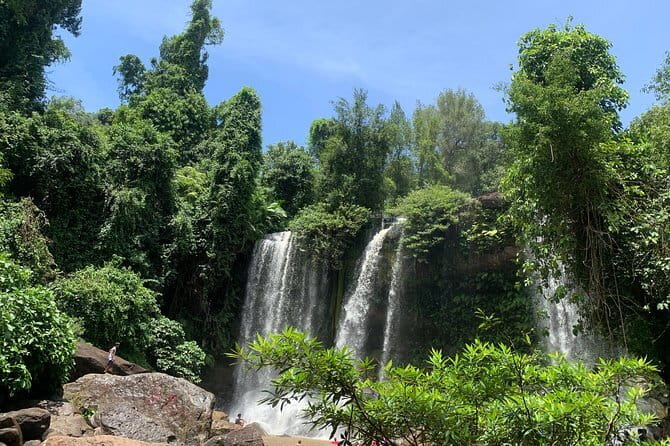
Day 2 is where the trip turns into more than just famous temples. You get Banteay Srei, then the remote feel of Beng Mealea, then you switch settings completely with Kompong Phluk on Tonle Sap Lake.
Banteay Srei: the pink sandstone carving stop
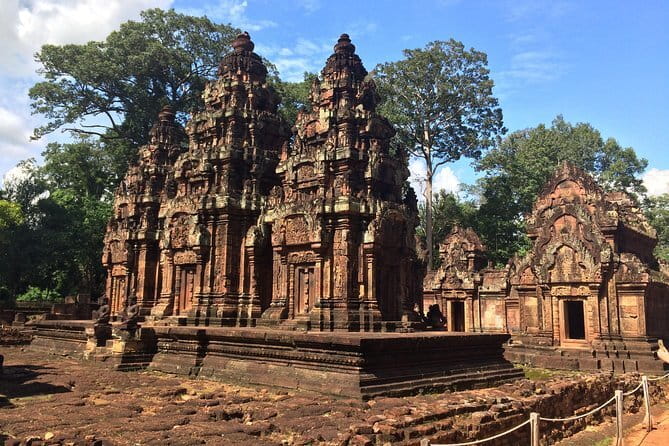
Banteay Srei is known for pink sandstone and for carving quality. It’s described as a 10th-century temple, and one of the big reasons people talk about it is that the craftsmanship can feel more precise and delicate than at some larger sites. In other words, this is a “look close” temple.
Because it’s about craftsmanship, your guide can really help you notice the patterns—what’s carved where, how details repeat, and how the temple’s size makes the carvings stand out more clearly.
It’s also a drive time consideration: you’ll be traveling roughly 50 minutes to 1 hour to get there, depending on conditions.
Beng Mealea: the remote ruins that feel untamed
Beng Mealea was built in the 12th century during Suryavarman II’s reign, dedicated to Vishnu, and it’s made of sandstone in a structure that includes a moat and three concentric enclosures. The central sanctuary is in ruins, while other parts are described as relatively well-preserved.
Here’s why this stop works so well: Beng Mealea is popular, but it’s not as crowded as the main Angkor cluster. The remote location and overgrown state make it different. Instead of feeling like a showpiece, it feels like a place you’re walking through in real time—broken stones, thick greenery, and that sense of being away from the main flow.
If you like temples that feel less polished, this is the one you’ll probably remember most vividly.
Kompong Phluk: village life on stilts over Tonle Sap
Then you move from stone ruins to living culture. Kompong Phluk is a floating village on Tonle Sap Lake, about 16 kilometers (10 miles) southeast of Siem Reap. The village is described as home to about 3,700 people, living in houses built on stilts above the water.
This part is known for traditional life tied to fishing and agriculture. What you should plan for is variety: you can explore around the village on foot or by boat, and you may see floating schools, local markets, flooded forests, and you might even have the option to go fishing.
Timing matters here. The best time to visit is described as wet season (June to October), when water levels rise and the village becomes more accessible. That doesn’t mean it’s impossible in other months—it’s simply that the “floating village” feel can be more dramatic when the water is higher.
The guide makes the temples click: Thom San and Sokkun as examples
Angkor guides can be very different. Some point out what to look at; others help you understand why those details exist. Feedback highlights that guides like Thom San and Sokkun get praised for strong English and for staying attentive—keeping your group focused on Khmer history and spiritual context rather than only quick visual cues.
That matters because Angkor is layered. You’re looking at places that shift between Hindu and Buddhist symbolism over centuries, and a good guide helps you connect temple features to those themes. It also helps when you’re tired, because the guide can steer the day so you keep seeing more instead of just traveling between sites.
If you value interpretation, this tour format is a strong fit. You’re not just paying for access—you’re paying for sense-making.
What you need to know before you go: tickets, clothes, and comfort
A few practical notes can save you stress.
First, temple entrance fees are not included. You’ll pay at the temples, so bring a simple cash plan. The same goes for any small add-ons you choose during the day.
Second, dress code is required: you need to cover your knees and shoulders when entering temples. Don’t assume you’ll be able to borrow anything last-minute. A light scarf or long layer can be your easiest fix.
Third, wear comfortable walking shoes. Angkor temple paths aren’t uniform, and Beng Mealea in particular can be uneven and overgrown. Plan for real walking, not gallery-stroll steps.
Fourth, don’t carry valuables you don’t need. That’s basic advice, but on a busy multi-stop day, it helps you move without worrying.
Finally, remember the included comforts: you’ll have an air-conditioned vehicle plus drinking water and cold towels. That’s not fancy, but it’s the kind of “small” support that keeps you functioning on long temple days.
Who this tour suits best
This is a good match if you:
- Want a first-time Angkor experience that feels paced and not frantic
- Like off-main-circuit stops such as Beng Mealea and the village setting at Kompong Phluk
- Prefer traveling with a guide who helps you interpret what you’re seeing
- Appreciate practical comfort like pickup, vehicle air-con, and cold towels
It may not be the best fit if you:
- Want only the most famous Angkor sites with maximum time at each one
- Hate paying extra on the spot (temple fees and the boat fee)
- Are expecting a single, fully inclusive ticket price
Social impact: how your tour helps locally
One of the positive points of this experience is that some profits go to supporting the local community. In feedback about guide involvement, there are mentions tied to school-related community work. Even if you don’t get a big sales pitch, it’s still worth noting: this isn’t only about sightseeing. Your money is intended to feed back into the area.
That makes a difference for many people, especially when Angkor tourism can be high-pressure and unevenly distributed.
Should you book this 2-day Angkor Complex, Beng Mealea, and Kompong Phluk tour?
I’d book it if your goal is balance: a calmer Angkor pace, memorable variety beyond the usual main-temple circuit, and a guide who helps you see the temples as more than just postcards. The two-day structure is the core reason it feels better than the one-day sprint, and Beng Mealea plus Kompong Phluk turn the trip into a more rounded Cambodia day.
Just go in with the right expectations: you’ll pay temple entrance fees separately, and you should budget for the boat portion at Kompong Phluk. If you’re okay with that, this tour offers solid value for what’s included—pickup, guide, vehicle comfort, and the kind of attention that turns Angkor from a checklist into an understanding.
FAQ
FAQ
Are temple entrance fees included in this tour price?
No. Temple entrance fees are available at the temples and are not included in the tour price. You should plan to pay on site.
Is the boat fee included for Kampong Phluk?
No. The boat fee is listed as not included. If you choose boat time at the floating village, you’ll pay that fee separately.
What’s included in the tour?
The tour includes a local English-speaking tour guide, an air-conditioned vehicle, drinking water and cold towels, and hotel pickup and drop-off.
What additional costs should I expect?
Temple entrance fees are not included, and the boat fee at Kampong Phluk is also not included. Tipping for the guide and driver is recommended as well.
Do I need to dress a certain way for temples?
Yes. You must cover your knees and shoulders when entering temples. Comfortable walking shoes are also recommended.
Does the tour involve hotel pickup and drop-off?
Yes. Hotel pickup and drop-off are included.
How long is the tour?
It’s listed as about 2 days (approx.).
Is this tour private?
Yes. It’s described as private, meaning only your group participates.
What’s the cancellation window?
You can cancel up to 24 hours in advance for a full refund.
Out on Tonle Sap
- From Siem Reap: Kampong Phluk Floating Village Tour by Boat
★ 4.9 · 6,979 reviews - Sunset tour of Kampong Phluk stilts home village on the Tonle Sap
★ 5.0 · 4,865 reviews - Kompong Phluk Floating Village Half-Day Tour ( Morning / Sunset )
★ 5.0 · 1,494 reviews - Siem Reap: Kulen Mountain, Beng Mealea and Tonle Sap Tour
★ 5.0 · 1,483 reviews - Tonle Sap Lake & Kampong Phluk Village Half-Day Tour
★ 5.0 · 1,045 reviews
More Temple Circuits Around Siem Reap
- Angkor Wat Sunrise or Sunset Tour with Guide from Siem Reap
★ 5.0 · 12,109 reviews - Siem Reap: Angkor Wat: Small-Group Sunrise or Sunset Tour
★ 5.0 · 9,444 reviews - Siem Reap: Angkor Wat 2-Day Tour with Sunrise and Sunset
★ 4.9 · 4,429 reviews - Siem Reap: Full-Day Angkor Wat Guided Tour with Sunset
★ 4.9 · 3,803 reviews - Angkor Wat Sunrise tour with Small – Group and Guide tours
★ 5.0 · 3,655 reviews
Into the Jungle at Beng Mealea
- Siem Reap: Kulen Mountain, Beng Mealea and Tonle Sap Tour
★ 5.0 · 1,483 reviews - Kulen Mountain with Beng Mealea and Tonle Sap Small Group Tour
★ 5.0 · 780 reviews - Koh Ker Temple Group & Beng Mealea Full-Day Join-in Tour
★ 5.0 · 710 reviews - From Siem Reap: Koh Ker and Beng Mealea Temples Tour
★ 4.9 · 293 reviews - Banteay Srei, Kulen Waterfall & Beng Mealea Exploration
★ 5.0 · 185 reviews
Just Added: Fresh Siem Reap Tour Reviews

Angkor Temple Tours, compared.
 ★ 5.0Angkor Wat Sunrise or Sunset Tour with Guide from Siem ReapFrom $1812,109 reviews
 ★ 5.0Angkor Wat: Small-Group Sunrise or Sunset TourFrom $159,444 reviews
 ★ 4.9Angkor Wat 2-Day Tour with Sunrise and SunsetFrom $344,429 reviews
 ★ 4.9Full-Day Angkor Wat Guided Tour with SunsetFrom $153,803 reviews
 ★ 5.0Angkor Wat Sunrise tour with Small – Group and Guide toursFrom $143,655 reviews
 ★ 5.0Angkor Wat Highlights and Sunrise Guided Tour from Siem ReapFrom $233,213 reviews
 ★ 5.0Angkor Wat Sunset Small Group Tour with Lunch IncludedFrom $203,059 reviews
 ★ 5.0Full-Day Angkor Wat Sunrise Private Tour with Guide from Siem ReapFrom $602,920 reviews
Browse the lists this tour appears in