
Reviewed · ANGKOR WAT TEMPLE TOURS
Ultimate Angkor Wat Sunrise, Bayon, Ta Prohm Temple
That 4:20 a.m. start pays off fast. This Ultimate Angkor Wat sunrise tour is built for early light, with air-conditioned pickup and a professional English guide moving you through Angkor National Park to Angkor Wat, Bayon, and Ta Prohm. One key consideration: you’ll need to budget for the Angkor Pass, since admission tickets aren’t included.
I like that the day has a clear rhythm: a long window for sunrise at Angkor Wat, then shorter temple visits that keep you walking but not trapped all day in lines. You’ll also stop for breakfast near Srah Srang, the Royal Bath area, though food costs are on you.
In This Review
- Key things to know before you go
- Entering Angkor National Park with a 7-hour, pickup-first plan
- The 4:20 a.m. sunrise window and how to use it
- Getting to the temples: air-conditioned transport and the calm factor
- Stop 1: Angkor Wat sunrise—largest religious monument energy, up close
- Watch-outs at Angkor Wat
- Stop 2: Srah Srang and breakfast near the Royal Bath
- Stop 3: Bayon Temple—54 towers and 200 smiling faces
- What to consider at Bayon
- Stop 4: Ta Prohm—the Tomb Raider temple with tree roots
- Ta Prohm practical advice
- Price and value: $13 per person plus the real cost of the Angkor Pass
- How the itinerary pacing feels across the day
- Who this tour suits best (and who should think twice)
- Quick checklist so the day feels smooth
- Should you book Ultimate Angkor Wat Sunrise, Bayon, and Ta Prohm?
Key things to know before you go
- 4:20 a.m. sunrise timing so you’re at Angkor Wat early enough to enjoy the light and the first waves of visitors
- English-speaking guidance focused on helping you read what you’re seeing at Angkor Wat, Bayon, and Ta Prohm
- Private transportation with air-conditioning so Siem Reap heat doesn’t crush your morning
- Bayon Temple’s 200 smiling faces tied to King Jayavarman VII, plus the temple’s 54 towers
- Ta Prohm’s jungle feel where massive tree roots grow into the ruins
- Angkor Pass not included at $37 per person, which is the biggest extra cost to plan for
Other ways to walk the great temple
- Angkor Wat Sunrise or Sunset Tour with Guide from Siem Reap★ 5.0 · 12,109 reviews
- Siem Reap: Angkor Wat: Small-Group Sunrise or Sunset Tour★ 5.0 · 9,444 reviews
- Siem Reap: Angkor Wat 2-Day Tour with Sunrise and Sunset★ 4.9 · 4,429 reviews
- Siem Reap: Full-Day Angkor Wat Guided Tour with Sunset★ 4.9 · 3,803 reviews
Entering Angkor National Park with a 7-hour, pickup-first plan
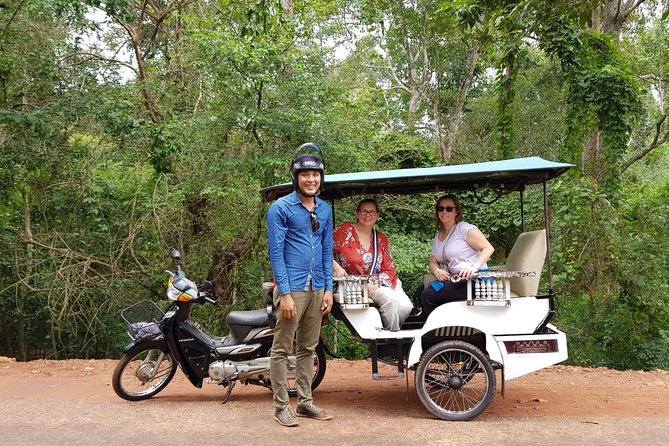
This tour is designed around one simple idea: make the hardest part easy—getting from Siem Reap into the temples with time to see them well. You’re picked up at the Krong Siem Reap meeting point, dropped back there at the end, and transported in an air-conditioned vehicle.
The “private tour” label matters. It means your group moves together, without being folded into other independent groups mid-day. That can help the timing feel more controlled, especially for the sunrise-focused part of the experience. It also pairs nicely with the “mobile ticket” detail, since you’re not trying to manage paper tickets on the fly.
The 4:20 a.m. sunrise window and how to use it
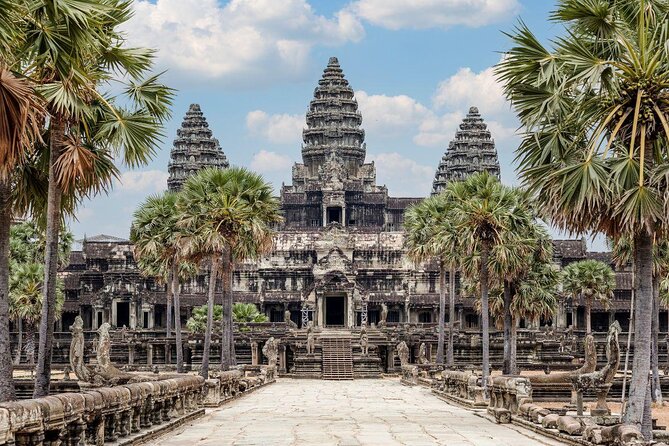
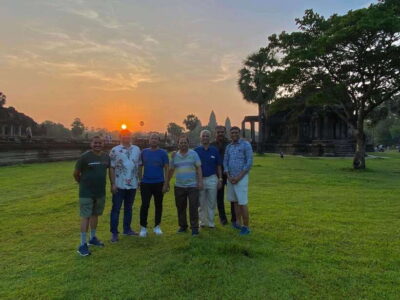
Angkor Wat sunrise is the headline for a reason. Starting at 4:20 a.m., you’re aiming for that first period when the sky is changing and shadows help reveal the temple’s shape. The tour gives you a 2-hour block for Angkor Wat, which is important. Sunrise viewing goes fast if you only have minutes, and you lose too much time if you’re forced to rush straight to the next stop.
You’ll also benefit from having a guide during this early window. Temple details—carvings, levels, and alignment—are easier to make sense of when someone explains what you’re looking at while you’re standing in the right spot.
One practical consideration: you’re up early. Even with air-conditioning in transit, the temples themselves are outdoor walking. If you’re not a morning person, plan to treat this as your “one big early commitment,” not a casual start.
Getting to the temples: air-conditioned transport and the calm factor

The included hotel pickup and drop-off is more than convenience. In Siem Reap, travel time can eat your energy. This tour handles the logistics so you can focus on the temples, not the clock.
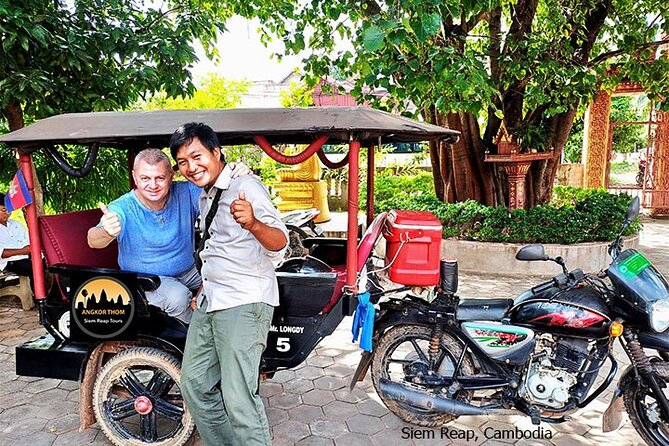
You’re on a professional English tour guide plus private transportation. In one real-world scenario, the guide was running a few minutes late, but the operator still met the group at pickup time and had things moving with the local tuk-tuk driver quickly (driver referred to as D). That’s the kind of practical support that matters most at the start—because missing your early momentum usually can’t be recovered later.
Stop 1: Angkor Wat sunrise—largest religious monument energy, up close
Angkor Wat is the anchor of this day. The tour focuses on it as the world’s largest religious monument, built in the early 12th century, and known for intricate carvings and grand architecture. Even if you’ve seen photos, the scale is hard to get from a screen.
This is where your 2-hour time block helps you. You’re not only chasing a peak moment; you have enough time to notice the structure, look at details, and take breaks without feeling like you’ll fall behind the schedule.
What you’ll likely appreciate most here is the way the guide frames the temple. With sunrise, the shadows and highlights shift quickly, so it’s easy to miss meaningful carved sections if you’re just scanning. A good guide helps you pick out what matters and where to stand to see it clearly.
Chasing the light? More dawn and dusk runs



Watch-outs at Angkor Wat
- You’re outdoors and moving early, so plan for fatigue.
- Admission isn’t included, so make sure your Angkor Pass plan is set before you show up.
Stop 2: Srah Srang and breakfast near the Royal Bath

After the big morning moment, you get a breather stop at Srah Srang, often called the Royal Bath. The tour schedules 1 hour here.
This stop is a smart reset. It’s not another “tiny photo corner.” It’s a place that helps you slow down and remember that Angkor isn’t only about one temple. Srah Srang gives you a different type of scene: water and a more relaxed pace compared with stone-heavy temple circuits.
The tour includes time for breakfast at a local restaurant near Srah Srang, but food and drinks are not included, so you’ll pay out of pocket. That’s typical for this kind of temple-day format, but it’s still worth planning budget-wise so you don’t get surprised mid-tour.
Stop 3: Bayon Temple—54 towers and 200 smiling faces
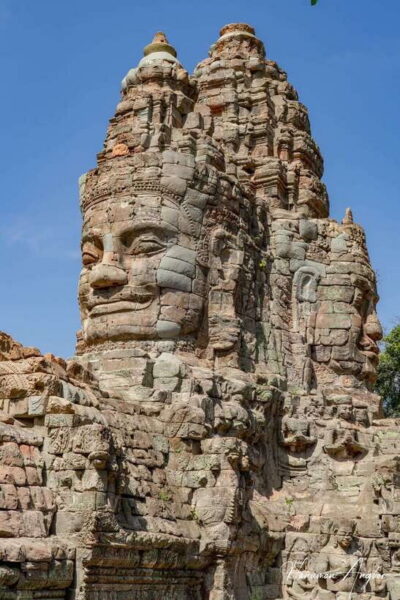
Next up is Bayon Temple, located in Angkor Thom’s area. The tour describes it clearly: 54 towers and more than 200 smiling stone faces representing King Jayavarman VII.
This is one of those temples where direction matters. If you wander randomly, you can end up seeing the same face from a dozen angles and still miss the temple’s overall layout. With a guide, you can focus on what makes Bayon feel different: the expression, the repetition, and how the towers shape your sense of the space.
It’s also a perfect middle stop between Angkor Wat and Ta Prohm. It’s intense, but you don’t have to spend the full day there. You get 1 hour at Bayon, which is usually the right length for a place known for visual impact rather than long interiors.
What to consider at Bayon
- Expect walking and climbing on uneven stone surfaces.
- Since admission tickets aren’t included, keep your Angkor Pass accessible and ready.
Stop 4: Ta Prohm—the Tomb Raider temple with tree roots
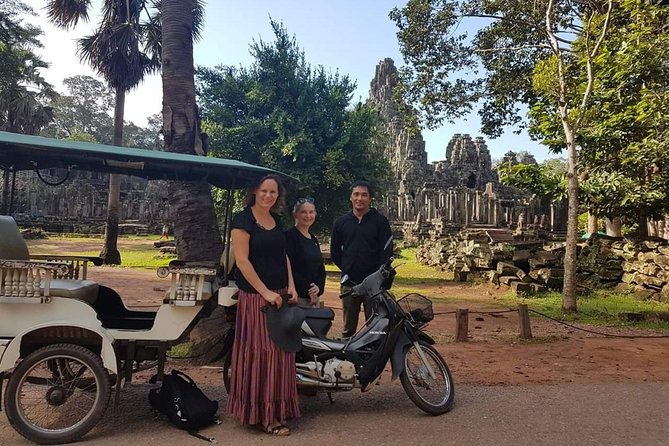
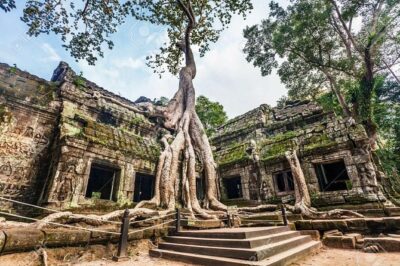
Then comes Ta Prohm, famous as the Tomb Raider temple thanks to the dramatic look of the ruins. In this tour, Ta Prohm is described as a jungle temple where massive tree roots overgrow the architecture, creating a unique blend of nature and stone.
That description is exactly why Ta Prohm is so different from Angkor Wat and Bayon. Angkor Wat is disciplined and geometric. Bayon is face-filled and symbolic. Ta Prohm is more chaotic—beautifully so—and you’ll feel that once you see the roots wrapping around structures.
You get 1 hour here, which works well. Ta Prohm photography can trick you into staying too long in one corner. With a time cap, you still get the highlights without losing the entire day.
Ta Prohm practical advice
- Wear shoes that handle stone and roots safely.
- Bring your patience for photos. This is a high-recognition site, so you’ll likely be sharing space while you wait for the angles you want.
Price and value: $13 per person plus the real cost of the Angkor Pass
Let’s talk money honestly, because this tour’s value depends on one line item: the Angkor Pass.
The tour price is listed as $13.00 per person, but admission fees aren’t included, and the Angkor Pass is $37.00 per person. Food and drinks are also not included. So your likely total is the tour fee plus the pass, with meals added on top.
Why does this matter? Because $13 alone sounds like a bargain, but the pass is what actually gets you into most of the temple experience. Once you account for the pass, you’re paying for:
- a professional English tour guide
- air-conditioned vehicle transport
- hotel pickup and drop-off
- private transportation for your group
In other words, the tour fee is less about “entry ticket value” and more about paying for time, translation, and smoother movement across the park. If you’re the type who wants the temples explained while you’re standing there, that’s where the value shows.
If you prefer to go totally DIY, you can compare costs against hiring a driver for the day. But if you want a guide to interpret Angkor Wat sunrise and connect Bayon to King Jayavarman VII, this format is a solid trade.
How the itinerary pacing feels across the day
A 7-hour temple day can go two ways: either it feels rushed, or it feels like you at least got time to breathe. This one is built to avoid the worst version by front-loading the day’s most time-sensitive moment.
- Angkor Wat gets the longest attention (2 hours) for sunrise viewing and slow-to-zoom-in looking.
- Srah Srang gives a calmer break (1 hour) and a chance to eat.
- Bayon stays efficient (1 hour) for its visual impact.
- Ta Prohm rounds it out (1 hour) so you still experience the dramatic look without burning out.
You’re also not stuck with a giant list of extra stops. That’s good value if you’d rather spend your attention on the three top targets.
Who this tour suits best (and who should think twice)
This is a great fit if you:
- want an Angkor Wat sunrise plan that’s organized and timed from Siem Reap
- value a professional English guide to explain what you’re seeing
- prefer air-conditioned transport and simpler logistics over full DIY driving
- are traveling with a group that likes a shared plan but not crowded mixing
You might think twice if you:
- hate very early mornings
- want long, slow exploration of each site without time caps
- aren’t willing to budget for the Angkor Pass and meals
Also, because you’re walking and climbing on ancient stone, the “most travelers can participate” line works best for visitors who are comfortable with a fair amount of outdoor movement.
Quick checklist so the day feels smooth
Based on what’s included and what isn’t, I’d plan around these three things:
- Have your Angkor Pass ready in advance so you’re not dealing with delays at the gate.
- Expect to pay for breakfast and drinks at your own expense.
- Take sunrise seriously: treat it like a priority appointment, not a maybe.
Should you book Ultimate Angkor Wat Sunrise, Bayon, and Ta Prohm?
I’d book it if you want a well-structured day that hits the big three—Angkor Wat sunrise, Bayon’s smiling faces, and Ta Prohm’s tree-root ruins—with a guide and transport handled for you. The inclusion of pickup/drop-off, an English-speaking guide, and air-conditioned transport makes the $13 tour fee meaningful once you factor in how admission works.
Skip it if you’re already set on going entirely DIY or if you want a slower, longer stay at each temple without the built-in time windows. For most visitors, though, this is a practical way to see the highlights while keeping the day from turning into a logistics scramble.
Through Angkor Thom to Bayon
- Siem Reap Tour: Angkor Wat Sunrise, Bayon, Ta Prohm, Banteay Srei
★ 5.0 · 931 reviews - Angkor Wat Private Driver Tours to Angkor Wat Sunrise, Angkor Thom & Ta Prohm
★ 5.0 · 98 reviews - Angkor Wat Sunrise and Angkor Thom Sunset Tour
★ 5.0 · 89 reviews - Angkor Wat, Angkor Thom Ancient Capital, Ta Promh Temple
★ 5.0 · 85 reviews - Private Temples Guided Tour (Angkor Wat, Ta Prom & Angkor Thom)
★ 5.0 · 75 reviews
Dawn and Dusk Over Angkor
- Angkor Wat Sunrise or Sunset Tour with Guide from Siem Reap
★ 5.0 · 12,109 reviews - Siem Reap: Angkor Wat: Small-Group Sunrise or Sunset Tour
★ 5.0 · 9,444 reviews - Sunset tour of Kampong Phluk stilts home village on the Tonle Sap
★ 5.0 · 4,865 reviews - Siem Reap: Angkor Wat 2-Day Tour with Sunrise and Sunset
★ 4.9 · 4,429 reviews - Siem Reap: Full-Day Angkor Wat Guided Tour with Sunset
★ 4.9 · 3,803 reviews
Angkor Wat, a Few More Ways In
- Angkor Wat Sunrise or Sunset Tour with Guide from Siem Reap
★ 5.0 · 12,109 reviews - Siem Reap: Angkor Wat: Small-Group Sunrise or Sunset Tour
★ 5.0 · 9,444 reviews - Siem Reap: Angkor Wat 2-Day Tour with Sunrise and Sunset
★ 4.9 · 4,429 reviews - Siem Reap: Full-Day Angkor Wat Guided Tour with Sunset
★ 4.9 · 3,803 reviews - Angkor Wat Sunrise tour with Small – Group and Guide tours
★ 5.0 · 3,655 reviews
Just Added: Fresh Siem Reap Tour Reviews



Angkor Wat Temple Tours, compared.
 ★ 5.0Angkor Wat Sunrise or Sunset Tour with Guide from Siem ReapFrom $1812,109 reviews
 ★ 5.0Angkor Wat: Small-Group Sunrise or Sunset TourFrom $159,444 reviews
 ★ 4.9Angkor Wat 2-Day Tour with Sunrise and SunsetFrom $344,429 reviews
 ★ 4.9Full-Day Angkor Wat Guided Tour with SunsetFrom $153,803 reviews
 ★ 5.0Angkor Wat Sunrise tour with Small – Group and Guide toursFrom $143,655 reviews
 ★ 5.0Angkor Wat Highlights and Sunrise Guided Tour from Siem ReapFrom $233,213 reviews
 ★ 5.0Angkor Wat Sunset Small Group Tour with Lunch IncludedFrom $203,059 reviews
 ★ 5.0Full-Day Angkor Wat Sunrise Private Tour with Guide from Siem ReapFrom $602,920 reviews
Browse the lists this tour appears in