
Reviewed · ANGKOR TEMPLE TOURS
1-Day private Angkor Temple Tour by Tuk Tuk from Siem Reap
A tuk tuk makes Angkor feel doable. This private day is built around an expert guide and smart routing through the big hits and a couple of off-the-beaten moments, without the usual slog. I especially love the expert explanations as you move temple to temple, and I also like that Angkor Wat is approached from a less-visited eastern side to help you get better time in the complex. The one drawback to plan for: the Angkor Wat entrance fee isn’t included, so you’ll want to handle that e-ticket ahead of time.
The practical perks add up fast: hotel pickup and drop-off keep you from wrestling with Siem Reap logistics, and bottled water is covered during the day. You also stop for lunch at a local restaurant in a temple complex setting, with cold drinks, which is a nice break when the morning heat starts to push.
Before you go, there’s one more thing to keep in mind: some temples require clothes that cover knees and shoulders, and you’ll be walking on uneven ground. Pack light, wear flat shoes, and you’ll be glad you did when the day turns into a lot of steps.
In This Review
- Key things that make this tour a smart Angkor day
- A private Angkor day that doesn’t feel like a theme park sprint
- Tuk tuk comfort, hotel pickup, and the small touches that matter
- Angkor Wat: east-side entry, jungle path, and bas-reliefs that actually stick
- Angkor Thom South Gate: the 54 stone figures and the moment you feel the scale
- Bayon Temple: 200+ faces, two layers of bas-reliefs, and that famous stare
- Baphuon: three-tiered temple mountain and the Tower of Bronze story
- The “secret” stops in Angkor Thom: when your guide adds quiet time
- Phimeanakas in the Royal Palace enclosure: a celestial temple shape
- Terrace of Elephants and Terrace of the Leper King: ceremony you can walk through
- Terrace of the Elephants
- Terrace of the Leper King
- Lunch at a local restaurant inside a temple complex setting
- Ta Prohm: trees growing out of ruins and why UNESCO keeps it famous
- Price and value: $30 for the day plus one paid entrance to plan for
- Who this private tuk tuk Angkor day suits best
- Should you book this 1-day private Angkor tour by tuk tuk?
- FAQ
- Is this tour private?
- How long is the tour?
- Do you get hotel pickup and drop-off in Siem Reap?
- What is included in the $30.00 per person price?
- Is the Angkor Wat entrance fee included?
- Are tickets required for the other temples on the route?
- What should I wear for temple visits?
- What shoes should I bring?
- How do I get the temple tickets?
- What is the cancellation policy?
Key things that make this tour a smart Angkor day
- Private tuk tuk pacing: your whole day runs at your speed, not a fixed bus schedule
- Angkor Wat from the eastern side: a less common entry that helps you start strong
- The big faces at Bayon: you get the iconic smiles plus bas-reliefs explanations
- Two terraces built for royal ceremony: the Terrace of Elephants and the Terrace of Leper King are both on the same run
- Ta Prohm stays atmospheric: jungle-overgrown ruins with UNESCO World Heritage cachet
More temple circuits, set side by side
- Angkor Wat Sunrise or Sunset Tour with Guide from Siem Reap★ 5.0 · 12,109 reviews
- Siem Reap: Angkor Wat: Small-Group Sunrise or Sunset Tour★ 5.0 · 9,444 reviews
- Siem Reap: Angkor Wat 2-Day Tour with Sunrise and Sunset★ 4.9 · 4,429 reviews
- Siem Reap: Full-Day Angkor Wat Guided Tour with Sunset★ 4.9 · 3,803 reviews
A private Angkor day that doesn’t feel like a theme park sprint
This 1-day private tour is aimed at a simple goal: help you see major Angkor highlights without spending your day herding yourself through lines and heat. A tuk tuk works here for one reason that matters in real life—you can keep moving while still hopping out often for photos and closer looks.
Because it’s private, you can also adjust on the fly. If you want a longer pause at a viewpoint, or you’d rather spend less time at a stop that doesn’t pull you in, you can usually make that call without breaking the whole schedule.
One more thing I like: the tour’s tone is explained, not just toured. Your English-speaking guide isn’t there to recite facts from a brochure. They’ll talk through myths and stories tied to the bas-reliefs and major structures, so the stones start to make sense.
Tuk tuk comfort, hotel pickup, and the small touches that matter
The tour includes hotel pick-up and drop-off, which is worth real money in comfort alone. Siem Reap traffic and tuk tuk negotiations can eat time, and this removes that stress so you can start your temple day focused.
You’re also set up with bottled water for the day. Add in the comfort upgrades some people highlight—like cold towels and a very clean tuk tuk—and you’ve got a setup that feels less rough-and-tumble than the typical grab-any-ride approach.
What to expect on the ground: Angkor is outdoors, and the surfaces are uneven. You’ll want flat, comfortable shoes, and you should plan for some walking at each temple complex, even with the tuk tuk doing the heavy lifting between stops.
Angkor Wat: east-side entry, jungle path, and bas-reliefs that actually stick
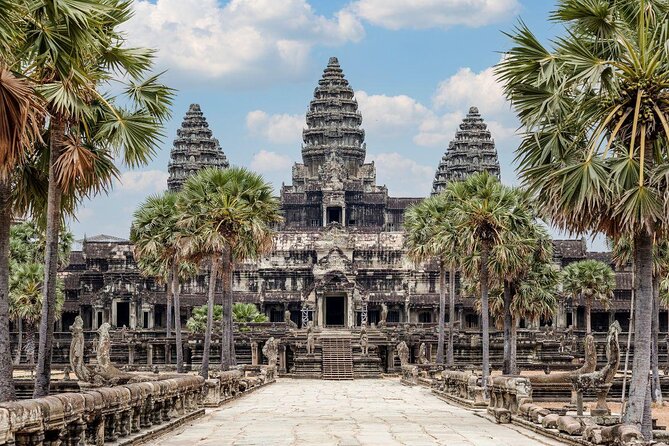
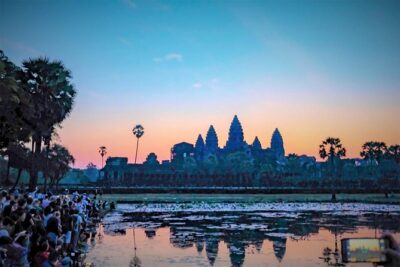
Angkor Wat is the headline for a reason—it’s the world’s largest religious complex and one of the best-preserved major temple sites. Built in the early 12th century, it also has a unique feel because it remained a significant religious center since its foundation.
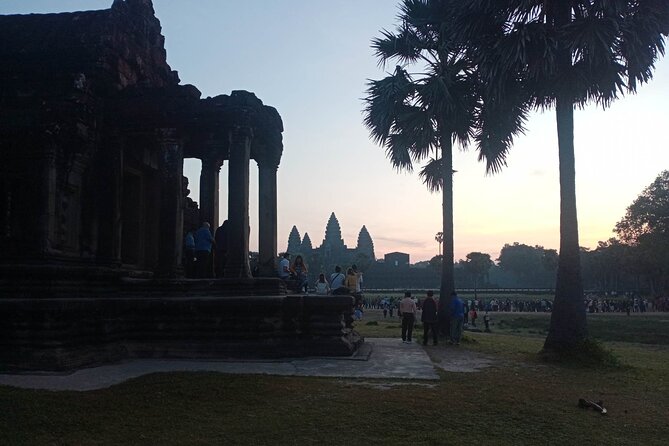
What makes this stop better than the usual rush is how you enter. Instead of the most obvious approach, you go in from the less-visited eastern side. Then you continue on foot, creeping through a jungle path toward the north ancient library pool. That short walk changes the vibe fast—you trade immediate crowds for that layered, green-in-the-distance feeling that makes Angkor special.
Inside the temple, your guide focuses on the central chambers and connects what you see to history, myths, and stone stories. The bas-reliefs here are a big deal, including a claim that this is the longest stretch of bas-relief carvings in the world. Even if you don’t remember every detail later, you’ll remember the moment you realize the walls are telling a narrative, not just decorating surfaces.
A practical note: Angkor Wat is where you’ll need to sort the paid entrance ticket. The rest of the stops on this run are marked free in the tour flow, so treat Angkor Wat as the one cost you should plan for upfront.
Angkor Thom South Gate: the 54 stone figures and the moment you feel the scale
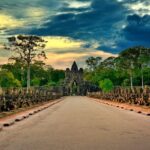
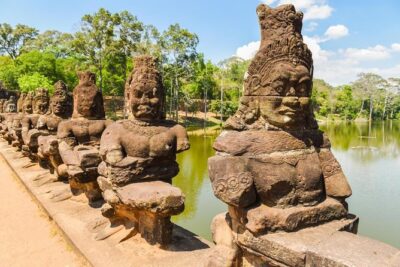
Next you move into Angkor Thom via the South Gate, one of the five main gates of the ancient capital. This gate is flanked by rows of 54 stone figures on each side—an attention-grabber that works well for photos, and it gives you a visual sense of the city’s defensive mindset.
There’s also a useful context your guide can give you. Angkor Thom at its height is described as having a population of more than one million people—larger than London in scale. Hearing that while you stand at a stone entrance really changes your mental picture of what this place meant.
This stop is short (about 20 minutes), so I treat it like a quick orientation tool: look, photograph, absorb, then move on. If you linger too long at the gate, you might steal time from the more story-rich parts farther in.
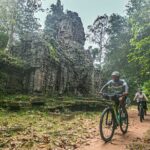
The temples by tuk-tuk, other routes

Bayon Temple: 200+ faces, two layers of bas-reliefs, and that famous stare
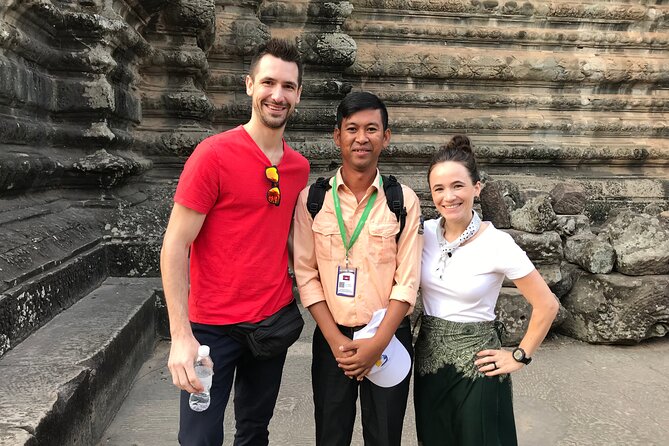
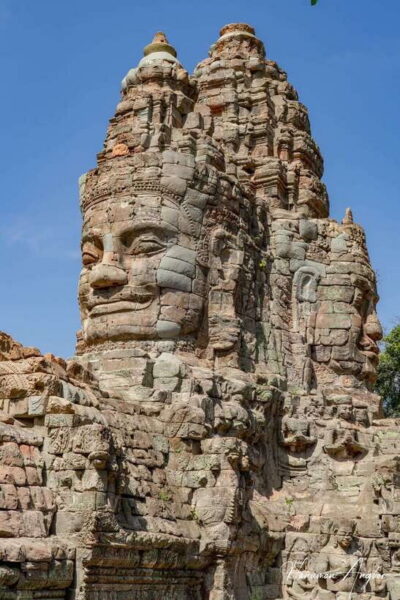
Bayon is the temple people come to for the faces—and in this case, you’re looking at more than 200 huge carved expressions. It’s a richly decorated Khmer temple built in the 13th century as the state temple of King Jayavarman VII.
The faces cluster around the central peak and spill across the upper terraces. When you’re standing close, it’s hard not to notice how the expressions shift as you move—serene, smiling, watchful. Your guide helps you connect those faces to what Bayon was meant to represent.
You’ll also see two sets of bas-reliefs: mythological and historical scenes mixed with more everyday or mundane imagery. That combination is one of the reasons Bayon works even if you’re not a hardcore archaeology person. It feels like a collage of belief, governance, and daily life.
This stop is about 50 minutes. It’s enough time to walk the main areas slowly, catch the best angles, and still have time to keep moving without feeling rushed.
Baphuon: three-tiered temple mountain and the Tower of Bronze story
Baphuon sits in Angkor Thom, northwest of Bayon. Built in the mid-11th century, it’s described as a three-tiered temple mountain built as a state temple.
If you like scale, this stop gives you some numbers to hold onto. It measures roughly 120 meters east-west by 100 meters north-south at its base and stands about 34 meters tall without its tower—roughly 50 meters tall when you include the tower as it would have been.
There’s also a great historical angle your guide can point out: an envoy named Chou Ta-kuan, visiting around 1296 to 1297, is said to have compared Bayon as the Tower of Gold and Baphuon as the Tower of Bronze. That kind of detail makes the temple feel less like a random stop and more like part of a political and cultural statement.
You’ll spend about 40 minutes here. Again, it’s enough to take in the structure and listen without needing to sprint to the next point.
The “secret” stops in Angkor Thom: when your guide adds quiet time
This itinerary includes extra moments labeled as hidden or secret stops inside Angkor Thom. The exact sites aren’t pinned down in the provided details, but the intent is clear: your guide takes you to a place most people skip.
I like this strategy because Angkor can feel repetitive if you only bounce from the most photographed spots to the next most photographed spot. A quieter pause—even 10 minutes—can reset your brain. It also helps with photos if the main routes get crowded.
Think of these stops as flexible breathing space. Don’t expect a brand-new “wow” structure every time. Instead, expect a change in viewpoint and a chance to see the temple complex from a different angle without the same crowd pressure.
Phimeanakas in the Royal Palace enclosure: a celestial temple shape
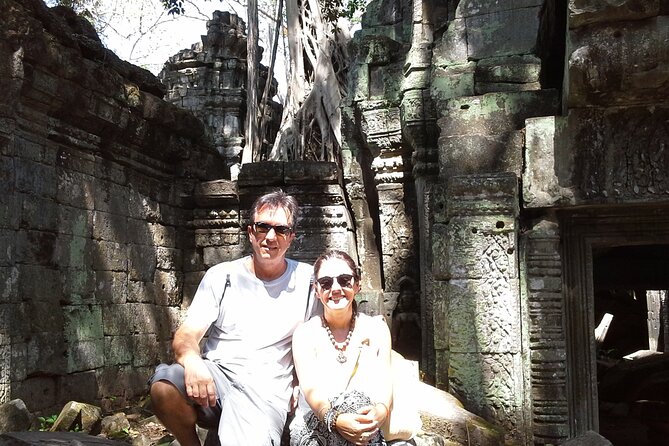
Phimeanakas is often described as the celestial temple, also called Vimeanakas. It dates to the end of the 10th century during the reign of Rajendravarman, then was completed by Suryavarman I.
Structurally, it’s built as a Hindu temple shaped like a three-tiered pyramid, with a tower on top and galleries along the edges of the upper platform. It sits inside the walled enclosure of the Royal Palace of Angkor Thom, so it fits the “royal center” theme of the day.
This stop is about 35 minutes. That time is usually right for looking at the form, checking out the placement within the enclosure, and listening to how it fits into the larger Khmer royal complex idea.
If you’re the type who likes architecture and religious function over big crowds, this is one of the best places in the day to slow down a notch.
Terrace of Elephants and Terrace of the Leper King: ceremony you can walk through
Two of the most memorable parts of the royal core are also some of the most story-rich outdoor terraces. Together, they give you that sense of how rulers presented power—first through ceremony, then through dramatic symbolism.
Terrace of the Elephants
You’ll walk the Terrace of Elephants, a long structure about 350 meters in length. It served as a giant reviewing stand for public ceremonies and was also a base for the king’s grand audience.
Some local Khmer residents even call it the Ancient Khmer Stadium. Your guide can help you imagine the space filled with people, noise, and processions, which turns it from “a long wall” into a stage.
Time here is about 30 minutes, so focus on pacing yourself along the terrace rather than trying to photograph every square inch.
Terrace of the Leper King
Next is the Terrace of the Leper King, an U-shaped structure built in the 13th century under King Jayavarman VII. One interpretation is that it may have been used as a royal cremation site.
The name is actually modern and comes from a 15th-century sculpture discovered at the site. The sculpture depicts the Hindu god Yama, the god of death. That detail matters because it links the terrace’s dramatic reputation to something older than the label people remember.
This is another about 30 minutes. If you enjoy myth-and-meaning explanations, this is a good place to lean in and listen.
Lunch at a local restaurant inside a temple complex setting
You’ll have lunch with cold drinks in a local restaurant at a 12th-century temple complex. This is the kind of detail that can save your afternoon.
Angkor days can blur together—heat, walking, and stone after stone. Lunch here gives you a change of pace without removing you from the temple atmosphere completely, so the day keeps its flow.
I’d treat lunch like part of the plan, not a pause you rush through. If you’re tired, you’ll come back better with a slower meal and a real break.
Ta Prohm: trees growing out of ruins and why UNESCO keeps it famous
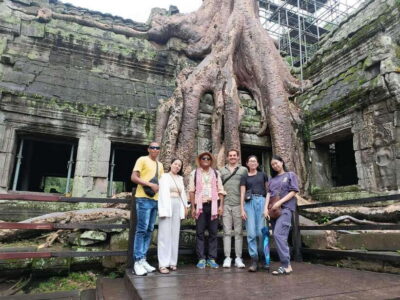
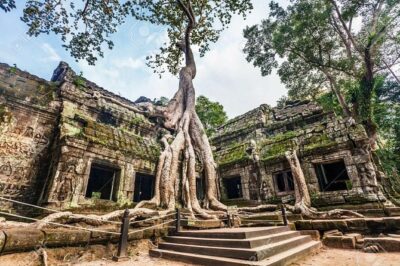
Ta Prohm is the temple that often feels most cinematic in real life—and it’s included later in the day. It’s the jungle-enveloped Tomb Raider temple and one of the most atmospheric sites in Angkor.
Built in the 13th century, it’s also famous because it was left in much the same condition it was found. That means you see trees and jungle surrounds intertwined with the ruins, which is why the place looks so photogenic and haunting.
There’s also a strong credential: UNESCO inscribed Ta Prohm as a World Heritage site in 1992. And for context, Ta Prohm is described as a religious temple that sat at the center of the Ancient Khmer University during the 12th and 13th centuries.
Expect around 1 hour here. That’s enough time to walk the key areas, try different photo angles, and still not feel like you’re sprinting through jungle roots.
Price and value: $30 for the day plus one paid entrance to plan for
At $30.00 per person for an about 8-hour private day, the value mostly comes from the combination: English-speaking guide + private tuk tuk + hotel pickup/drop-off + bottled water.
The tricky part is the cost you don’t see in the base price. The Angkor Wat entrance fee isn’t included, and you’ll need to buy an e-ticket. The guide provides a link to purchase the entrance e-ticket days in advance, which is smart because it lets you get the paperwork handled before you’re tired and sunburned.
In this route, the other temple stops are marked as free entry in the tour flow. So your main paid temple cost is Angkor Wat, and the rest of what you get is guided access through major sights.
If you’re comparing to bus tours, the private setup is usually a better deal when you want flexibility and fewer crowd headaches. If you’re traveling solo, it can still feel fair because you’re paying mostly for the guide and the tuk tuk time—not splitting a seat cost across strangers.
Who this private tuk tuk Angkor day suits best
This tour is a strong match if you:
- Want avoid-crowds-and-heat energy and a plan that tries to keep you moving smartly
- Like guided storytelling, not just “stand here, take photo” sightseeing
- Prefer a private day where you can adjust your pace
- Want a full run through Angkor Wat, Angkor Thom highlights, and Ta Prohm in one go
It may not be ideal if you:
- Struggle with walking on uneven surfaces for extended periods
- Hate the idea that Angkor Wat requires a separate entrance ticket you must handle ahead of time
- Want a slow, leisurely pace with long stays at only one or two temples
Should you book this 1-day private Angkor tour by tuk tuk?
If you’re doing Angkor for the first time and want a well-paced, guide-led day without wasting time on logistics, I’d book it. The private tuk tuk approach helps you keep control of your day, and the combination of Angkor Wat plus Bayon plus Ta Prohm hits the emotional and architectural range you’re looking for.
My only “don’t forget” advice: budget for the Angkor Wat entrance fee and pack clothing that fits the knees and shoulders rule for temples that require it. Do that, and the day stays smooth.
If you want, tell me your travel dates and whether you’re going in the hot season. I can suggest a simple packing checklist and the best mindset for keeping your energy up through Ta Prohm and the terraces.
FAQ
Is this tour private?
Yes. It’s a private tour/activity, and only your group participates.
How long is the tour?
The duration is approximately 8 hours.
Do you get hotel pickup and drop-off in Siem Reap?
Yes. Hotel pick up and drop off are included.
What is included in the $30.00 per person price?
An English speaking tour guide, a private vehicle in a tuk tuk, hotel pickup/drop off, and bottled water are included.
Is the Angkor Wat entrance fee included?
No. The Angkor Wat entrance ticket is not included. Your guide will send a link to purchase an e-ticket days in advance.
Are tickets required for the other temples on the route?
In the tour flow, the other listed stops are marked as admission ticket free.
What should I wear for temple visits?
Some temples require clothes that cover your knees and shoulders. Casual clothes are fine as long as you meet that requirement.
What shoes should I bring?
Wear flat shoes that are comfortable for walking.
How do I get the temple tickets?
You’ll receive a link from your tour guide to purchase the temple entrance e-ticket days in advance, and the tour uses a mobile ticket.
What is the cancellation policy?
You can cancel for free up to 24 hours in advance for a full refund.
Just Your Group: Private Days
- Full-Day Angkor Wat Sunrise Private Tour with Guide from Siem Reap
★ 5.0 · 2,920 reviews - Siem Reap: Angkor Wat Private Tuk-Tuk Tour
★ 4.9 · 2,222 reviews - Angkor Wat Private Day Tour from Siem Reap
★ 5.0 · 834 reviews - Angkor Wat Private Tuk-Tuk Tour (sunrise Option) & more
★ 5.0 · 439 reviews - Private Angkor Wat Day Tour – Best of Angkor
★ 5.0 · 269 reviews
The Temples by Tuk-Tuk
- Siem Reap: Angkor Wat Private Tuk-Tuk Tour
★ 4.9 · 2,222 reviews - Siem Reap Countryside Bike Tour / E-Bike or Tuk Tuk
★ 5.0 · 935 reviews - Angkor Sunrise Bike Tour / E-Bike or Tuk Tuk
★ 5.0 · 615 reviews - Angkor Wat Private Tuk-Tuk Tour (sunrise Option) & more
★ 5.0 · 439 reviews - Old Siem Reap Sunset Food Tour by Tuk-tuk
★ 5.0 · 311 reviews
More Temple Circuits Around Siem Reap
- Angkor Wat Sunrise or Sunset Tour with Guide from Siem Reap
★ 5.0 · 12,109 reviews - Siem Reap: Angkor Wat: Small-Group Sunrise or Sunset Tour
★ 5.0 · 9,444 reviews - Siem Reap: Angkor Wat 2-Day Tour with Sunrise and Sunset
★ 4.9 · 4,429 reviews - Siem Reap: Full-Day Angkor Wat Guided Tour with Sunset
★ 4.9 · 3,803 reviews - Angkor Wat Sunrise tour with Small – Group and Guide tours
★ 5.0 · 3,655 reviews
Just Added: Fresh Siem Reap Tour Reviews

Angkor Temple Tours, compared.
 ★ 5.0Angkor Wat Sunrise or Sunset Tour with Guide from Siem ReapFrom $1812,109 reviews
 ★ 5.0Angkor Wat: Small-Group Sunrise or Sunset TourFrom $159,444 reviews
 ★ 4.9Angkor Wat 2-Day Tour with Sunrise and SunsetFrom $344,429 reviews
 ★ 4.9Full-Day Angkor Wat Guided Tour with SunsetFrom $153,803 reviews
 ★ 5.0Angkor Wat Sunrise tour with Small – Group and Guide toursFrom $143,655 reviews
 ★ 5.0Angkor Wat Highlights and Sunrise Guided Tour from Siem ReapFrom $233,213 reviews
 ★ 5.0Angkor Wat Sunset Small Group Tour with Lunch IncludedFrom $203,059 reviews
 ★ 5.0Full-Day Angkor Wat Sunrise Private Tour with Guide from Siem ReapFrom $602,920 reviews
Browse the lists this tour appears in