
Remote Angkor feels different.
This Grand Circuit route is interesting because it favors less-visited, more remote temple stops, so the day feels calmer than the main handful of big names. I especially like the combination of island-and-tree temples (hello, Neak Pean and Ta Som) with the controlled pace of a guided circuit. Then Banteay Srei brings a whole other mood: delicate 3D carvings in soft pinkish sandstone that feel like Khmer art at close range.
One consideration: the tour price is $50 per person, but the Angkor Pass admission is not included (listed at $37). Add that to the fact you’ll be out for about 6–8 hours, plus time in the vehicle between sites, and you’ll want to start the day rested.
In This Review
- Key Points Worth Knowing Before You Go
- Why the Grand Circuit Feels Calmer Than the Main Temples
- Preah Khan: Jayavarman VII’s Big Shrine Complex
- Neak Pean: The Island Temple in the Middle of Water
- Ta Som: The Tree-Entwined Gate You’ll Keep Thinking About
- Eastern Mebon: Five Towers Like a Die, Plus Three Tiers of Enclosures
- Banteay Samre: Hindu Temple Form and a More Intimate Feel
- Banteay Srei: The Pink Sandstone Jewel Built by a Brahman Courtier
- Comfort, Timing, and Why Mr. K’s Style Matters
- Price and Value: What $50 Covers (and What the Angkor Pass Adds)
- How Long Will It Take, and How to Plan Your Day in Siem Reap
- Who Should Book This Tour (and Who Might Skip It)
- Should You Book Angkor Grand Circuit Tour & Banteay Srei?
- FAQ
- FAQ
- How long is the Angkor Grand Circuit & Banteay Srei tour?
- Where does the tour take place?
- What is included in the tour price?
- What is not included?
- Do I need the Angkor Pass for this experience?
- Is this a private tour?
- Does the tour include hotel pickup and drop-off?
- Is there a guide, and what language do they speak?
- How do group discounts work?
- What is the cancellation policy?
Key Points Worth Knowing Before You Go
- Remote temple circuit, not just the headline stops for a quieter-feeling Angkor day
- Banteay Srei’s pink sandstone carvings and the scale difference from bigger complexes
- English-speaking guidance that helps you know what to look for (and when)
- Mr. K’s calm, attentive style paired with an excellent driver for smooth transitions
- Pickup, drop-off, AC vehicle, and cold water, so you can focus on temples, not logistics
- Mobile ticket included, which cuts down on hassle on the day
The pink sandstone carvings, a few more runs
- Siem Reap Tour: Angkor Wat Sunrise, Bayon, Ta Prohm, Banteay Srei★ 5.0 · 931 reviews
- 2-Day Angkor Wat With Small, Big Circuit and Banteay Srei Tour★ 5.0 · 545 reviews
- From Siem Reap: Banteay Srei Temple & Grand 5 Temple Tour★ 4.8 · 262 reviews
- 3-Days Discovery Of Angkor: Waterfalls,Floating Village and Banteay Srei temple★ 5.0 · 214 reviews
Why the Grand Circuit Feels Calmer Than the Main Temples
Angkor can be loud. Even when the temples are stunning, the crowds can turn “wow” into “move, move, move.” The Grand Circuit approach is appealing because it steers you toward temples that tend to feel quieter and more spread out, so you spend more time looking and less time queuing.
In practice, that changes how you experience the park. You get time to notice details in doorways, lintels, and brickwork, and you can actually slow down at the spots that catch your eye. It’s also a good fit if you’ve already done the bigger hits and you want Angkor with more breathing room.
Preah Khan: Jayavarman VII’s Big Shrine Complex
Your day starts at Preah Khan, built in the 12th century for King Jayavarman VII to honor his father. This stop sits northeast of Angkor Thom, west of the Jayatataka baray, which helps you understand why the complex is so visually tied to water and ritual geography.
Preah Khan has the feel of a working “world” temple rather than a single monument. Expect to walk the grounds and spend time letting the layout make sense—courtyards, walls, and the way entrances pull you deeper. One practical note: Preah Khan is marked with admission ticket not included on the schedule, so plan around the day’s access needs and carry what your guide tells you.
Neak Pean: The Island Temple in the Middle of Water
Neak Pean is one of those places where the setting does half the work. It’s an artificial island with a Buddhist temple on a circular island in Jayatataka Baray, connected with Preah Khan. The setting helps you understand why Angkor wasn’t only about stone—it was also about symbolic water and sacred space.
When I like an Angkor stop, it’s usually because it gives you a different angle on the same civilization. Neak Pean does that. It’s smaller and more focused than many large complexes, and the circular island layout helps you picture the religious ideas behind the design.
The schedule marks Neak Pean as admission ticket free for this tour, which makes it a nice “easy win” early in the route. You still get value from the time you spend here, because the setting gives you that calm, almost self-contained feeling.
Ta Som: The Tree-Entwined Gate You’ll Keep Thinking About
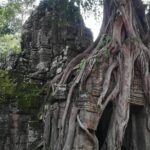
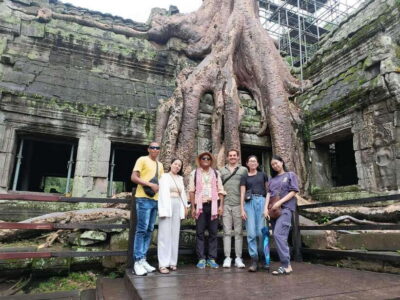
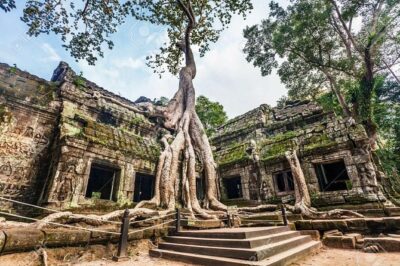
Ta Som is built at the end of the 12th century for King Jayavarman VII. What most people remember is the gate with roots and trunks wrapping around it—one of Angkor’s most photographed images for a reason. Even if you’ve seen pictures before, seeing the gate in real scale changes things.
This is a stop where a good guide helps a lot. Instead of just pointing and moving on, your guide can show you how the temple’s structure frames the tree growth, and what to look for in the stone and edges around the entrance. In the reviews, Mr. K stood out for being attentive and informative, including directing people toward what’s of most interest and what time of day works best. That style matters on a place like Ta Som, because details reward slower looking.
The itinerary marks Ta Som as admission ticket free, so you’re not juggling extra entry costs mid-route. Just come with your eyes open—this is the kind of stop where you’ll take fewer steps than the bigger temples, but you’ll look longer.
Round the grand circuit, a few more stops
Eastern Mebon: Five Towers Like a Die, Plus Three Tiers of Enclosures
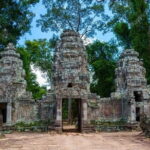
Eastern Mebon offers a different kind of Angkor geometry. It has five towers arranged like the numbers on a die atop a base with three tiers, surrounded by three enclosures. The towers represent the five peaks of the mythical Mount Meru, which gives you a symbolic way to interpret the design rather than treating it like decorative architecture.
What I like here is how it rewards pattern recognition. Even if you’re not an architecture nerd, you can still use the die-like arrangement as a mental hook. A guide can also help you understand what the enclosures mean and why the overall layout matters.
The schedule lists Eastern Mebon as admission ticket free, which makes it a smart stop in a long day. It’s also a good break from the heavier, maze-like feel of bigger complexes. You can take in the design from a few angles without losing the thread of what you’re looking at.
Banteay Samre: Hindu Temple Form and a More Intimate Feel
Banteay Samré is located 400 meters east of the East Baray and was built in the early 12th century during the reigns of Suryavarman II and Yasovarman II. It’s a Hindu temple in the Angkor area, and what you’ll notice most is how it feels more intimate compared to the larger, louder complexes.
This is a temple I like for a different reason than “most famous.” It’s easier to spend time in the details without feeling rushed. Even if you only catch a few carvings and door frames up close, the overall structure stays readable enough to enjoy.
The itinerary marks Banteay Samre as admission ticket free. That helps you keep your mental budget on track while still hitting a meaningful temple stop. If you’re the type of traveler who loves variety over volume, this kind of inclusion is where the Grand Circuit tour earns its place.
Banteay Srei: The Pink Sandstone Jewel Built by a Brahman Courtier
Then comes Banteay Srei, the day’s art highlight. It’s a 10th-century temple dedicated to the Hindu god Shiva, located near Phnom Dei about 25 km northeast of the main group. People call it the jewel of Khmer art, or the Citadel of the Women, largely because of the intricate craftsmanship.
What makes Banteay Srei special is the stone. The carvings sit in soft, pinkish sandstone, and they look more sculpted than simply carved. The temple is also relatively miniature compared with other Angkor temples, which is a big deal for how you experience it. Smaller scale means you can actually study the details instead of scanning from far away.
The best context to know before you walk around is the commissioning story. Banteay Srei was not commissioned by a king, but by a Brahman courtier. That fact helps you see it as a prestige project with deep artistic ambition—not just royal propaganda on an enormous stage.
The schedule lists Banteay Srei as admission ticket free for this tour. Still, since the Angkor Pass is listed as not included in general, you’ll want to make sure you have what your guide requires for access that day.
Comfort, Timing, and Why Mr. K’s Style Matters
This tour includes an English speaking tour guide, pickup and drop-off, an air conditioned vehicle, and cold drinking water. That combination sounds basic until you’re actually doing Angkor in a long day. Heat and travel fatigue can steal your attention—so having AC and water keeps you in “temple mode.”
In the reviews, Mr. K is described as informative and attentive, with a strong sense of what temples are of most interest and what time of day works best. That’s not just a nice-to-have. In Angkor, the difference between arriving when you’re fresh vs. when you’re fried can be the difference between enjoying details and staring at stone while thinking about lunch.
Mr. K also comes through as someone who loves Cambodia, not only the temples. That shows up when you’re moving between sites: you’ll likely get context about the area outside the main structures, which helps the day feel like culture and place, not only a photo shoot.
And since this is a private tour/activity where only your group participates, you’re less likely to feel swept along by a huge crowd dynamic. The “elegant continuity” described in feedback fits this: a smooth run of stops where each one leads naturally to the next.
Price and Value: What $50 Covers (and What the Angkor Pass Adds)
At $50 per person, this is positioned as a value-focused guided day out of Siem Reap. What you’re paying for isn’t only transportation; it’s the English guidance, AC comfort, cold water, and a coherent route that mixes several meaningful temple stops rather than turning the day into a random grab-bag.
The one extra line item to budget for is the Angkor Pass admission, listed at $37 per person and not included. So your realistic spend is closer to $87 per person once the pass cost is included.
Is it still good value? For many people, yes—because the tour bundles multiple sites across the Grand Circuit plus Banteay Srei, with a guide and practical comfort. You also skip the mental load of figuring out timing and route order on your own.
How Long Will It Take, and How to Plan Your Day in Siem Reap
The duration is listed as about 6 to 8 hours. That range matters because Angkor days aren’t only about time at the temples. Vehicle transfers and time spent transitioning between stops add up fast.
If you’re doing multiple Angkor outings, this kind of half-to-full-day mix is a smart pairing. The Grand Circuit approach gives you variety after the headline temples, and Banteay Srei adds a very different “art texture” moment.
For your comfort, wear breathable clothes you can move in and plan for sun exposure around open temple areas. You’ll also want a small bag for water and essentials so you’re not constantly asking the guide mid-stop.
Who Should Book This Tour (and Who Might Skip It)
This tour fits best if you:
- Want a more relaxed feel than the main crowd magnets
- Care about temple details and symbolism, not only big silhouettes
- Prefer the structure of a guided route with pickup and comfort
- Like an “art plus atmosphere” day, with Banteay Srei as the highlight
You might think twice if:
- You’re only interested in one or two of the most famous Angkor temples and don’t want a longer run of smaller sites
- You dislike spending a full chunk of your day in a vehicle, since the temples are spread across the park area
Should You Book Angkor Grand Circuit Tour & Banteay Srei?
If you already have Angkor Wat or the main icons in your rearview mirror, this is a great next step. The Grand Circuit route gives you a quieter temple rhythm, and Banteay Srei delivers the kind of close-up carving experience that bigger complexes can make harder to enjoy.
I’d book it if you want your Angkor day to feel guided, calm, and detail-friendly. The inclusion of an English speaking guide, AC ride, and cold water is real value, not fluff—especially with a 6–8 hour schedule. Just budget for the Angkor Pass since it’s listed separately.
FAQ
FAQ
How long is the Angkor Grand Circuit & Banteay Srei tour?
The tour duration is approximately 6 to 8 hours.
Where does the tour take place?
The tour is based in Siem Reap, Cambodia.
What is included in the tour price?
It includes an English speaking tour guide, pickup and drop-off, an air conditioned vehicle, and cold drinking water. A mobile ticket is also included.
What is not included?
Admission fee under the Angkor Pass is not included, listed as $37.00 per person.
Do I need the Angkor Pass for this experience?
The Angkor Pass admission is listed as not included, so you should plan on needing it as part of your overall cost.
Is this a private tour?
Yes. It’s private, and only your group will participate.
Does the tour include hotel pickup and drop-off?
Yes, pickup and drop-off are included.
Is there a guide, and what language do they speak?
You’ll have an English speaking tour guide.
How do group discounts work?
Group discounts are mentioned as a feature of the tour.
What is the cancellation policy?
Free cancellation is available. You can cancel up to 24 hours in advance for a full refund.
More Temple Circuits Around Siem Reap
- Angkor Wat Sunrise or Sunset Tour with Guide from Siem Reap
★ 5.0 · 12,109 reviews - Siem Reap: Angkor Wat: Small-Group Sunrise or Sunset Tour
★ 5.0 · 9,444 reviews - Siem Reap: Angkor Wat 2-Day Tour with Sunrise and Sunset
★ 4.9 · 4,429 reviews - Siem Reap: Full-Day Angkor Wat Guided Tour with Sunset
★ 4.9 · 3,803 reviews - Angkor Wat Sunrise tour with Small – Group and Guide tours
★ 5.0 · 3,655 reviews
Along the Grand Circuit
- Siem Reap: Banteay Srei and Grand Circuit Heritage Tour
★ 4.9 · 163 reviews - Banteay Srei and Grand Circuit Heritage Tour from Siem Reap
★ 5.0 · 142 reviews - 2-Day Private Tour in Angkor Wat Grand Circuit
★ 5.0 · 23 reviews - Preah Khan, Neak Pean, Ta Som-East MebonTemple – Grand Circuit
★ 5.0 · 10 reviews - Angkor Grand Circuit Temples Tour
★ 5.0 · 8 reviews
The Carvings of Banteay Srei
- Full-Day Banteay Srei & 4 Temples – Grand Tours Join-in Tour
★ 5.0 · 1,155 reviews - Siem Reap Tour: Angkor Wat Sunrise, Bayon, Ta Prohm, Banteay Srei
★ 5.0 · 931 reviews - 2-Day Angkor Wat With Small, Big Circuit and Banteay Srei Tour
★ 5.0 · 545 reviews - From Siem Reap: Banteay Srei Temple & Grand 5 Temple Tour
★ 4.8 · 262 reviews - 3-Days Discovery Of Angkor: Waterfalls,Floating Village and Banteay Srei temple
★ 5.0 · 214 reviews
Just Added: Fresh Siem Reap Tour Reviews


Angkor Temple Tours, compared.
 ★ 5.0Angkor Wat Sunrise or Sunset Tour with Guide from Siem ReapFrom $1812,109 reviews
 ★ 5.0Angkor Wat: Small-Group Sunrise or Sunset TourFrom $159,444 reviews
 ★ 4.9Angkor Wat 2-Day Tour with Sunrise and SunsetFrom $344,429 reviews
 ★ 4.9Full-Day Angkor Wat Guided Tour with SunsetFrom $153,803 reviews
 ★ 5.0Angkor Wat Sunrise tour with Small – Group and Guide toursFrom $143,655 reviews
 ★ 5.0Angkor Wat Highlights and Sunrise Guided Tour from Siem ReapFrom $233,213 reviews
 ★ 5.0Angkor Wat Sunset Small Group Tour with Lunch IncludedFrom $203,059 reviews
 ★ 5.0Full-Day Angkor Wat Sunrise Private Tour with Guide from Siem ReapFrom $602,920 reviews
Browse the lists this tour appears in