
Reviewed · ANGKOR SUNRISE & SUNSET TOURS
Sunrise in Angkor and Banteay Srei Private Tour
Waking up before dawn is worth it here. This Sunrise in Angkor and Banteay Srei private tour gets you into Angkor Wat while the light is soft, the air feels cool, and the crowds are still thin. You’ll also get guided context as you move from the big icons (Bayon faces) to the atmospheric jungle temple of Ta Prohm and then to Banteay Srei’s pink-carved artistry.
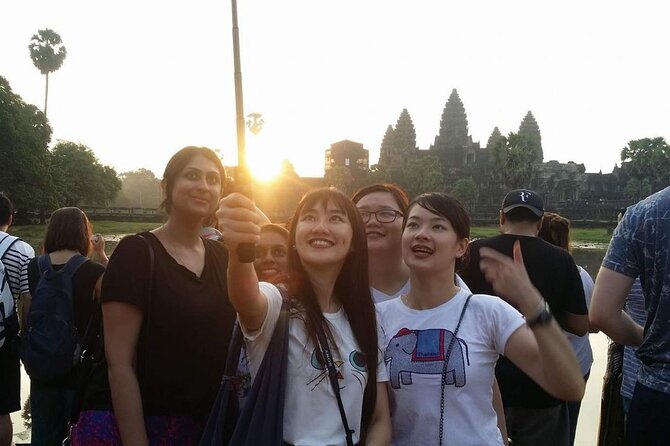
I love how much time you get at the places that matter most. At Angkor Wat, you’re not just rushing through—you’ll cross the floating bridge, pause by the pond, and watch the sky change before you head into the complex. I also like that the experience is built around a professional English-speaking guide—in feedback for this tour, names like So and Rei, Pheap, and Tann come up for being on time, attentive, and good with photos.
The main drawback to plan around is that it’s an early start (pickup around 4:20 to 4:40 a.m.) and you’ll still pay extra for temple access (entrance fees are not included, and lunch/breakfast are your responsibility). If mornings are your weak spot, this one will feel like commitment.
In This Review
- Key highlights worth getting up for
- Sunrise at Angkor Wat: the timing that makes the whole day work
- Pickup, tickets, and how your morning is planned
- Angkor Wat at dawn: pond reflections, carvings, and a smart pace
- Angkor Thom South Gate and Bayon: entering the city of stone faces
- Ta Prohm with giant roots: lunch at your pace, then back into ruins
- Banteay Srei: pink stone carvings and the Citadel of the Women
- Price and value: what $135 includes, what you pay separately
- Guide quality is the secret ingredient (and it shows)
- Small rules that affect your day: dress and drones
- How the day ends: a long but satisfying route
- Who should book this sunrise Angkor and Banteay Srei private tour
- Should you book it?
- FAQ
- What time do they pick me up for Angkor Wat sunrise?
- Are temple entrance fees included in the tour price?
- Does the tour include breakfast and lunch?
- Is pickup and drop-off included?
- Is the tour private, and how many people can go?
- Can I fly a drone at the temples?
Key highlights worth getting up for
- Angkor Wat sunrise timing with time to stand at the pond and watch the sky build
- Professional guide focus on story and photos, with guides like Pheap, Tann, and So/Rei referenced in past feedback
- An efficient temple route that connects Angkor Wat to South Gate, Bayon, Ta Prohm, and Banteay Srei in one long day
- Ta Prohm’s jungle setting and its famous giant tree roots around the ruins
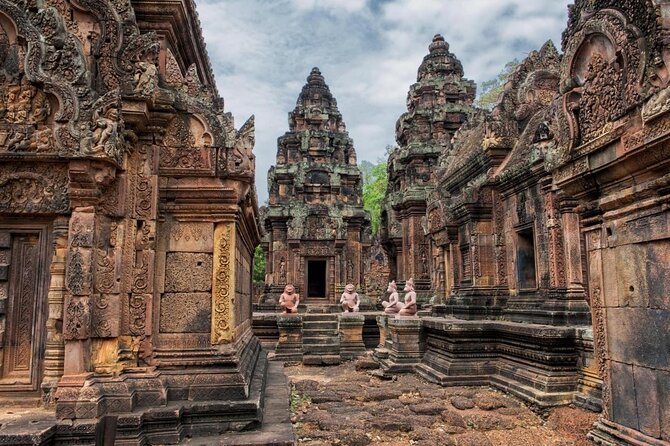
- Banteay Srei’s pink stone carvings—smaller site, big craftsmanship impact
Chasing the light? More dawn and dusk runs
- Angkor Wat Sunrise or Sunset Tour with Guide from Siem Reap★ 5.0 · 12,109 reviews
- Siem Reap: Angkor Wat: Small-Group Sunrise or Sunset Tour★ 5.0 · 9,444 reviews
- Sunset tour of Kampong Phluk stilts home village on the Tonle Sap★ 5.0 · 4,865 reviews
- Siem Reap: Angkor Wat 2-Day Tour with Sunrise and Sunset★ 4.9 · 4,429 reviews
Sunrise at Angkor Wat: the timing that makes the whole day work
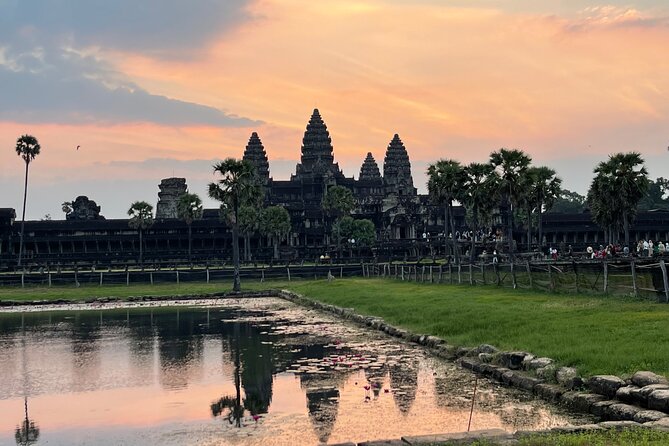
If you’ve ever tried to see Angkor Wat mid-morning, you know what changes when the tour buses arrive. The temples don’t get worse, but the energy does. This tour’s value starts with the very early pickup from Siem Reap hotels (between 4:20 and 4:40 a.m., depending on where you’re staying). That timing is what lets you experience Angkor Wat while the light is gentle and the crowd noise is lower.
What you’re really paying for isn’t just the sunrise itself. It’s the sequence. You go straight from the vehicle into the ticket process, then into the temple complex before the main surge. That means you can spend your best energy where photos and atmosphere matter most—around dawn, when the reflections by water and the texture of stone look their best.
Also: sunrise at Angkor Wat is not only about seeing the sun crest the horizon. It’s about standing still long enough to notice how the light moves across carvings, towers, and surrounding structures. Your guide helps you slow down in the right places and explains what you’re seeing instead of leaving you to guess.
Pickup, tickets, and how your morning is planned
Here’s what your morning flow looks like in practical terms. Your guide picks you up from your hotel, then you head to the ticket office, which typically takes about 15 to 30 minutes. After that, you travel another 15 minutes to reach Angkor Wat itself.
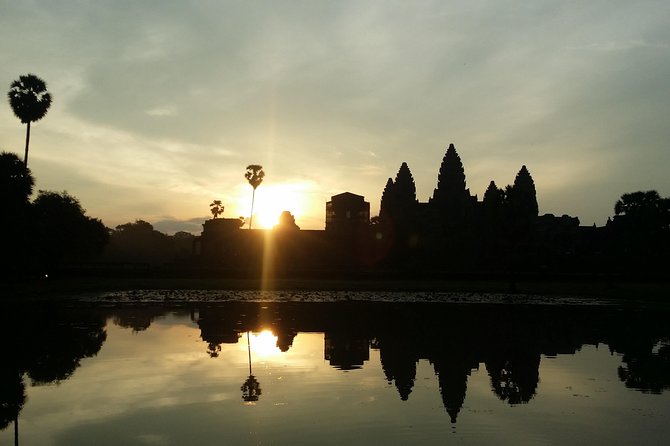
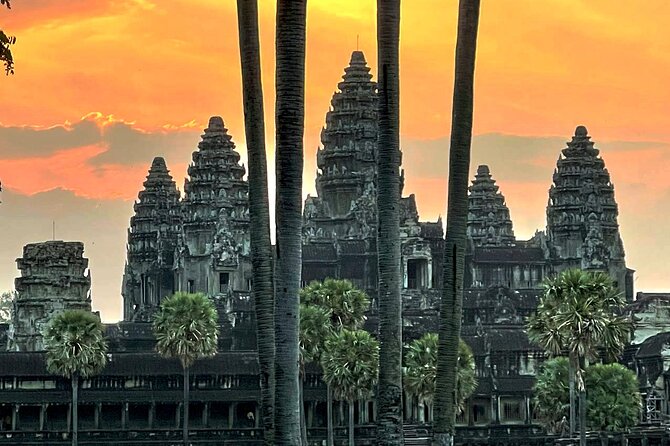
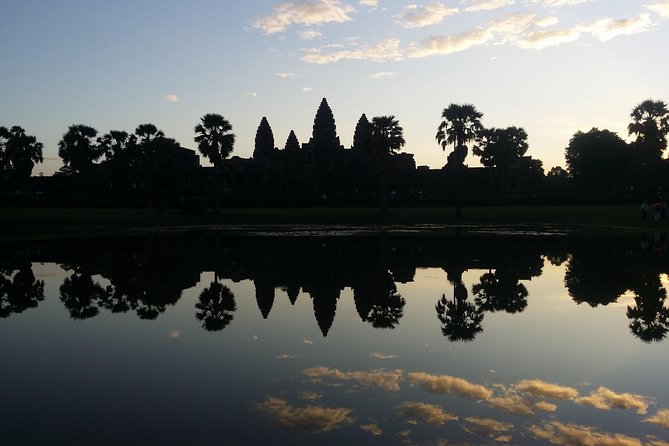
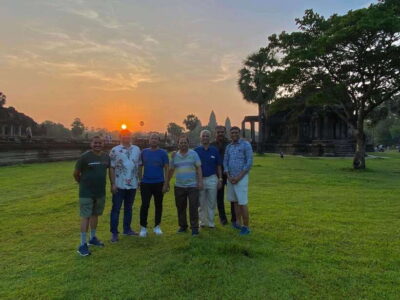
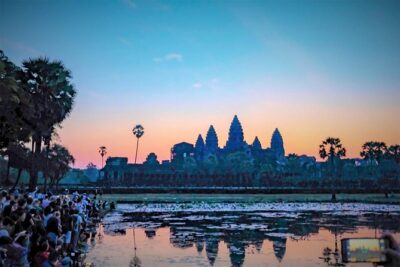
Once you’re inside, you start at the western area by crossing a floating bridge. That detail sounds small, but it changes the feel. The moment you cross and arrive, you’re already in the mood—early, quiet, and focused. Then you get to the pond area inside the complex and wait for the sky to develop.
Two small notes that help you enjoy this day more:
- Temple entrance fees are extra. The tour price covers the tour services, but the temple admission fee is not included.
- If you’re used to winging it, don’t try to. This plan works because the timing is tight between pickup, ticketing, and the sunrise moments.
Angkor Wat at dawn: pond reflections, carvings, and a smart pace
Angkor Wat is big. The trick is not to see everything. The trick is to see the best parts in the right order, without feeling like you’re sprinting. This tour gives you about two hours at Angkor Wat after sunrise watching, which is a very workable amount for a private group.
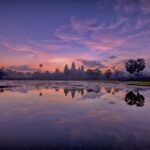
Before the sun rises, you’ll stand near the pond inside the complex and look up at the changing sky above Angkor Wat. That waiting period is where most people either get rushed or get a real experience. Here, you’re positioned for it, and you’re not fighting the crowd movement.
After the sunrise moment, you spend about two hours exploring other areas of Angkor Wat. You’ll see:
- statues and detailed stone bas-reliefs
- libraries and other structural features of the main complex
- views connected to the central tower area
Then comes the part that keeps the rest of the day sane: breakfast time. Plan for about 35 to 45 minutes for breakfast after your Angkor Wat exploring. If your hotel includes breakfast, you can also request a breakfast pack to eat after sunrise, which is a smart way to keep energy up without losing time.
Photography tip you’ll appreciate: the dawn light is the star, but composition matters. A big part of why this tour feels photo-friendly is that your guide is thinking in angles and timing, not just facts.
Angkor Thom South Gate and Bayon: entering the city of stone faces
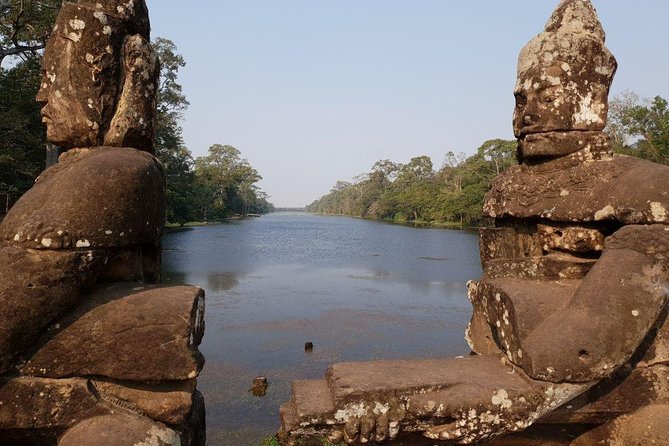
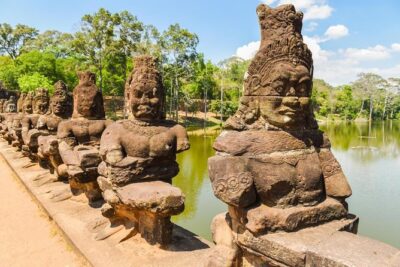
After Angkor Wat, you head toward Angkor Thom South Gate. This stop matters because it’s a strong entry point and, in particular, it’s the south gate that has been restored most extensively. Your guide gives about 15 minutes of explanation, which helps you connect what you’re seeing to the bigger city layout.
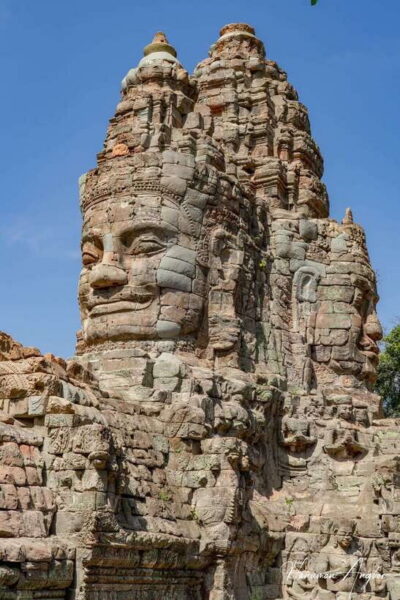
From there, you move on to Bayon Temple, and this is a temple that rewards walking slowly. Bayon is described as compact, with the temple layout encouraging you to find your own order of visit. One reason it feels engaging is the lack of a surrounding wall, so you’re not trapped in a strict path—you’re guided, but you also have freedom.
Bayon’s emotional payoff comes from the architecture itself. You’ll experience the confusion of narrow inner corridors, chambers, and stairway connections, with frequent surprise glimpses of the enigmatic faces. Your guide’s job here is more than narration. It’s helping you understand what you’re seeing so it doesn’t become random stone.
Time here is about one hour, which is long enough to enjoy the maze-like interior without exhausting you before Ta Prohm and Banteay Srei.
The pink sandstone carvings, a few more runs

Ta Prohm with giant roots: lunch at your pace, then back into ruins
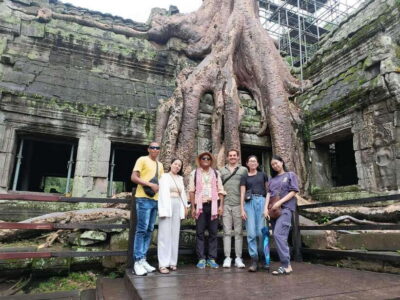
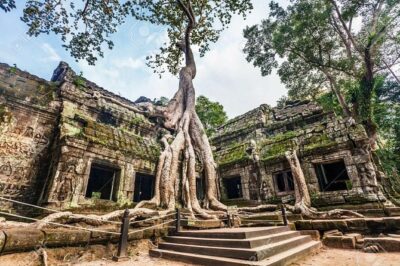
Ta Prohm is where Angkor stops being purely formal and becomes wild. The setting is jungle-heavy, and the way those tree roots grip the stone makes the place feel half ruin, half living thing. This stop is ideal if you like atmosphere as much as art history.
You’ll take a lunch at your own expense break and a rest stop before moving into Ta Prohm. That’s important because Ta Prohm can be physically tiring—uneven ground, lots of steps, and plenty of time spent looking upward.
Once you’re inside, you explore the maze-like interior of Ta Prohm. The tour also connects the site to the story of discovery: it was once home to 2,740 monks, and the French explorer Henri Mouhot is linked to its rediscovery in the early 1850s. That context makes your walk feel less like a photo stop and more like you’re tracing how modern understanding grew around these ruins.
This stop is timed at about one hour, and then you head back toward Siem Reap for drop-off later in the afternoon.
Banteay Srei: pink stone carvings and the Citadel of the Women
After lunch and rest, you’ll spend about 30 minutes to reach Banteay Srei, known for its pinkish stone and extremely detailed carving. This temple stands apart from the larger Angkor cluster. Even if you’ve already seen big names, Banteay Srei has a different feel—more intimate, more about craft and texture than scale.
What makes it special:
- It began in 967 CE.
- It’s one of the smaller sites, but the carvings are said to be among the finest in the region.
- It’s a Hindu temple dedicated to Shiva.
- Many carvings are three-dimensional, so they cast shadows and feel almost sculptural even when you’re looking from ground level.
The name also adds personality: Banteay Srei means Citadel of the Women. You’ll hear the story that it must have been built by a woman because the carving is considered too fine for a man’s hand. Whether you treat that as legend or cultural framing, it adds an extra layer to your viewing. You end up looking for delicacy, not just damage and age.
Time here is about one hour, which works well since you’re already coming off a long day. If you want close-up photos, this is the place to slow down and frame shots around patterns in the stone rather than rushing for the overall view.
Price and value: what $135 includes, what you pay separately
This tour costs $135 per group (up to 6) for the private experience, and it runs about 9 to 10 hours. On paper, that price can look high if you’re traveling alone—but it gets more reasonable fast when you share it.
Here’s what you do get included:
- free pickup and drop-off at city hotels
- a professional English-speaking guide
- air-conditioned vehicle transportation
- bottled water
- sightseeing as described
- a mobile ticket
What you don’t get included:
- temple entrance fees: $37 per person (covers all temples admission)
- breakfast and lunch (and drinks)
- tips and other personal expenses
- travel insurance
So the true “cost of doing it” is: tour price shared across your group, plus temple fees per person. If your group is full (up to 6), you’re effectively buying a private, guided route plus dawn logistics at a per-person rate that can be close to—or sometimes better than—what you’d spend on separate entrances and transport without the personal attention.
One more practical angle: paying a little extra for the early start and guided sequencing saves time and reduces decision fatigue. In a place like Angkor, that time-savings is real value.
Guide quality is the secret ingredient (and it shows)
I pay attention to guides because temples are information-heavy. Without context, you end up staring at stone like it’s just decoration. With context, stone becomes a language.
This tour’s guide is part of what repeatedly earns praise. In past feedback, guides such as Pheap, Tann, and the pair So and Rei are credited with:
- being punctual and organized
- staying attentive and flexible
- helping with great photos (not just taking them, but spotting angles)
- explaining temple meanings in ways that actually stick
Even if you don’t consider yourself a history person, having a guide matters at Angkor because symbols show up again and again: face motifs at Bayon, Shiva references, and carving patterns across different sites. The guide helps you notice those repeated visual ideas and connect them.
Also, this tour is private. So if you want a minute longer at the pond for dawn light, or you want to spend more time carefully looking at carving depth at Banteay Srei, you’re not trapped behind a group with a rigid pace.
Small rules that affect your day: dress and drones
Two practical constraints show up in the instructions, and they’re easy to handle if you plan ahead.
Dress code: you’ll need respectful clothing with shoulders and knees covered. A real scarf is acceptable; the guidance notes that only a real dress scarf is allowed. If you’re coming in from the beach or wearing shorts/tank tops, fix it before you go.
Drones: flying drones at the temples is not allowed, and the instruction is to only ask permission from APSARA. Most people won’t have the process completed in time, so assume you won’t be able to fly your drone.
These rules may not sound exciting, but they protect your schedule. Nothing ruins a dawn plan like scrambling for a cover-up at 4 a.m.
How the day ends: a long but satisfying route
You’ll return to Siem Reap after Ta Prohm and Banteay Srei. Drop-off is typically around 3:30 p.m. to 4:30 p.m., depending on where your hotel is. That timing means you still have your afternoon for swimming, a massage, or just sitting somewhere cool and letting the day sink in.
The itinerary is a full loop: start with Angkor Wat for the dawn atmosphere, move into Angkor Thom for city-scale complexity, switch mood to Ta Prohm with jungle ruins, then end with Banteay Srei for fine carvings and a calmer, more detailed finish.
Who should book this sunrise Angkor and Banteay Srei private tour
This works best if you:
- want sunrise at Angkor Wat without fighting crowds
- care about photos and want a guide who pays attention to framing
- like an efficient route that still leaves room to breathe
- prefer private pacing over bus-style temple hopping
- travel with a group of up to 6 to maximize value
It may not be your best match if you hate early mornings, or if you want a fully self-guided day where you don’t have to follow a tight schedule around tickets and sunrise viewing.
Should you book it?
If you’re choosing between seeing Angkor Wat at sunrise versus catching it later, book the sunrise. The schedule here is built for that first light moment—pond, sky, and all—and it then strings together the rest of the must-sees in a way that doesn’t feel chaotic.
I’d also book it if you want the comfort piece: hotel pickup, air-conditioned transport, bottled water, and an English-speaking guide who can explain what you’re looking at. With temple fees and meals added on top, it’s still a solid value because the pricey part—planning the order and getting there at the right time—is handled for you.
If you do book: wear the right clothes the night before, charge your camera gear, and plan to budget the $37 per person temple admission plus lunch. Then get some sleep. You’ll earn it at the pond.
FAQ
What time do they pick me up for Angkor Wat sunrise?
Pickup is typically between 4:20 and 4:40 a.m., depending on your hotel location.
Are temple entrance fees included in the tour price?
No. Temple entrance fees are not included. The temple fee is listed as $37 per person and covers all temples admission.
Does the tour include breakfast and lunch?
Breakfast and lunch are not included. There is a breakfast period after Angkor Wat, and lunch is at your own expense near Ta Prohm.
Is pickup and drop-off included?
Yes. The tour includes free pickup and drop-off at city hotels.
Is the tour private, and how many people can go?
This is a private tour/activity, and only your group participates. The price is per group up to 6.
Can I fly a drone at the temples?
Drones are not allowed at the temples. You must ask permission from APSARA if you plan to request anything related to drone use.
More Temple Circuits Around Siem Reap
- Angkor Wat Sunrise or Sunset Tour with Guide from Siem Reap
★ 5.0 · 12,109 reviews - Siem Reap: Angkor Wat: Small-Group Sunrise or Sunset Tour
★ 5.0 · 9,444 reviews - Siem Reap: Angkor Wat 2-Day Tour with Sunrise and Sunset
★ 4.9 · 4,429 reviews - Siem Reap: Full-Day Angkor Wat Guided Tour with Sunset
★ 4.9 · 3,803 reviews - Angkor Wat Sunrise tour with Small – Group and Guide tours
★ 5.0 · 3,655 reviews
The Carvings of Banteay Srei
- Full-Day Banteay Srei & 4 Temples – Grand Tours Join-in Tour
★ 5.0 · 1,155 reviews - Siem Reap Tour: Angkor Wat Sunrise, Bayon, Ta Prohm, Banteay Srei
★ 5.0 · 931 reviews - 2-Day Angkor Wat With Small, Big Circuit and Banteay Srei Tour
★ 5.0 · 545 reviews - From Siem Reap: Banteay Srei Temple & Grand 5 Temple Tour
★ 4.8 · 262 reviews - 3-Days Discovery Of Angkor: Waterfalls,Floating Village and Banteay Srei temple
★ 5.0 · 214 reviews
Dawn and Dusk Over Angkor
- Angkor Wat Sunrise or Sunset Tour with Guide from Siem Reap
★ 5.0 · 12,109 reviews - Siem Reap: Angkor Wat: Small-Group Sunrise or Sunset Tour
★ 5.0 · 9,444 reviews - Sunset tour of Kampong Phluk stilts home village on the Tonle Sap
★ 5.0 · 4,865 reviews - Siem Reap: Angkor Wat 2-Day Tour with Sunrise and Sunset
★ 4.9 · 4,429 reviews - Siem Reap: Full-Day Angkor Wat Guided Tour with Sunset
★ 4.9 · 3,803 reviews
Just Added: Fresh Siem Reap Tour Reviews

Angkor Sunrise & Sunset Tours, compared.
 ★ 5.0Angkor Wat Sunrise or Sunset Tour with Guide from Siem ReapFrom $1812,109 reviews
 ★ 5.0Angkor Wat: Small-Group Sunrise or Sunset TourFrom $159,444 reviews
 ★ 5.0Sunset tour of Kampong Phluk stilts home village on the Tonle SapFrom $214,865 reviews
 ★ 4.9Angkor Wat 2-Day Tour with Sunrise and SunsetFrom $344,429 reviews
 ★ 4.9Full-Day Angkor Wat Guided Tour with SunsetFrom $153,803 reviews
 ★ 5.0Angkor Wat Sunrise tour with Small – Group and Guide toursFrom $143,655 reviews
 ★ 5.0Angkor Wat Highlights and Sunrise Guided Tour from Siem ReapFrom $233,213 reviews
 ★ 5.0Angkor Wat Sunset Small Group Tour with Lunch IncludedFrom $203,059 reviews
Browse the lists this tour appears in